An automatic nitrogen membrane generator achieves nitrogen‑oxygen
separation by leveraging different permeation rates of gas components through
polymer hollow-fibre membranes, and can supply nitrogen continuously under
unattended operation. Compared with adsorption systems, it has fewer moving
parts without frequently switched programmed valves, which often creates the
impression of inherently high stability. In reality, membrane elements are
highly sensitive to inlet contaminants and operating disturbances. Long-run
stability depends on coordinated protection from inlet pretreatment, proper
membrane rating, pressure and temperature control, automatic regulation logic,
piping sealing and routine condition monitoring. Stability is not an attribute
of a single component, but the overall capacity of the whole system to sustain
consistent nitrogen purity and flow under load variation, ambient change and
consumable ageing. Understanding influencing factors, fault development paths
and corresponding protection measures supports selection, inspection and
maintenance while reducing unplanned shutdowns.
The pretreatment system forms the first protective line governing membrane
service life and gas stability, and is also the source of many hidden faults.
Polymer membrane material is vulnerable to oil mist, liquid water and solid
particles. Oil molecules stick to membrane micropores and cause irreversible
blockage of permeation channels. Liquid water covering membrane layers directly
hinders gas transport and leads to sharp purity decline within a short time.
Hard particles scratch fibre surfaces and create gas bypass channels.
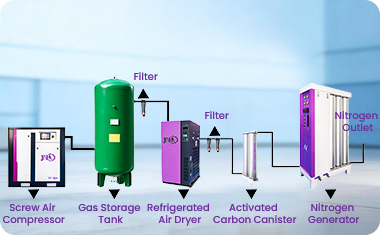
Pretreatment chains usually combine multi-stage filters, dryers and automatic
drains for graded protection. Primary filters remove bulk water and coarse
solids, coalescing cartridges capture oil aerosols, and dryers control inlet dew
point within design limits. Stability challenges arise from dynamic operating
conditions: compressor cycling, rising ambient humidity and variable downstream
demand change liquid and oil loading in compressed air. Filter dirt holding
capacity gradually depletes and differential pressure rises. Stuck drain valves
carry condensate toward membrane modules. Premature membrane failure in many
membrane nitrogen generators originates not from defective membrane material,
but from failed upstream protection allowing contaminants to reach the fibre
bundle.
Membrane assemblies constitute the separation core and set the upper limit
of gas performance. Numerous hollow fibres are bundled inside pressure housings.
Feed air flows along the shell or lumen side. Fast gases including oxygen, water
vapour and carbon dioxide permeate preferentially through fibre walls and are
vented, while nitrogen, the slower gas, accumulates as product. Membrane polymer
has a defined operating envelope for inlet pressure and temperature. Within a
certain range, higher feed pressure boosts nitrogen output, yet excessive
pressure induces long-term fibre tension, creep, delamination or rupture. Higher
temperature accelerates permeation and raises flow rate at the expense of faster
polymer ageing, fibre brittleness and permanent loss of separation selectivity.
Where multiple modules run in parallel, uniform flow distribution directly
affects overall stability. Poor manifold design creates uneven loading across
branches, causing premature ageing of individual modules and gradual performance
decay of the whole unit. Membrane elements degrade slowly rather than failing
abruptly. Gradually falling purity is the typical sign of entering the wear
phase, calling for trend tracking and planned replacement.
Pressure regulation and stabilization assemblies maintain consistent
separation conditions. Membrane separation performance is strongly tied to
stable feed pressure, as minor pressure variation changes permeation driving
force and shifts both purity and flow. Automatic units build closed-loop
regulation with pressure reducing valves, stabilizers, transmitters and
controllers. Pulsation from upstream compressors and variable downstream
consumption introduce disturbances. Weaknesses in stabilizing components usually
appear as slow response or poor accuracy from worn valve plugs and fatigued
springs. Besides feed pressure control, permeate side backpressure must also
stay stable. Blocked vent lines or fouled silencers alter differential pressure
across membranes and break nitrogen‑oxygen separation balance. Many maintenance
operators only monitor product nitrogen pressure while ignoring vent path
resistance, leading to unexplained purity drift that is difficult to trace.
Automatic control logic distinguishes unattended models from basic versions
and acts as the stability brain of the system. The controller continuously
samples feed pressure, inlet temperature, product pressure, nitrogen purity and
filter differential pressure to execute regulation, logging and interlock
protection. Robust programmes set reasonable thresholds to distinguish normal
fluctuation from real faults and avoid false or delayed alarms. When
pretreatment differential pressure, inlet temperature or purity goes out of
limits, graded responses activate: early warnings notify maintenance staff,
while sustained deviation triggers protective shutdown to stop feed air entering
membranes and prevent irreversible damage under poor inlet quality. Common
control limitations rely only on discrete threshold checks without trend
analysis. Instant disturbances trigger alarms, yet slow purity drift and gradual
filter loading go undetected until membrane degradation is already irreversible.
Sensor drift, loose wiring and electromagnetic interference also produce false
readings and misoperation, so regular calibration is required.
Piping, fittings and seals sustain the pressure environment required for
separation. The system runs under continuous pressure, and sealing materials
age, harden or swell under cyclic pressure and temperature change. External
leakage reduces net output and forces continuous pressure compensation. Internal
leakage allows oxygen-rich vent gas to mix into product nitrogen and degrade
purity rapidly. End cap seals of membrane modules are the highest-risk sealing
points. Failed end sealing lets feed air bypass fibre separation directly into
the product stream and causes sudden purity loss. Pipe material selection must
match gas cleanliness; rust debris from corroded internal surfaces travels
downstream and damages membranes. These accessory faults tend to be concealed.
Minor leakage is hard to spot visually and can only be identified through
periodic pressure retention testing and purity trend comparison.
Ambient conditions exert continuous influence on long-term stability.
Membrane permeation characteristics shift with temperature. Units installed
outdoors or in hot workshops without thermal protection show purity drift
following diurnal and seasonal temperature swings. High humidity and corrosive
atmospheres accelerate rusting of valves, seals and metal piping. Poor cabinet
ventilation overheats electronic components and triggers signal anomalies.
Proper installation reserves ventilation and thermal isolation away from heat
and corrosive sources to mitigate environmental disturbance.
Structured maintenance is indispensable for sustained performance. Low
moving-part count does not mean maintenance-free operation. Maintenance
priorities include consumable replacement for pretreatment, sensor calibration,
seal inspection, vent clearing and purity trend recording. Filter replacement
cycles cannot follow fixed schedules rigidly and should adapt to compressor
condition and inlet contamination level. Operators record purity and flow under
consistent inlet parameters to build degradation curves and assess membrane
health. After filter replacement or membrane disassembly, sealing integrity is
rechecked to eliminate assembly-induced leakage. Many stability issues stem not
from design flaws but neglected maintenance, where intervention only occurs
after severe quality loss, often when membrane damage has become permanent.
Overall, stability of an automatic nitrogen membrane generator is a coupled
system-level index. Pretreatment protects membranes from contamination; pressure
stabilization locks separation driving force; well-designed control logic
identifies slow degradation and delivers protection; sealing and piping preserve
separation conditions; disciplined maintenance removes accumulating hazards.
Unlike adsorption systems prone to sudden valve sticking or molecular sieve
powdering, membrane units are susceptible to slow, irreversible performance
loss. Reliable nitrogen supply cannot rely solely on automation functions.
Stable operation integrates inlet air treatment, operating envelope control,
condition monitoring and scheduled maintenance into a complete protection
framework, keeping the equipment within rated working conditions and delivering
nitrogen that meets specifications consistently.