In high-end manufacturing sectors such as semiconductor fabrication,
electronic packaging, lithium battery production, pharmaceutical synthesis,
special material heat treatment and precision laboratories, processes impose
strict requirements on oxygen content, particulate impurities and dew point of
protective gases. A high purity nitrogen generator system serves as an on-site
inert gas solution, continuously delivering stable high-purity nitrogen. It can
replace traditional bottled nitrogen and purchased liquid nitrogen, improve
product yield and optimize long-term gas costs. Rather than a standalone unit,
the complete setup is an integrated gas supply system composed of air
pretreatment units, nitrogen generation mainframes, deep purification modules,
monitoring instruments, gas storage and pressure stabilizing loops and automatic
control systems. Quality defects in any component may compromise the purity of
final product gas.
Three major processes are adopted for high purity nitrogen generator
systems: PSA combined with post-purification, membrane separation with
hydrogen-assisted purification, and cryogenic air separation. Membrane
separation generally achieves only moderate purity; extra hydrogen catalytic
deoxygenation is required to reach ultra-high purity. Cryogenic air separation
suits sites with ultra-large flow rates and large-scale factories, featuring
high capital investment and long startup periods. For most small and
medium-sized high-end manufacturing scenarios, PSA plus post-purification is the
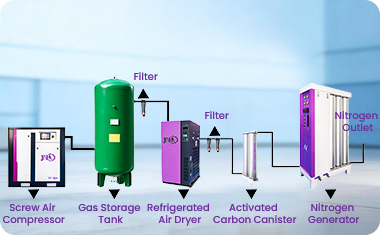
most widely adopted solution. Compressed air is first processed through
multi-stage precision filtration, freeze drying or adsorption drying to remove
dust, oil and moisture, then fed into adsorption towers filled with carbon
molecular sieves. Selective oxygen adsorption of molecular sieves under varying
pressures enables nitrogen-oxygen separation. Nitrogen after primary separation
flows into deep purification units for catalytic deoxygenation to strip trace
oxygen, raising nitrogen purity up to 99.999% or higher to meet stringent
process requirements in semiconductors and lithium batteries. Two towers
alternate between adsorption and desorption regeneration to achieve
uninterrupted continuous gas production.
Each unit of the complete system performs distinct functions. The front-end
air pretreatment system forms the first line of defense to stabilize mainframe
performance. It includes air compressors, pre-filters, activated carbon oil
removal filters and dryers, which eliminate oil, water and solid particles in
compressed air. Moisture and oil contamination will degrade carbon molecular
sieves or purification catalysts continuously, causing rapid decay of adsorption
performance and shortening consumable service life. Core components of the
nitrogen generator mainframe are carbon molecular sieves, adsorption towers and
high-frequency pneumatic valves. Purification modules consist of catalytic
reactors and cooling separation assemblies. Supporting instruments include
online oxygen analyzers, dew point meters, flow and pressure sensors. Online
monitoring instruments collect gas parameters in real time. Once purity or dew
point exceeds limits, the automatic control system triggers alarms and
protective actions to vent unqualified nitrogen and prevent it from entering
production lines. The control system can be equipped with local touchscreens or
connected to factory DCS and MES systems. Some models support remote
communication modules for remote monitoring and fault early warning.
High purity nitrogen generator systems have drastically different index
requirements across industries. Semiconductor wafer manufacturing and chip
packaging impose the strictest control over nitrogen purity, particulate content
and dew point, requiring stable low-oxygen and low-dew-point high-purity
nitrogen as protective gas to avoid oxidation failure of components under high
temperature. In lithium battery manufacturing, inert atmosphere is required
during electrolyte filling, packaging and formation processes to prevent
deterioration of electrolyte and active materials upon oxygen exposure. For APIs
synthesis and material transfer in pharmaceutical industries, high-purity
nitrogen isolates air to guarantee drug purity and operational safety. In metal
brazing and vacuum heat treatment, high-purity nitrogen prevents oxidation on
workpiece surfaces and reduces surface defects. System specifications range from
small skid-mounted integrated equipment to large containerized complete sets,
customizable according to customers’ on-site gas flow, purity, pressure and dew
point parameters.
During project selection and procurement, buyers need to evaluate the whole
system from multiple dimensions instead of merely comparing mainframe
quotations. First, verify purity stability under rated continuous flow, check
third-party test reports and focus on purity decay during long continuous
operation; short-term compliance does not equal long-term stability. Second,
assess overall system energy consumption. Power consumption dominates operating
costs of on-site nitrogen generation. Each unit including pretreatment, nitrogen
generation and purification consumes energy, and energy indicators under full
operating conditions should be calculated. It is also necessary to evaluate the
service life of core consumables such as molecular sieves, catalysts and filter
elements to predict annual operation and maintenance expenses. Besides,
automatic protection logic of the system, instrument calibration plans, spare
parts supply and vendors’ on-site engineering service capacity are equally
important. Skid-mounted equipment is fully assembled, piped and tested at the
factory. After delivery to site, it only requires power supply and compressed
air pipeline connection, shortening construction lead time, which is ideal for
factories with limited floor space or projects requiring fast commissioning.
After equipment delivery and commissioning, standardized operation and
maintenance is critical to sustain high-purity gas supply. Maintenance covers
four major sections: air pretreatment, nitrogen generation mainframe,
purification unit and online instruments. Filters of all stages shall be
replaced regularly according to pressure differential indicators to prevent oil
and impurities from entering downstream units. Performance of carbon molecular
sieves and deoxygenation catalysts should be inspected periodically for
maintenance or replacement upon degradation. Precision instruments such as
oxygen analyzers and dew point meters require regular calibration to avoid
distorted readings and misjudgment. Operation and maintenance staff need to be
familiar with system alarm logic to quickly identify abnormalities such as
purity drop, pressure fluctuation and dew point excess. Under abnormal working
conditions, the system can automatically switch to backup gas storage loops to
secure gas supply continuity for production lines. It should be noted that even
highly automated systems require routine on-site inspection. Major overhauls and
consumable replacement must be performed on site, while remote monitoring serves
only as an auxiliary management tool.
A high purity nitrogen generator system is one component of the full
industrial gas supply system and must work in coordination with air compressors,
gas storage tanks and pressure stabilizing devices. Pipeline material also
affects final gas quality. For high-purity applications, electropolished
stainless steel pipelines are generally adopted to reduce impurity release from
inner walls. Many enterprises overlook pipeline design, fitting selection and
purging procedures in project planning, leading to failure to meet particulate
and dew point specifications for end gas. With continuous upgrading of high-end
manufacturing, market demand for high-purity inert gas keeps growing. Integrated
nitrogen generation and purification systems are becoming more intelligent, with
functions such as data logging, energy consumption statistics and predictive
maintenance alarms gaining wider adoption. During system selection, enterprises
need to comprehensively evaluate initial investment, long-term energy
consumption, consumable replacement cycles and maintenance response speed, and
define solutions based on hard process requirements for purity, flow and dew
point. A properly designed and well-maintained high purity nitrogen generator
system can consistently deliver high-quality nitrogen, reduce reliance on
purchased liquid nitrogen or bottled nitrogen, mitigate gas supply interruption
risks, stabilize high-end production processes and cut full-lifecycle gas
costs.