In indoor closed operation scenarios such as laboratory precision testing,
electronic patch processing, food packaging, miniature precision machining and
pharmaceutical production, indoor nitrogen generators serve as core
energy-saving equipment to replace purchased bottled nitrogen and liquid
nitrogen. When calculating Indoor Nitrogen Generator Cost, most users only focus
on the initial equipment purchase price while ignoring the decisive impact of
process architecture on full-life-cycle costs. The price difference, energy
consumption level, consumable service life, failure rate and gas supply
stability of nitrogen production equipment are essentially gaps in process
design. Low-cost equipment with extensive and crude processes seems
budget-friendly, but brings continuous hidden costs including power waste,
frequent consumable replacement, high failure rate and unstable purity due to
incomplete purification, low separation efficiency, backward pressure
stabilization and simple regeneration logic. From a professional process
perspective, high-quality indoor nitrogen production equipment achieves
comprehensive cost reduction in procurement, operation and maintenance through
refined and closed nitrogen production processes, eliminating ineffective losses
from the source and becoming the optimal solution for stable lightweight indoor
gas supply.
Upgraded pre-purification process avoids long-term cumulative costs caused
by impurity loss. The cleanliness of compressed air is the core premise of
indoor nitrogen production. Low-end ordinary models adopt simple single-stage
filtration, which can only filter large dust particles and cannot deeply remove
oil stains, water vapor and impurities in compressed air. Long-term invasion of
impurities blocks the microporous structure of the molecular sieve, leading to
adsorption failure and attenuated gas purity, greatly shortening the service
life of core consumables. This forces frequent replacement of molecular sieves
and filter elements, resulting in continuous consumable procurement costs and
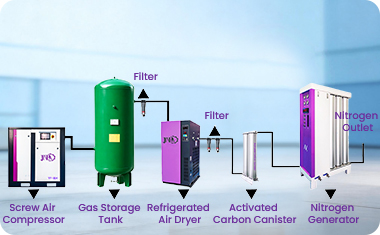
shutdown losses. Professional indoor nitrogen generators adopt a four-stage
gradient purification process, including precise pre-filtration, freeze drying,
activated carbon oil removal and post fine filtration. It thoroughly removes
moisture, oil mist, dust and impurities to ensure highly clean air entering the
adsorption tower. The closed purification process prevents molecular sieve
contamination and aging, greatly extends consumable service life, protects
precision accessories such as solenoid valves and pipelines from corrosion,
reduces component damage and maintenance frequency, and realizes long-term cost
reduction through front-end process optimization.
Optimized PSA pressure swing adsorption separation process improves gas
production efficiency and reduces energy consumption costs. The core nitrogen
separation process directly determines the energy consumption and gas
utilization rate of equipment. Low-end equipment adopts extensive pressure
control with unreasonable adsorption, pressure relief and regeneration cycle
matching and low pressure switching accuracy. Incomplete oxygen-nitrogen
separation leads to unstable nitrogen purity, low gas production volume and
massive compressed air waste with high no-load energy consumption. High-quality
indoor models adopt an optimized PSA pressure swing adsorption process. Based on
the precise screening principle of carbon molecular sieves and molecular
diameter differences between oxygen and nitrogen, the equipment is equipped with
an intelligent timing control system to accurately adjust the alternating
adsorption, pressure relief and regeneration rhythm of double towers. It
maximizes the conversion rate of qualified nitrogen from compressed air. The
whole process operates at normal temperature and pressure without thermal loss
or potential safety hazards, fully adapting to indoor closed environments.
Compared with traditional crude processes, the gas production efficiency is
increased by more than 25% with greatly reduced air compression energy
consumption, saving substantial long-term electricity costs and solving the
process defects of low output, high power consumption and unstable purity of
ordinary equipment.
Closed pressure stabilization and uniform air distribution process reduce
equipment loss and waste costs caused by air pressure fluctuation. Indoor
precision gas scenarios require extremely stable air pressure and purity.
Ordinary equipment features disordered air distribution and backward pressure
stabilization structures, resulting in internal airflow turbulence and local
overpressure. This easily causes fuselage vibration, loose pipelines,
accelerated aging of sealing parts, instantaneous purity fluctuation and
unstable air pressure, further leading to defective products and test data
errors in precision processing and laboratory testing, producing invisible
operational losses. High-end indoor nitrogen generators adopt a full-domain
uniform air distribution process and multi-stage pressure buffering and
stabilization technology. The internal airflow channel is fluid-optimized with
evenly distributed airflow and stable pressure output, avoiding local
high-pressure impact and turbulence. Meanwhile, a closed-loop pressure control
system calibrates output pressure and nitrogen purity in real time to ensure
accurate and stable terminal gas supply. This refined process effectively
buffers operating pressure, reduces mechanical fatigue loss, extends the overall
equipment service life, and avoids hidden costs such as product scrapping and
rework caused by unstable air pressure, perfectly adapting to high-precision
indoor gas demand.
Intelligent low-pressure regeneration process reduces consumable loss and
operation and maintenance costs. The molecular sieve regeneration process
determines equipment maintenance frequency. Traditional equipment fails to
thoroughly exhaust residual oxygen and impurities during regeneration, causing
cumulative passivation of molecular sieve adsorption performance, annual
attenuation of equipment productivity, and frequent disassembly, maintenance and
filler replacement. The upgraded intelligent low-pressure slow-release
regeneration process completely releases adsorbed oxygen, water vapor and
impurities during pressure relief to fully restore molecular sieve activity and
avoid aging and failure. Fully automatic intelligent regulation eliminates
manual intervention and greatly reduces labor maintenance costs. In addition,
the equipment adopts a modular integrated process with neat pipeline layout and
simple structure, enabling rapid fault location. Daily maintenance only requires
replacing basic filter elements without complex disassembly and overhaul,
greatly simplifying maintenance procedures, cutting operation costs and
realizing long-term low-loss operation.
In terms of process cost logic, the true cost performance of an indoor
nitrogen generator lies not in low initial quotation, but in mature and
sophisticated integrated nitrogen production technology. The energy waste,
frequent consumable replacement, premature equipment aging, production loss and
frequent maintenance caused by inferior processes bring far higher long-term
costs than equipment price differences. With comprehensive optimization of four
core processes including purification, separation, pressure stabilization and
regeneration, high-quality indoor nitrogen generators balance safety, stability,
energy saving and low loss. Tailored for various indoor closed operation
scenarios, they achieve full-life-cycle cost reduction through process upgrading
and build a low-cost, high-stability and zero-risk on-site indoor nitrogen
production system for enterprises.