With the large-scale popularization of fiber laser cutting, special
nitrogen generators for laser cutting have become core supporting equipment for
sheet metal processing, stainless steel cutting, and aluminum alloy precision
processing industries. The market price of laser cutting nitrogen generators
varies greatly. Devices with the same flow rate and purity parameters are priced
from tens of thousands to more than 100,000 yuan. Most buyers only focus on
basic parameters and quotations, ignoring the essential cost differences brought
byprecision manufacturing technology, core process standards and complete set
process configuration. Laser cutting has strict requirements on nitrogen
quality, requiring stable high purity above 99.99%, constant output pressure of
12-25 bar and ultra-low dew point dry gas source. The manufacturing process of
the equipment directly determines the cutting section quality, burr-free effect,
equipment stability and full-service life, which are also the core reasons for
product price differentiation. This article deeply analyzes the pricing logic of
laser cutting nitrogen generators from the perspective of manufacturing
technology, and clarifies the process differences and value gaps between
low-cost models and high-quality models.
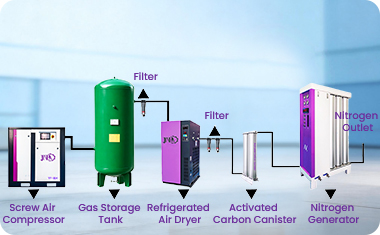
Laser cutting nitrogen generators mainly adopt PSA pressure swing
adsorption nitrogen production technology. The complete equipment consists of
five core modules: air pretreatment system, double-tower adsorption nitrogen
production system, high-pressure boosting system, pressure stabilizing energy
storage system and intelligent measurement and control system. The manufacturing
process standards of each module constitute the core pricing units of the
equipment. Low-cost nitrogen generators on the market generally adopt simplified
processes, universal accessories and extensive assembly modes, which only meet
basic gas production needs but cannot adapt to the high-precision, high-pressure
and high continuous stability process requirements of laser cutting. In
contrast, high-end industrial-grade models rely on refined manufacturing
processes, customized component processing and strict process testing to ensure
dual guarantees of gas source quality and equipment stability, which is the core
reason for their higher selling prices.
The process difference of the air pretreatment system is the first key
threshold for price stratification. The gas source for laser cutting is strictly
prohibited from containing oil and water. Once the gas source impurities exceed
the standard, it will not only pollute the carbon molecular sieve and cause loss
of core components, but also lead to yellowing, slag hanging and precision
deviation of laser cutting sections. High-end nitrogen generators adopt an
integrated process of four-stage precision filtration and freeze drying. The
filter shell is integrally forged and formed without welding gaps, featuring
pressure resistance and explosion proof. The filter element is made of
multi-layer composite filter material processed by precision pressure bonding
technology, with a filtration accuracy of 0.01μm, which completely isolates oil
mist, water vapor and dust. Meanwhile, the drying system is equipped with
precise temperature control technology to stably control the gas source dew
point below -40℃, adapting to long-term continuous cutting operations. On the
contrary, low-cost models adopt simple three-stage filtration and ordinary
welded shells with low-grade universal filter elements and no precise dew point
control process. Problems such as water and oil in the gas source will occur
after short-term use. Although the initial equipment cost is low, it will
continuously affect the cutting process quality and increase consumable
replacement costs.
The manufacturing process of the core adsorption nitrogen production unit
determines the gas production accuracy and service life of the equipment,
serving as the biggest price difference factor. The carbon molecular sieve
filling and tower sealing process directly affect the stability of nitrogen
purity. High-quality models adopt a layered uniform filling and compaction shock
absorption process, utilizing mechanical constant-pressure compaction technology
to eliminate loosening, uneven filling and cavities of molecular sieves. No
molecular sieve friction and pulverization occur during the alternating pressure
adsorption and pressure relief process of double towers, ensuring stable gas
production for 3-5 years. In addition, the tower body adopts internal and
external double-layer anti-corrosion spraying technology, with multiple
processes of pickling, phosphating and high-temperature curing, featuring
corrosion resistance and resistance to alternating pressure impact. Low-cost
models adopt extensive manual filling without standardized compaction
technology, resulting in uneven density of the molecular sieve bed. The
molecular sieve is prone to pulverization and failure during operation, causing
fluctuations in nitrogen purity and failing to meet the high-precision cutting
requirements of stainless steel and aluminum alloys. Furthermore, high-end
models adopt a precise airflow distribution process with optimized flow guiding
and pressure equalizing structure to fully contact air with molecular sieves,
achieving higher nitrogen recovery rate and lower long-term energy consumption
with far superior process value to low-cost models.
The manufacturing process of the high-pressure boosting and pressure
stabilizing system is the key to adapting to the high-pressure working
conditions of laser cutting, as well as a easily ignored pricing detail.
Conventional PSA nitrogen generators only produce nitrogen at 5-10 bar, while
laser cutting requires a high-pressure gas source of 12-25 bar, and thick plate
cutting needs higher stable pressure output, which must be equipped with a
special boosting system. High-end equipment adopts an integrated high-pressure
boosting process. The booster cylinder is precisely cast and formed, with
internal pistons and seals processed by military-grade wear-resistant
technology. Equipped with a multi-stage buffer and pressure stabilizing
structure, it realizes fluctuation-free pressure output, eliminating cutting
defects such as uneven cutting edges and piercing failures caused by unstable
air pressure. Meanwhile, the pipeline connection adopts seamless precision
welding technology with excellent air tightness and zero gas leakage. Low-cost
models mostly adopt external simple boosters with generalized accessories and
rough assembly technology, resulting in poor pressure stability, high failure
rate, frequent pressure attenuation and air leakage. These problems not only
reduce cutting efficiency but also increase electricity and operation and
maintenance costs.
The overall equipment integration and intelligent control process further
widen the price and value gap. Industrial-grade laser cutting nitrogen
generators adopt a modular integration process. All pipelines, circuits and gas
circuits are optimized through simulation, with regular layout and balanced gas
circuit resistance. The complete machine has perfect noise reduction and shock
absorption technology, ensuring no vibration deviation or abnormal noise during
long-term continuous operation. The control system is equipped with customized
intelligent industrial control programs optimized through tens of thousands of
working condition debugging. It can real-timely and accurately monitor nitrogen
purity, pressure, flow rate and dew point data, automatically adjust operating
loads to adapt to peak and off-peak gas demand of laser cutting, and eliminate
energy waste. In contrast, low-cost models adopt universal electronic control
modules without targeted working condition adaptation technology, featuring low
data monitoring accuracy and no automatic pressure stabilization adjustment
function. They fail to respond timely to gas demand fluctuations, easily leading
to substandard gas production and frequent equipment startup and shutdown
failures.
In addition, the factory inspection process is the core premium value of
high-quality equipment. Before delivery, high-end equipment undergoes multiple
strict tests including 72-hour full-load continuous operation test, precision
calibration of purity and pressure, full air tightness inspection and high and
low temperature working condition simulation test. Each device has precisely
calibrated parameters to ensure it can adapt to various laser cutting working
conditions after delivery. Low-cost equipment only undergoes simple power-on and
gas production tests without refined calibration, resulting in large parameter
deviations and various process adaptation problems after application.
In conclusion, the price difference of laser cutting nitrogen generators is
essentially the value gap in manufacturing technology, process standards,
component precision and inspection system, rather than simple parameter and
appearance differences. Low-cost equipment with simplified processes only
reduces short-term procurement costs, but brings long-term hidden costs such as
unstable cutting quality, frequent failures, high energy consumption and high
consumable loss. Industrial-grade equipment manufactured with refined processes
ensures stable high-purity and high-pressure gas source, long service life and
low operation and maintenance costs, perfectly adapting to the precision process
requirements of laser cutting. It is a cost-effective choice for large-scale
production. Purchasers should not only compare prices but also focus on
manufacturing technology, process precision and testing standards to avoid later
production losses and ensure cutting quality and production efficiency.