In the industrial gas supply operation and maintenance system, mastering
the core working principle of an N2 generator is the fundamental basis for
accurately troubleshooting faults, stabilizing gas quality, extending equipment
service life and reducing operational costs. Most industrial nitrogen generators
adopt mature PSA (Pressure Swing Adsorption) nitrogen generation technology.
Based on normal-temperature physical separation principles, the equipment
realizes oxygen-nitrogen separation without chemical reactions or
high-temperature loss, ensuring stable operation for long-term continuous gas
supply in mining, chemical, welding, electronics, food and other industries.
From the operation and maintenance perspective, all equipment abnormalities
including purity fluctuation, air volume attenuation, excessive energy
consumption and shutdown failures can be traced back to its working principle.
Mastering the principle enables standardized maintenance, hidden danger
prediction and stable production guarantee.
The core working principle of the N2 generator relies on the selective
adsorption characteristics of carbon molecular sieve (CMS) and dynamic pressure
switching mechanism. Air is mainly composed of nitrogen, oxygen, water vapor and
carbon dioxide. The equipment separates nitrogen from air by utilizing the
differences in molecular diameter and diffusion rate between oxygen and
nitrogen. With a smaller molecular diameter and faster diffusion speed, oxygen
molecules quickly penetrate and be adsorbed by the micropores of carbon
molecular sieve under pressurized conditions. In contrast, nitrogen molecules
feature larger diameter and slower diffusion rate, so they cannot enter the
micropores and are enriched to form high-purity industrial nitrogen. The entire
separation process is completed at normal temperature and low pressure with pure
physical filtration, requiring no heating or chemical reagents, which accounts
for the equipment’s low energy consumption, low failure rate and high
adaptability for continuous industrial operation.
The complete nitrogen generation process consists of four cyclic procedures
that ensure uninterrupted gas supply, serving as the key monitoring focus for
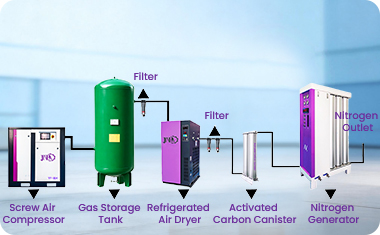
daily maintenance. First is pressurized adsorption: clean compressed air treated
by air compression, precision filtration and drying enters the adsorption tower.
Under rated working pressure, the carbon molecular sieve rapidly adsorbs oxygen,
water vapor and dust impurities to separate high-purity nitrogen. Second is
pressure equalization: when the adsorption tower approaches saturation, the
system automatically balances the pressure of the two towers to avoid gas
fluctuation and purity drift caused by sudden pressure changes. Third is
pressure relief and regeneration: the saturated tower depressurizes to
atmospheric pressure to break the adsorption balance, realizing desorption and
discharge of oxygen and impurities to restore the adsorption capacity of the
molecular sieve. Fourth is purging: a small amount of high-purity nitrogen
purges the tower to completely remove residual impurities and prepare for the
next cycle. The two adsorption towers work alternately to achieve 24/7 stable
nitrogen supply.
From the perspective of operation and maintenance, most performance
attenuation faults are directly caused by abnormal cyclic procedures. Common
problems such as insufficient nitrogen purity and reduced air volume mainly
result from substandard front-end air source purification. Oil, water and dust
in compressed air block the micropores of carbon molecular sieve, causing
molecular sieve poisoning and failure, which thoroughly undermines
oxygen-nitrogen separation efficiency. In addition, delayed or stuck solenoid
valves and pneumatic valves will cause disordered switching timing, unbalanced
adsorption and regeneration procedures, and further lead to unstable gas purity.
Abnormal system pressure and air leakage will also break the pressure adsorption
balance and trigger equipment operation failures.
Standardized maintenance strategies derived from the working principle can
effectively eliminate faults from the source. First, prioritize air source
maintenance by regularly replacing front-end precision filter elements and
inspecting dryer operation to ensure compressed air cleanliness and protect
molecular sieve activity. Second, calibrate program-controlled valves and timing
systems periodically to guarantee accurate tower switching and stable cyclic
operation. Meanwhile, adjust the working pressure according to actual gas demand
to avoid excessive molecular sieve loss from overpressure or insufficient
adsorption from underpressure. Regular condensate draining, air tightness
inspection and sensor calibration are also essential to maintain optimal
equipment operating conditions.
A thorough understanding of the N2 generator working principle upgrades
operation and maintenance from passive fault repair to active stability
guarantee. PSA nitrogen generators feature simple structure, mature principles
and high reliability. Most equipment failures stem from non-standard operation
and insufficient maintenance rather than natural aging. Refined and standardized
maintenance based on core working principles ensures stable nitrogen purity and
sufficient air volume, extends the service life of core components, reduces
shutdown losses and maintenance costs, and provides a long-term stable,
energy-saving and safe inert gas supply for industrial production lines.