When two quotations for nitrogen systems differ markedly, most buyers
assume one supplier is simply more expensive. In practice the gap usually comes
from the two quotes covering different scopes rather than the same configuration
priced differently. The difference often sits at the filters: whether
pre-filters, activated carbon, fine filtration and sterile filtration are all
included, and how filter precision and replacement intervals are defined. These
details shape both the quoted figure and later running costs, so comparing a
nitrogen generator price with filter configuration means putting both on the
same sheet. The sections below cover quote inclusions, filter grades, purity and
flow, commonly missed costs, comparison methods, lifecycle cost and
misconceptions.
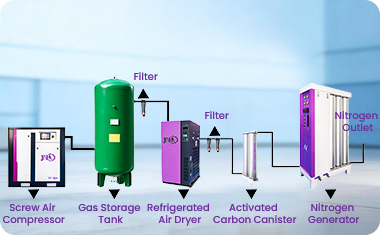
First, what a quotation actually includes. A complete nitrogen system
normally comprises the main unit and air pretreatment, buffer tanks, valves and
piping, controls, plus installation, commissioning and training. If the quote
lists only the main unit and prices everything else separately, the final total
may be very different from the initial figure. The quote should be checked item
by item: whether compressor and refrigerant dryer are included, whether
pre-filters and fine filters are included, whether buffer and storage tanks are
included, whether installation, piping and commissioning are included, and
whether first-fill consumables are included. Lay these items out in a table and
the difference between two suppliers becomes immediately visible. The quote
should also name equipment specifications, materials and models; a quotation
that says only one system cannot be compared.
Second, why filters affect price. Air pretreatment is the precondition for
stable nitrogen generation. If oil, water and particles in compressed air reach
the adsorption towers, they contaminate the adsorbent, causing purity loss and
shorter life. Filters are configured by grade: pre-filtration intercepts large
particles and liquid water, activated carbon removes oil vapor and odor, fine
filtration catches finer particles, and sterile filtration serves applications
with cleanliness requirements. Each added stage raises the price, though
replacement intervals and cartridge costs shift as well. Some quotations look
cheap because they include only one coarse filter stage, after which adsorbent
replacement becomes more frequent and total spending ends up higher. Conversely,
filtering more finely than the site's intake air warrants adds unnecessary
cartridge cost, so configuration should match actual conditions.
Third, how purity and flow affect cost. Higher purity raises energy
consumption per unit of gas and equipment investment; larger demand raises main
unit and tank specifications. These two parameters drive most of the equipment
cost. Sizing should follow peak demand and fluctuation patterns rather than
averages. Where demand swings widely, tank capacity and buffering must increase,
a cost easily overlooked. Performance at partial load should also be confirmed
to avoid high energy use when demand is low.
Fourth, costs easily left out. The first is electricity: energy consumption
is a large share of total cost, usually absent from the quote and needing
estimation by running hours. The second is consumables: cartridge and adsorbent
replacement intervals depend heavily on intake air quality and ambient humidity,
becoming more frequent in dusty or humid sites. The third is maintenance:
routine inspection, draining and valve checks require labor, and unattended
sites may need remote monitoring investment. The fourth is piping and
installation: large workshops with many points of use raise piping and branch
valve costs noticeably. The fifth is downtime loss: a line stop caused by
out-of-spec purity often matters more than the price gap between units, and
where downtime is costly, spare and consumable availability should also be
assessed, not price alone.
Fifth, how to compare different quotes. Break the quotation into four
columns: equipment list, consumables and spares, installation and service, and
estimated running cost. Compare the equipment list item by item against a common
specification, so one supplier cannot quote a single filter stage while another
quotes three; state cartridge models, quantities and recommended replacement
intervals in the consumables column; specify installation scope, commissioning
content and training in the service column; and estimate annual running cost
from electricity price and operating hours. Add the four, then compare total and
annual cost for a defensible judgment. Where possible, ask suppliers for
operating data from similar installations as a reference, and require a common
quotation format to reduce misreading caused by differing wording.
Sixth, how to read lifecycle cost. Equipment price is only the initial
investment; lifecycle cost also includes energy, consumables, maintenance and
downtime risk. Comparing two options can use a simple calculation: initial
investment plus several years of energy and consumable spending, allowing for
differences in replacement intervals. If the cheaper option needs more frequent
consumable replacement, total spending over three to five years may exceed the
alternative. For continuous production where downtime is expensive, stability
and spare parts availability deserve more weight than the initial quote. Where
the plant tracks energy use, metering the nitrogen system separately supports
later accounting and optimization.
Seventh, common misconceptions. First, comparing main unit prices without
checking inclusions. Second, ignoring filter stage count and cartridge cost.
Third, sizing by average demand, leaving pressure short at peaks. Fourth,
ignoring electricity and consumable spending. Fifth, not costing piping and
installation. Sixth, looking only at the initial quote and not at maintenance or
spare supply. Seventh, comparing options with different purity and flow. Eighth,
failing to consider how intake air quality affects consumable life.
Quotation comparison is essentially comparing total investment and
long-term spending on a common basis. Nitrogen generator price and filter
configuration cannot be discussed separately: money saved on filter stages tends
to be spent again on consumables and reliability. Lay out inclusions clearly,
state filter configuration explicitly, estimate running cost, and only then do
prices become comparable and choices defensible.