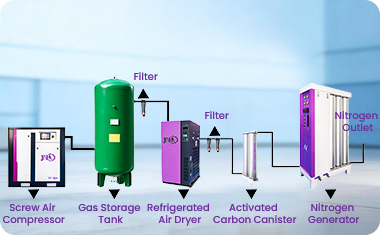
A nitrogen generator system extracts nitrogen from compressed air by air
separation technology, widely used in chemical industry, food packaging,
electronic soldering, laser processing and other fields. Equipped filters serve
as essential components at the front end and pipelines of the system. They
purify intake air and gas sources step by step to stabilize the main unit and
ensure the purity of output nitrogen meets process requirements.
Compressed air naturally contains moisture, oil mist and solid dust. If fed
directly into the separation unit, these contaminants will continuously erode
core components such as molecular sieves or membrane modules. Accumulated oil
and particles block separation channels, reduce separation efficiency, shorten
service life of consumables and even cause fluctuations in nitrogen purity.
Filters intercept pollutants by different precision grades and complete
pre-treatment before air enters the main generator, delivering clean and stable
intake conditions for the whole system.
The filtration assembly usually adopts multi-stage configuration, and each
filter cartridge undertakes different purification tasks. Primary filters
capture large dust particles and liquid water droplets; intermediate filters
trap suspended oil mist and fine particles; high-precision filters remove trace
oil and ultra-fine dust. Adsorption dryers can be added in some working
conditions to control moisture jointly. Multi-stage filtration prevents
overloading of a single filter element, extends replacement intervals and
reduces maintenance costs.
Filter selection must match the intake flow, pressure and local air source
condition of the system. Undersized filters for high flow will raise air
resistance and power consumption. Sites with heavily oil-laden and humid air
need enhanced pre-purification. Besides, filter material and sealing structure
shall adapt to working conditions to maintain reliable sealing under continuous
air supply and avoid bypass leakage that impairs nitrogen quality.
Filters are key inspection items during routine maintenance. Pressure
difference is the most intuitive indicator for filter condition. When the
pressure difference between inlet and outlet exceeds the threshold, the filter
cartridge is saturated and requires timely replacement. Ignoring pressure
difference warnings leads to deteriorating filtration performance. Contaminants
entering the main unit may trigger breakdowns. Regular inspection and
replacement schedules help avoid unplanned shutdowns and sustain stable nitrogen
output.
It should be noted that filters are pre-treatment devices. They do not
change the separation principle of nitrogen generation and cannot replace the
separation performance of the main unit. Final nitrogen purity is determined by
process parameters of molecular sieves or membrane modules. The core function of
filtration is to reduce contamination loss of core separation parts and keep the
equipment running steadily under designed conditions.
To sum up, a nitrogen generator system with filter integrates gas
purification and nitrogen production. Multi-stage pre-filtration controls
impurities in compressed air from the source, lowers wear of core parts,
stabilizes nitrogen quality and reduces failure risks. Matching filter schemes
according to air source conditions and process cleanliness requirements,
together with regular inspection and maintenance, helps maximize equipment
efficiency and deliver stable nitrogen supply for production.