For many field operations, on-site testing and short-term engineering
scenarios, both fixed gas stations and cylinder gas supply have obvious
limitations. Fixed equipment requires long installation cycles and cannot be
moved flexibly. Cylinders involve cumbersome transportation, handling and
replacement, and are restricted by site conditions, transport regulations and
limited gas supply duration. To meet distributed, mobile and short-term gas
requirements, lightweight and rapidly deployable gas generation equipment has
attracted attention from many industries. It adopts membrane separation
technology to produce gas on location and fits various working conditions
outside permanent workshops.
The core principle of membrane separation technology lies in the different
permeation rates of gas molecules through polymer membranes to separate
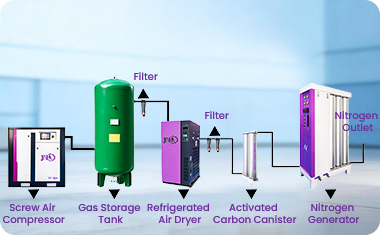
components in air. After compressed air goes through pretreatment to remove oil,
moisture and solid particles, it flows into membrane modules. Oxygen, water
vapor and other components pass through membrane fibers preferentially, and the
remaining enriched gas can meet application requirements. The whole unit
features a relatively simple structure with few moving parts. It runs steadily
and does not require complicated regeneration procedures. Qualified gas can be
obtained shortly after startup. Compared with other purification methods, this
technology stands out for fast startup and easy maintenance, making it suitable
for scenarios with high requirements on convenience.
Such lightweight units serve a wide range of sectors. In pipeline on-site
inspection and oil & gas field work, gas is commonly used for purging,
pressure testing and on-site protection. These sites usually lack complete
machine room facilities, so the equipment needs to be transported by vehicle and
put into operation quickly at different work points. For emergency repair and
temporary construction projects, gas demand may arise unexpectedly, and rapid
deployment cuts down waiting time for gas supply. Some remote field research and
sampling sites face difficulties in cylinder replenishment, and on-site gas
generation eases the pressure of gas supply logistics. It also supports
short-term exhibitions and temporary laboratory gas supply. Since these projects
run for a limited period, permanent gas systems are unnecessary. Lightweight
units can be started on demand and relocated to other sites after tasks
finish.
During selection, decisions should be made based on comprehensive working
conditions rather than equipment size alone. First, clarify continuous gas flow,
peak gas demand and target gas specifications. Insufficient flow leads to
inadequate supply, while excessive margin increases weight and energy
consumption and hinders transportation. Second, confirm preconditions for
incoming air. This type of unit normally requires clean compressed air feed, and
the quality of inlet air directly affects the service life of membrane modules.
Therefore, pre-filtering and drying configurations are essential. Working
environments also need evaluation. Outdoor sites have wide temperature and
humidity fluctuations, and some areas contain dust and rainwater. It is
necessary to verify the enclosure protection rating to adapt to open-air or
simple shelter conditions. Transportation factors should not be overlooked,
including load capacity and space of transport vehicles, compatibility with
vehicle mounting, and power supply options. For sites without mains power,
supporting power solutions need to be assessed. Long-term operating costs,
including consumable replacement cycles, energy consumption and membrane service
life, should also be taken into account.
After commissioning, routine maintenance focuses on the front-end
pretreatment system. Before each startup, check pipe connections and pressure
status, and ensure filter assemblies are not blocked to prevent irreversible
damage to membrane cores from impurities. Replace filter consumables regularly
according to usage frequency to maintain stable inlet air quality. Monitor
pressure and flow during operation. Shut down for inspection promptly if
parameters drift and avoid continuous operation under abnormal conditions. Store
the unit in dust-free and moisture-proof conditions, and protect pipelines
during long-term idle periods to slow membrane aging. Operators should follow
standard startup and shutdown procedures. Proper operation effectively extends
equipment lifespan and ensures stable gas output.
Nowadays, field operation modes are becoming more flexible, and many
projects do not have permanent supporting gas systems. Lightweight membrane gas
generation units, with convenient deployment, easy transport and fast startup,
fill the gap for temporary and mobile gas demand. Reasonable selection based on
gas parameters, site environment and transport conditions, together with proper
routine maintenance, delivers stable on-site gas supply for various field and
temporary tasks, reduces reliance on purchased gas cylinders and improves the
continuity of on-site operations.