During welding, the high-temperature molten pool tends to react with oxygen
and moisture in the air. This leads to oxidized and darkened weld seams,
porosity and inclusions, weakening the mechanical performance of welds and
impairing appearance and reliability of finished parts. As an inert shielding
medium, nitrogen builds a stable barrier around the molten pool and blocks
intrusion of harmful gases. It is widely adopted in welding of stainless steel,
non-ferrous metals and precision components. Workshops with multiple welding
stations and continuous production often face restrictions when relying on
bottled or liquid nitrogen, including delivery lead time, handling work and
fluctuating peak gas demand. A welding protection nitrogen generator serves as a
core solution for many manufacturers to obtain steady shielding gas supply.
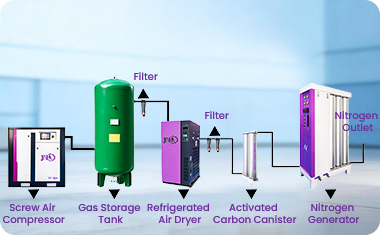
A complete gas supply system consists of not only the main generation unit,
but also upstream air compression, drying, multi-stage filtration, buffer
storage, online monitoring and delivery pipelines. Ambient air is pre-treated to
remove oil mist, moisture and particulate contaminants, preventing pollutants
from entering the separation core and compromising nitrogen purity and the
service life of adsorption media. Treated compressed air flows into separation
modules, where nitrogen is separated from oxygen through pressure swing
adsorption or membrane separation. Nitrogen meeting welding specifications is
stabilized and delivered to each welding torch. Different welding processes
require different nitrogen parameters. General welding accepts moderate purity
levels, while laser welding and precision component welding demand stricter
standards on purity, dew point and gas cleanliness. When evaluating a welding
protection nitrogen generator, enterprises shall first sort out the number of
stations, simultaneous working torches, instantaneous gas flow and daily
operating hours to define basic configuration.
Purity is a key factor for selection. Excessive oxygen content weakens
shielding performance and raises oxidation risk of the molten pool. However,
selecting ultra-high purity unnecessarily increases capital investment and power
consumption. Continuous stainless steel welding usually requires high-purity
nitrogen, while some ordinary shielding scenarios can adopt moderate purity
grades to balance process requirements and operating cost. Rated flow should
also include proper allowance. Gas consumption fluctuates during welding and
rises sharply when multiple stations run at the same time. Insufficient
production capacity causes pressure drop and breaks the stable gas curtain
around the weld pool, resulting in inconsistent weld quality. When selecting a
welding protection nitrogen generator, users should not only refer to average
consumption of a single torch. Peak gas data and buffer tanks are needed to
smooth consumption fluctuations.
Consistent performance relies on standardized routine maintenance.
Operators shall monitor inlet pressure, outlet purity and operating temperature
regularly and calibrate oxygen analyzers on schedule to ensure valid readings.
Filter elements, seals and adsorption materials are consumables and require
periodic inspection and replacement. Failure of upstream filters allows oil and
water to damage separation media and degrade gas quality. Pipelines should be
checked for leakage to cut pressure loss. A proper inspection schedule extends
the service life of a welding protection nitrogen generator and reduces
production loss caused by unexpected shutdown.
Compared with traditional purchased gas supply, on-site generation offers
better supply autonomy. Production will not be restricted by external delivery
schedules, which fits production lines with steady gas demand and high
continuity requirements. Cost evaluation should cover not only initial purchase
expense, but also long-term expenditure including power consumption, consumable
replacement and maintenance service. Some configurations carry low upfront cost
yet consume more power and need frequent part replacement, which brings higher
total expenditure over time. When researching a welding protection nitrogen
generator, buyers are advised to assess total cost of ownership and compare
different solutions comprehensively.
Site conditions should also be taken into account. Installation areas need
proper ventilation, power supply and drainage. Special working environments must
comply with relevant safety codes. Skid-mounted units have compact layout and
simple commissioning, suitable for workshops with limited space and tight
startup schedules. Split-type structures support later capacity expansion for
factories with growing output. Many enterprises reserve expansion interfaces
while planning a welding protection nitrogen generator. When new welding
stations are added later, gas output can be boosted by adding modules instead of
replacing the whole system.
Consistent gas quality directly affects welding yield. Stable nitrogen
shielding improves wettability of the molten pool and reduces defects such as
cold joints and cracks, cutting rework workload. Proper gas circuit design,
parameter monitoring and regular maintenance keep nitrogen purity, pressure and
flow matching welding requirements steadily, so the advantages of on-site gas
generation can be fully realized. Choosing a welding protection nitrogen
generator means building a gas source system matching local welding capacity.
Reliable and controllable shielding gas supply supports the welding process to
produce qualified workpieces continuously.