When purchasing an ASME standard nitrogen gas generator for projects in
North America or other markets working to that system, suppliers are often asked
whether they build to the ASME standard. The question looks simple but actually
involves pressure vessels, piping, welding, materials, inspection and
documentation as a whole. Only by understanding which links the ASME system
covers can requirements be stated clearly at inquiry and acceptance, rather than
settling for a verbal assurance.
First, which parts the system covers. In a nitrogen system, the parts
directly addressed are pressure-retaining components: adsorbers, storage tanks,
buffer tanks, the pressure vessel portion of the refrigerant dryer, and pressure
piping with valve connections. Non-pressure parts such as frames, control
cabinets and parts of filter housings fall more under electrical and protection
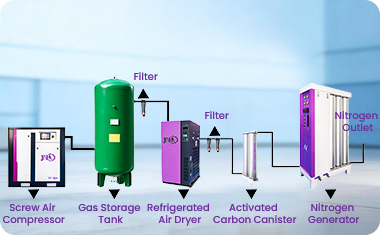
standards. Start by drawing the system flow diagram, marking which components
are pressurized, at what pressure and at what volume, then map them to specific
standards. Different components fall under different clauses, and a blanket
claim that the whole unit complies rarely survives scrutiny. In practice,
documents can be requested component by component: design calculations and test
records for the adsorber, nameplate and data report for the storage tank,
material certificates and welding records for the piping.
Second, key points for pressure vessels. Vessels above certain volume and
pressure thresholds are usually designed and built to the relevant division of
the boiler and pressure vessel code, covering allowable stress, wall thickness
calculation, opening reinforcement, joint types and non-destructive examination
ratios. The manufacturer needs the corresponding qualification and quality
system, and the product should carry a nameplate stating design pressure, design
temperature, volume, material and manufacturing information. Classification and
applicable division often depend on volume, pressure and medium, so the
purchaser should confirm the project's own determination basis and require the
supplier to work to the corresponding division, rather than leaving the judgment
to the supplier. Documentation typically includes design calculations, material
certificates, welding records, NDE reports and hydrostatic or pneumatic test
records. These belong on the delivery list, not discovered missing at
acceptance. Because documents accumulate during fabrication, recreating them
later is slow and rarely authentic, so delivery milestones should be fixed when
the contract is signed.
Third, piping and welding points. Pressure piping is often executed to the
process piping code, involving wall thickness, supports, flexible connections,
and matching valve and flange ratings. Design temperature and pressure of the
piping system should align with the vessels, avoiding a mismatch where vessels
are designed for high pressure and piping is selected for low pressure. Welding
involves procedure qualification, welder qualification, weld inspection and
repair records. The joint between adsorber and piping is a stress concentration
point, so welding quality and heat treatment requirements should be specified.
With stainless steel, post-weld cleaning and passivation also apply, preventing
residues from affecting gas purity and corrosion resistance. These details are
easily skipped at quotation yet directly affect delivery schedules. Where
cleanliness matters, cleaning methods and acceptance criteria should be agreed
in the technical agreement rather than judged visually.
Fourth, materials and non-destructive examination. Confirm grade,
specification, quality certificate and traceability for materials, especially
plate and tube used in pressure parts. NDE usually covers visual inspection,
radiographic or ultrasonic testing, and penetrant or magnetic particle testing,
with ratios and acceptance levels per the agreed standard. Reports should state
method, ratio, result and inspector qualification. For custom projects, whether
modified areas require re-examination should be written into the contract or
technical agreement. Where examination is by sampling, the rule for selecting
sampling locations should also be agreed, so only convenient spots are not
tested.
Fifth, nameplates, data reports and documentation. The ASME system is
specific about documents: nameplate information, manufacturer's data report,
material certificates, welding and inspection records, test records, drawings
and calculations. Documents should correspond one to one with equipment serial
numbers for later inspection and maintenance. Nameplate information should be
checked item by item against the documentation; inconsistency usually signals a
problem in fabrication or document control and should be raised at acceptance.
Where the destination region also requires local registration or third-party
inspection — for example registration in some Canadian provinces, or the
relevant directives in the EU market — that must be confirmed separately, since
compliance with this system does not automatically equal market access.
Sixth, how it connects with local regulation. The country or region where
the equipment will be used determines the access path. The same unit built to
the ASME system may need additional local registration, third-party inspection
or mark certification in another market. Before purchasing, confirm the
destination, project specification and owner requirements, which may not fully
coincide. Where conflicts exist, the technical agreement should state which
party prevails and require the supplier to provide corresponding documents.
Settling this early prevents equipment arriving on site and failing acceptance.
Some projects also require the third-party inspection agency's schedule and
witness points, which belong in the project plan as well.
Seventh, how to write requirements when purchasing. Break the technical
agreement into columns: applicable standard and division, design parameters of
pressure parts, material requirements and certificates, welding and inspection
requirements, test items and pressures, nameplate and document list, third-party
inspection arrangements, and acceptance basis. Each item should be verifiable
rather than a general statement of compliance. Agree document delivery timing as
well, since some documents form during fabrication and cannot realistically be
recreated later. Splitting the document list into two batches helps: process
documents submitted progressively during fabrication for witness purposes, and
final documents delivered with the equipment for acceptance filing.
Eighth, common misconceptions. First, treating designed to ASME as
equivalent to certified to ASME; the two mean different things. Second, focusing
on the main unit while ignoring storage tanks, buffer tanks and piping. Third,
technical agreements that name a standard without division or specific
requirements. Fourth, document lists left out of the contract, so items are
missing at acceptance. Fifth, ignoring destination regulations until
registration proves impossible. Sixth, modified areas not re-examined. Seventh,
material certificates inconsistent with materials actually used, leaving no
traceability. Eighth, third-party inspection arranged late, delaying delivery
milestones. Ninth, reviewing only final reports without fabrication process
records, making it hard to trace problems to specific operations.
Purchasing an ASME standard nitrogen gas generator is essentially
converting an engineering code into verifiable clauses. The more specific the
clauses, the more accurate the supplier's response and the fewer disputes at
acceptance. A standard's name is only the starting point; divisions, parameters,
materials, inspection and documentation are the substance. Write these clearly,
and the equipment will both meet project requirements and pass inspection
smoothly.