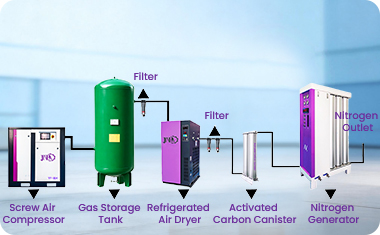
The matching selection of buffer tank volume is a key link in the overall design of nitrogen generator systems, which directly determines the stability of nitrogen output pressure, the continuity of gas supply, and the service life of the main nitrogen production equipment. The core function of the nitrogen buffer tank is to store qualified nitrogen generated by the main unit, balance the system pressure fluctuation caused by intermittent gas consumption and equipment cyclic operation, avoid frequent start-stop and load fluctuation of the nitrogen generator, and stabilize the downstream gas supply pressure and flow. Unreasonable buffer tank volume matching will lead to many operational problems: an excessively small buffer tank cannot effectively balance pressure, resulting in frequent pressure fluctuation of the pipeline network, unstable nitrogen purity, and increased equipment wear; an excessively large buffer tank will increase equipment investment cost, occupy excessive space, and cause unnecessary gas storage waste. Therefore, the buffer tank volume must be scientifically calculated and matched according to the nitrogen generator’s gas production capacity, downstream gas consumption fluctuation, and working cycle parameters.
The scientific calculation standard for buffer tank volume is mainly based on the rated gas production of the nitrogen generator and the peak gas consumption of the terminal equipment. For conventional PSA industrial nitrogen generators, the standard matching principle is that the buffer tank volume is 1/5 to 1/3 of the equipment’s hourly gas production. For small nitrogen generators with a gas production of less than 5 cubic meters per hour, a buffer tank of 1 to 2 cubic meters is usually matched to meet the basic pressure stabilization and gas storage requirements. For medium-sized equipment with a gas production of 10 to 50 cubic meters per hour, a buffer tank of 3 to 10 cubic meters is required to adapt to the continuous gas supply demand of industrial production. For large-flow nitrogen generators used in chemical, metallurgical, and coal mine industries with a gas production of more than 100 cubic meters per hour, it is necessary to configure a buffer tank of more than 20 cubic meters, and even adopt a dual-tank parallel configuration to ensure stable gas supply during peak gas consumption. In addition, for scenarios with large downstream gas consumption fluctuation, such as intermittent gas use and peak centralized gas use, the buffer tank volume needs to be increased by 20% to 30% on the basis of the standard matching volume to enhance the system’s gas storage and pressure regulation capacity.
In addition to gas production and gas consumption parameters, the working mode and application scenario of the nitrogen generator also affect the buffer tank volume selection. The PSA nitrogen generator operates in a cyclic adsorption and desorption switching mode, and there is a slight pressure fluctuation in the instantaneous gas production. A matched buffer tank can effectively eliminate this fluctuation and ensure the stability of terminal gas pressure. For high-precision application scenarios such as laboratory gas supply and electronic manufacturing protection, higher requirements for pressure stability are put forward, so the buffer tank volume needs to be appropriately increased to achieve ultra-stable constant pressure output. For explosion-proof nitrogen generators used in coal mines and chemical flammable and explosive environments, the buffer tank volume matching also needs to comply with industry safety specifications, and the tank body must undergo explosion-proof and pressure-resistant testing while ensuring sufficient gas storage capacity. Reasonable buffer tank volume matching can not only stabilize the system operation and improve gas supply quality but also reduce the start-stop frequency of the main unit, reduce equipment energy consumption and maintenance frequency, and greatly extend the overall service life of the nitrogen generator system.