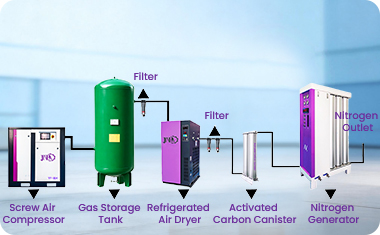
CMS (Carbon Molecular Sieve) nitrogen generator is the mainstream nitrogen production equipment in industrial and commercial fields, which relies on the selective adsorption principle of carbon molecular sieve to separate oxygen and nitrogen in compressed air and obtain high-purity nitrogen. The nitrogen purity of the equipment is affected by many factors such as air source pressure, adsorption time, molecular sieve performance and equipment operating parameters, and accurate purity adjustment is the key to make the equipment meet the nitrogen supply standards of different application scenarios. Scientific and standardized purity adjustment methods can not only ensure the nitrogen purity to reach the set standard, but also avoid energy waste caused by excessive purity and equipment failure caused by unreasonable parameter setting, realizing efficient and energy-saving operation of the system.
The basic parameter adjustment of the CMS nitrogen generator system is the core link of purity control, mainly including adsorption pressure adjustment and cycle time adjustment. The adsorption pressure directly affects the oxygen adsorption capacity of carbon molecular sieve. Within the rated pressure range, properly increasing the adsorption pressure can improve the oxygen adsorption efficiency of the molecular sieve and increase the nitrogen purity; if the pressure is too low, the oxygen cannot be fully adsorbed, resulting in low nitrogen purity. In actual adjustment, the user needs to stabilize the air source pressure at 0.7–0.8MPa (the optimal working pressure of CMS nitrogen generator) through the pressure reducing valve. On this basis, adjust the PLC control cycle time: appropriately extend the adsorption time, the molecular sieve can fully adsorb oxygen impurities, and the nitrogen purity will be significantly improved; shorten the adsorption time, the nitrogen production efficiency increases but the purity decreases, realizing the primary adjustment of purity through the matching of pressure and time parameters.
The auxiliary adjustment method focuses on air source purification and equipment operating state optimization, which is an important supplement to parameter adjustment and can effectively solve the problem of purity decline caused by external interference. Impurities such as moisture, oil and dust in the compressed air will seriously damage the adsorption performance of carbon molecular sieve, leading to rapid decline of nitrogen purity. Therefore, it is necessary to regularly check and replace the filter element of the system's multi-stage filter device to ensure the cleanliness of the air source entering the molecular sieve tower. At the same time, check the tightness of the equipment pipeline and valve seals to avoid air leakage of mixed air, which will cause nitrogen purity dilution. For the molecular sieve that has been used for a long time and has aging and failure problems, it is necessary to replace the carbon molecular sieve in time to restore the original adsorption performance of the equipment and ensure the stability of nitrogen purity.
Precision fine-tuning and intelligent calibration are the advanced adjustment methods of the CMS nitrogen generator system, which are suitable for scenarios with high purity requirements. The equipment is equipped with a real-time nitrogen purity detector, which can feed back purity data to the intelligent control system in real time. The system automatically fine-tunes parameters such as adsorption cycle and exhaust volume according to the real-time purity value to realize closed-loop automatic adjustment. When the set purity standard is not met, the system will automatically optimize the working parameters, increase the oxygen removal rate, and lock the optimal operating parameters after the purity is stable. Regular manual calibration of the purity detector and parameter resetting can eliminate system errors caused by long-term operation, ensure the long-term accuracy of nitrogen purity, and meet the diversified purity requirements of food fresh-keeping, industrial welding, electronic protection and other scenarios.