The emergence of low pressure small nitrogen generators allows medium and
small-sized users, who previously relied on bulk gas supply, to obtain stable
nitrogen at a lower threshold. Nitrogen has a wide range of uses, from material
protection to food preservation, from electronic component packaging to power
equipment maintenance. Many scenarios do not require high-pressure, high-flow
gas supply systems; instead, they value flexibility and immediacy of supply.
Such equipment is designed for dispersed, low-frequency, on-demand gas needs,
and has gradually become a supporting choice for many small and medium-sized
users.
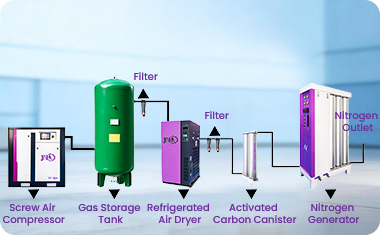
In terms of working principle, small nitrogen generators mostly adopt
pressure swing adsorption or membrane separation technology, using compressed
air as raw material. Relying on the selective difference of adsorbents for
oxygen and nitrogen molecules, they separate nitrogen from the air. The
equipment is compact in size. Compressed air enters the separation unit after
purification, and the produced nitrogen is delivered directly to the point of
use without an intermediate high-pressure storage tank. Pipeline pressure is
maintained at a medium to low level, offering good operational safety. The whole
system features a fairly high degree of automation. It can generate gas
continuously after startup, and shutdown and startup are both convenient,
fitting the habit of on-demand operation.
In laboratories and research institutions, such equipment is often used for
atmosphere protection, sample preservation and inert environment construction.
Gas consumption in experiments fluctuates greatly, and sometimes only short
periods of use are needed within a day. If a large gas supply system is
configured, the equipment sits idle frequently, making energy consumption and
maintenance costs less cost-effective. Low pressure small nitrogen generators
produce gas as needed, matching the pace of experiments and reducing gas waste.
In the food and agricultural product sectors, nitrogen is commonly used for
modified atmosphere preservation, delaying oxidation and microbial growth by
replacing oxygen in packaging, thus extending shelf life. Compact equipment is
easy to install near processing sites, shortening gas delivery distance and
facilitating control over gas source quality.
In mechanical processing and electronics manufacturing, low pressure
nitrogen can serve as a shielding gas for procedures such as laser cutting,
welding and electronic component packaging, reducing oxidation of materials
under high temperatures and improving product quality. In some power equipment
maintenance and cable construction situations, nitrogen is also used for
moisture removal, purging and insulation protection. Such applications are
mostly periodic operations, which place certain requirements on equipment size
and portability. Small nitrogen generators usually adopt a skid-mounted or
cabinet structure, which can be fixed or movable, adapting to these dispersed
operating points.
Compared with centralized gas supply, low pressure small nitrogen
generators require no long-distance pipelines and eliminate steps such as
periodic inspection of high-pressure vessels. Users can select corresponding
specifications based on actual consumption, avoiding waste caused by excessive
configuration. Daily operation mainly involves electrically controlled valve
switching and adsorbent regeneration. Maintenance tasks focus on filter
replacement and system inspection, keeping the maintenance burden light. In
addition, the on-demand generation approach reduces gas storage links and also
avoids potential risks brought by storage.
It should be noted that the output capacity and purity of small equipment
are limited by model specifications. During selection, users should confirm the
configuration based on peak consumption, continuous usage duration and required
purity, rather than deciding merely by price. The quality of compressed air
directly affects separation results. The supporting purification unit should
remain in normal operation. Once oil, water and dust enter the separation
system, they will accelerate performance degradation of the adsorbent and
shorten equipment service life. The installation location should also reserve
ventilation and maintenance space to ensure the equipment operates under
suitable environmental conditions.
As gas application scenarios become increasingly segmented, low pressure
small nitrogen generators show good adaptability in small and medium-sized
enterprises, laboratories, mobile operations and distributed gas demand. They
bring gas generation capacity down to the point of use, making the supply method
closer to actual production rhythm, and provide users with a more flexible and
economical way to obtain nitrogen. In the future, with continuous optimization
of adsorbent materials and control systems, the energy consumption level and
stability of such equipment are expected to improve further, and their
application scope will continue to expand.