When building an industrial gas supply system, nitrogen generators are
adopted in many process scenarios. Stable upstream air supply equipment serves
as the foundation to keep the whole nitrogen production system operating
smoothly. Many users overlook the matching relationship between upstream air
supply devices and nitrogen generators during scheme planning, which may lead to
unstable air supply pressure, high energy consumption and accelerated equipment
wear.
Nitrogen generators take compressed air as feed gas. The cleanliness,
pressure and flow rate of feed gas directly affect nitrogen production
performance and service life. The upstream air supply equipment, air compressor,
needs to match the parameters of nitrogen generators. Not all air compressors
can be directly connected to nitrogen production units.
First of all, flow matching should be prioritized. The output air volume of
the air compressor cannot simply equal the air consumption marked on the
nitrogen generator. Air loss occurs during filtration, drying and pipeline
transmission. Margin is also required to cope with equipment start-stop and
pressure fluctuation. A reasonable allowance should be reserved in selection, so
as to prevent the air compressor from running at full load continuously and
reduce mechanical wear caused by frequent start and stop. Insufficient air
supply will prevent the adsorption unit inside the nitrogen generator from
working properly, resulting in substandard nitrogen purity and flow. Excessive
air volume will cause idle energy waste and raise overall operating costs.
Pressure matching is another key point. Most nitrogen generators are
designed for a specific inlet pressure range. Too low pressure reduces the
adsorption efficiency of molecular sieve and lowers nitrogen purity. Excessively
high pressure increases the load on internal pipelines and valves and raises the
risk of leakage. Users need to check the inlet pressure range marked on the
nameplate of the nitrogen generator. The rated output pressure of the air
compressor should fall within this range, and a pressure stabilizer should be
installed to maintain steady air pressure delivered to the nitrogen
generator.
Gas cleanliness cannot be ignored. Natural air contains moisture, oil and
dust. Once these impurities enter the nitrogen generator, they will contaminate
molecular sieve materials, weaken adsorption capacity, shorten the replacement
cycle of molecular sieve and increase maintenance expenses. Complete
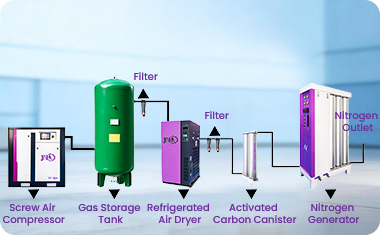
post-treatment units including precision filters and dryers should be installed
after the air compressor to remove oil, dust and water from compressed air.
Oil-free air compressors deliver cleaner air, suitable for food, pharmaceutical
and electronic industries with strict cleanliness requirements. Oil-injected
models have lower procurement cost and fit general industrial scenarios with
looser impurity requirements, yet multi-stage filters must be equipped to
control residual oil content.
Ambient conditions affect system performance as well. Workshops with high
temperature, high humidity or heavy dust will add heat dissipation burden to the
air compressor and bring more moisture into pipelines. Enough ventilation space
should be reserved for equipment installation, away from heat sources and
corrosive materials. Regular maintenance including pipeline drainage, filter
replacement and routine inspection is necessary. During daily operation, check
lubricant, belts and seals of the air compressor on schedule, and monitor
nitrogen outlet parameters. If nitrogen purity drops, check the upstream air
supply system first for unstable pressure, blocked filters or failed drying
units.
Energy consumption is a common concern. The total power consumption of the
system comes from both the air compressor and nitrogen generator. Models with
favorable energy efficiency are preferred. Reasonable pressure limit setting
helps cut idle running time and reduce electricity cost in the long run.
Besides, the pipeline between the air compressor and nitrogen generator should
be shortened as much as possible to minimize pressure loss along pipelines.
In summary, the air compressor supplies feed gas for nitrogen generators,
and the two devices work as a coordinated system. The core of selection lies in
the matching of flow, pressure and gas cleanliness. The final plan should be
determined based on nitrogen purity, output, working environment and budget
requirements of production processes. Proper parameter verification in the early
stage and regular maintenance later help the whole nitrogen supply system run
steadily and efficiently to meet continuous gas demand in production.