In the field of normal-temperature air separation, pressure swing
adsorption equipment has become the mainstream equipment for on-site industrial
gas preparation due to its modular design, low energy consumption and no need
for low-temperature liquefaction. Most manufacturing enterprises configure air
separation equipment according to initial production demands to produce inert
protective gas for production scenarios such as material anti-oxidation and
explosion isolation. With the upgrading of production lines, process iteration
and product category expansion, the gas demand of some enterprises will change
from traditional nitrogen supply to oxygen supply, which is widely used in
wastewater treatment, combustion supporting, medical assistance, aquaculture
oxygenation and other scenarios. Compared with purchasing brand-new oxygen
generating equipment directly, targeted transformation based on the original air
separation equipment architecture is the optimal solution that balances cost,
efficiency and resource utilization, and it is also the mainstream method for
equipment upgrading of small and medium-sized factories at present.
To realize the accurate function switching of air separation equipment, it
is necessary to clarify the core technical differences between nitrogen
generating equipment and oxygen generating equipment first. Both types of
equipment rely on pressure swing adsorption technology, take compressed air as
raw material, and realize air component separation through selective adsorption
of molecular sieves, but their core adsorption media and separation principles
are completely different. Conventional nitrogen generators adopt carbon
molecular sieves as the core adsorption materials. Taking advantage of the
faster diffusion rate of oxygen molecules, they adsorb oxygen in the air under
pressure and retain nitrogen for enrichment and output. In contrast, oxygen
generators are equipped with zeolite molecular sieves, which preferentially
adsorb nitrogen impurities in the air and allow oxygen to penetrate and enrich
smoothly to prepare high-purity oxygen. The differentiated selection of core
media is the fundamental reason for the different functions of the two types of
equipment and the core entry point for equipment transformation.
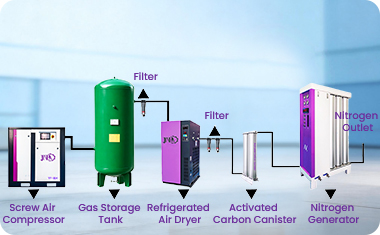
In terms of equipment structure, nitrogen generating equipment and oxygen
generating equipment have highly versatile basic frameworks, including air
pretreatment systems, compression and filtration components, dual adsorption
tower structures, pressure stabilizing gas storage systems and intelligent
electric control modules. Their basic gas supply links, pressure adaptation
ranges and pipeline layouts are basically consistent, which provides feasibility
for equipment transformation. Enterprises do not need to replace large-scale
basic components such as the whole machine frame, air compressor and
refrigerated dryer. They only need to replace core adsorption consumables,
adjust pipeline pressure stabilizing parameters and optimize electric control
procedures to complete equipment function switching. This greatly reduces the
procurement cost and disassembly and assembly period of equipment upgrading,
maximizes the reuse of original equipment resources and avoids idle equipment
waste.
The complete equipment transformation process is standardized and
lightweight, without large-scale civil construction and structural
modifications. The first step is core medium replacement. Remove the original
carbon molecular sieves, thoroughly clean residual impurities inside the
adsorption tower, fill high-quality zeolite molecular sieves suitable for
working conditions, and inspect the tower sealing structure to eliminate air
leakage and gas channeling problems and ensure separation accuracy. The second
step is parameter system debugging. The pressure, adsorption duration and
pressure relief cycle of the original nitrogen generating equipment are adapted
to nitrogen separation requirements. After transformation, the equipment
operating parameters need to be recalibrated, and the time ratio of pressure
adsorption and pressure relief desorption needs to be optimized to match the
kinetic characteristics of oxygen separation, avoiding problems such as
insufficient purity and unstable gas production. The third step is pipeline and
accessory optimization. Replace seals and valves adapted to oxygen-enriched
environments to prevent accelerated aging and oxidation failure of ordinary
accessories under high-oxygen working conditions and improve equipment operation
safety. The final step is whole machine commissioning and purity testing to
verify the gas production effect under different pressure and flow rates step by
step, ensuring that oxygen purity, gas production flow and stability meet
standards.
The air separation equipment after professional transformation can fully
meet the operating standards of special oxygen generating equipment, while
retaining the original advantages of low energy consumption, simple operation
and maintenance and flexible deployment. In terms of service performance, the
oxygen purity of the transformed equipment can be stably controlled within the
standard range, meeting the needs of most civil and industrial scenarios such as
industrial combustion supporting, sewage aeration, aquaculture and laboratory
gas supply. Compared with purchasing new equipment, the transformation solution
can save more than half of the upgrading cost and shorten the construction
period by more than two-thirds. In addition, the original equipment operation
and maintenance system does not need to be rebuilt, and operators can get
started by following the original inspection and maintenance process, greatly
reducing the time and labor costs of enterprise equipment upgrading.
This type of equipment transformation solution is suitable for industrial
upgrading demands in multiple industries with a wide range of application
scenarios. In the industrial manufacturing field, after the traditional heat
treatment and metal processing production lines relying on nitrogen protection
are upgraded to oxygen-enriched combustion supporting processes, the transformed
equipment can provide stable oxygen gas sources, improve fuel combustion
efficiency and reduce energy consumption and exhaust emissions. In the
environmental protection water treatment industry, idle original air separation
equipment can be transformed to produce sufficient oxygen for biochemical tank
aeration and oxygenation, activate microbial activity and improve sewage
treatment efficiency, meeting the energy-saving transformation needs of small
and medium-sized sewage stations. In the aquaculture industry, the transformed
equipment can continuously output clean oxygen-enriched gas to improve the
dissolved oxygen environment of water bodies, avoid the death of fish and shrimp
caused by oxygen deficiency and increase the breeding survival rate. In
addition, scenarios such as small-scale medical assistance, laboratory
scientific research, glass smelting and kiln combustion supporting can realize
low-cost gas source upgrading through equipment transformation.
In the process of equipment transformation and later operation and
maintenance, core details need to be controlled to ensure long-term and stable
operation. Firstly, molecular sieve materials of corresponding specifications
should be selected according to actual gas purity and flow demands to avoid low
gas production efficiency caused by improper consumable selection. Secondly, air
pretreatment should be strengthened after transformation to strictly filter oil,
moisture and impurities in compressed air, prevent pollution and failure of
zeolite molecular sieves, and extend the service life of core consumables. At
the same time, electric control procedures and pressure parameters need to be
calibrated regularly, and operation logic should be fine-tuned according to
seasonal temperature differences and gas load to ensure stable gas production
throughout the year. Basic daily maintenance work such as filter element
replacement, pipeline leakage detection and tower pressure inspection can
effectively reduce equipment failure rate and extend the service life of the
whole machine.
With the development of energy-saving and intensive industrial production,
functional upgrading and resource reuse of old equipment have become important
ways for the manufacturing industry to reduce costs and increase efficiency. The
functional switching and transformation technology of air separation equipment
solves the equipment iteration problem caused by enterprise gas process
upgrading with the advantages of high adaptability, low cost and short cycle,
avoiding resource waste caused by traditional equipment elimination and
replacement. In the future, with the continuous upgrading of molecular sieve
materials and intelligent control technology, the gas production accuracy,
energy consumption control and operation stability of transformed equipment will
be further improved. It will provide an efficient and economical gas source
solution for process upgrading and production capacity optimization in more
industries, and help the high-efficiency and green development of industrial
production.