best nitrogen generator manufacturers:Analysis of Selection Considerations
for Nitrogen Generator Manufacturers
Best nitrogen generator manufacturers refer to qualified manufacturers of
nitrogen generation equipment, which are the key objects to evaluate during the
selection phase of industrial on-site gas projects. When purchasing pressure
swing adsorption, membrane separation and other types of nitrogen generation
units, selecting a proper equipment manufacturer is not simply about looking for
brand rankings. Instead, comprehensive evaluation should be carried out
combining project working conditions, process requirements, delivery capacity
and long-term operation and maintenance support. Manufacturers differ greatly in
technical routes, product design, production processes, project experience and
after-sales systems. Only through thorough screening can users select equipment
suppliers matching project demands and guarantee long-term stable operation of
nitrogen systems.
The core technical strength of nitrogen generator manufacturers is first
reflected in their capability of process design. Mature manufacturers can
customize system solutions according to on-site gas consumption, nitrogen
purity, outlet pressure, ambient conditions and continuous operation duration.
The mainstream nitrogen generation technologies include pressure swing
adsorption (PSA) and membrane separation. Some large manufacturers master both
technologies and can recommend suitable routes according to working conditions.
PSA nitrogen generation is suitable for high-purity nitrogen requirements and
widely used in chemical industry, heat treatment and lithium battery
manufacturing. Membrane separation is more applicable for medium-low purity,
large flow and mobile deployment scenarios. Technically capable manufacturers
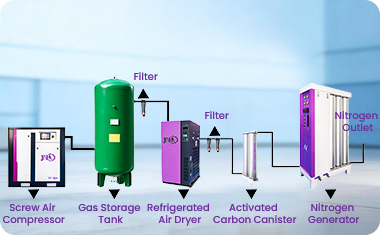
attach importance to the design of air pretreatment systems. They fully
understand that pretreatment determines the service life of carbon molecular
sieves and separation membranes. Proper configuration of filters and dryers
protects core separation media from the source and reduces later performance
degradation. Manufacturers lacking solution design capability often adopt
standardized universal models, which are difficult to adapt to special working
conditions and prone to purity fluctuation and shortened consumable service life
in long-term operation.
The next factor to inspect is the manufacturer’s production and product
testing capacity. Formal manufacturers have complete procedures for component
inspection, whole-machine assembly and factory testing. Core components
including adsorption towers, control valves, sensors and buffer gas tanks need
quality inspection before warehousing. After assembly, complete machine joint
commissioning will be performed to simulate real working conditions and test gas
production stability, purity control and valve switching logic. Well-equipped
manufacturers build standardized test platforms to carry out continuous aging
tests and expose potential defects in structure, sealing and control programs in
advance. Some small foundry enterprises lack complete testing procedures.
Equipment only undergoes simple power-on inspection before delivery, which
easily leads to difficult commissioning and unstable operation after arriving on
site. Factory testing and reliability verification are especially critical for
continuous production projects requiring 24-hour non-stop gas supply.
Project implementation experience is another important dimension for
evaluation. Reliable manufacturers have cross-industry project cases covering
chemical, electronics, laser processing, food preservation, oil & gas,
pharmaceutical and other sectors. Rich project experience means manufacturers
can identify potential risks in different industries, such as explosion-proof
requirements in chemical scenarios, strict nitrogen purity stability
requirements for lithium battery production lines, and temperature and humidity
adaptability of outdoor cabinet-type equipment. In early technical
communication, experienced manufacturers will actively point out risk factors
and provide supporting solutions, such as adding backup circuits, online
monitoring and alarms, and reserved maintenance interfaces. Suppliers with
limited project cases tend to produce inadequate solutions facing complex
working conditions, resulting in many modifications during installation and
commissioning and prolonged project delivery cycles.
Delivery, operation and maintenance and technical service systems are
easily overlooked yet vital evaluation items. The service life of a nitrogen
generation system can last for several years or even more than a decade. Stable
equipment operation relies on continuous technical support and consumable
supply. Trustworthy manufacturers can provide equipment installation guidance,
on-site commissioning and operator training, and build a responsive after-sales
mechanism. They can remotely troubleshoot control system faults and arrange
engineers for on-site service when necessary. Meanwhile, they can steadily
supply original filter elements, seals, carbon molecular sieves and other
consumables to meet long-term maintenance and replacement demands. Some
suppliers only deliver equipment without local service networks. When equipment
fails, long response time may trigger production shutdown. For continuous
manufacturers, production loss caused by downtime far exceeds the price
difference of equipment. Therefore, after-sales capacity should be prioritized
in assessment.
During selection, price should be viewed rationally, and low price alone
should not be the screening criterion. Nitrogen generation equipment belongs to
industrial complete sets with relatively strong non-standard attributes. Price
differences stem from material grade, core component brands, pretreatment
configuration, automation systems, factory test standards and service scope.
Low-cost products tend to cut corners on filtration systems, valve quality and
molecular sieve filling processes. Although nitrogen can be produced in the
short run, purity degrades rapidly and failure frequency rises in long-term
operation, leading to higher overall operating costs. During evaluation, users
should compare the configuration of the whole system, verify test reports,
material certificates and qualification documents, and confirm that equipment
meets process and safety specifications.
It is also necessary to clarify the evaluation boundary. There is no
absolutely “world’s best” manufacturer. Different manufacturers have their
strengths: some focus on large stationary nitrogen stations, some specialize in
integrated cabinet models, while others develop small portable membrane
separation nitrogen generators. Suppliers matching project conditions with sound
technical and service capacity are the most suitable choice. Buyers should build
a multi-dimensional evaluation checklist covering process solutions,
manufacturing capacity, project cases, delivery cycle, maintenance service and
compliance. Multiple suppliers’ technical proposals should be compared
comprehensively instead of merely relying on promotional materials.
In summary, searching for best nitrogen generator manufacturers is
essentially finding partners that match project conditions and have reliable
manufacturing capacity and long-term service guarantees. Nitrogen generators are
key gas source equipment supporting industrial production, and their reliability
directly affects production safety and continuity. Only by conducting sufficient
technical assessment in the early stage, comparing solutions rationally and
attaching importance to long-term operation and maintenance can enterprises
select suitable manufacturers, ensure stable on-site nitrogen supply and reduce
full-lifecycle operational risks.