Comprehensive R&D Analysis of CMS Nitrogen Generators Dedicated to Cold
Storage
1. R&D Initiation Background & Industrial Technical Pain Points
The cold chain warehousing industry serves as the core carrier for
long-term fresh preservation of fresh produce, pharmaceuticals and meat
products. Conventional cold storage merely relies on low-temperature temperature
control to slow down oxidative spoilage of food materials, yet it fails to
restrain fruit and vegetable respiration, grease oxidation, mold breeding and
degradation of active pharmaceutical ingredients. Traditional storage protection
solutions mostly adopt manually refilled nitrogen cylinders and simple membrane
separation nitrogen generators, which bring four prominent industrial drawbacks,
also acting as the core starting points for the R&D of this CMS nitrogen
generator.
First of all, the cylinder gas supply mode incurs high operating costs and
discontinuous nitrogen supply. Frequent cylinder replacement forces cold storage
doors to stay open, and convection between cold and hot air triggers temperature
fluctuations over ±3℃ inside warehouses, which sharply increases energy
consumption of compressors. Secondly, the maximum nitrogen purity of
early-generation membrane separation nitrogen equipment only reaches 92%~95%,
while storage of high-value fresh goods and rare medicinal herbs requires
nitrogen concentration of no less than 99.5%; insufficient purity shortens the
fresh-keeping cycle by more than 30%. Thirdly, universal nitrogen generators
available on the market lack optimization for cold storage working conditions
featuring low temperature and high humidity. Electric control components are
prone to short circuits caused by dew condensation, and the adsorption
efficiency of molecular sieves continuously declines as ambient temperature
drops. Fourthly, conventional equipment boasts low integration level, split
pipelines occupy limited storage space inside cold warehouses, and weak
automatic operation requires full-time staff to adjust nitrogen flow rate and
concentration, resulting in high labor management costs.
In response to the above industrial pain points, the R&D team has
defined core development objectives: taking Carbon Molecular Sieve (CMS)
Pressure Swing Adsorption nitrogen generation technology as the core, develop an
integrated special nitrogen generation system adaptable to wide temperature and
high humidity working conditions of cold storage ranging from -5℃ to 15℃. Five
core R&D indicators including ultra-high nitrogen purity, stable operation
under low temperature, low energy consumption, fully automatic unattended
operation and compact installation are covered, filling the market gap of
high-purity nitrogen generation equipment exclusively designed for cold chain
warehousing.
2. R&D Iteration of Core Structures & Key Modules
The R&D of this CMS nitrogen generator for cold storage consists of
four core modules: molecular sieve adsorption unit, low-temperature adaptive air
source pretreatment system, intelligent pressure cycle control system and
constant-temperature protective frame, which have undergone three rounds of
prototype iteration and optimization.
The CMS adsorption tower acts as the core reaction unit of the whole
equipment. Instead of ordinary general CMS fillers widely used in the industry,
the R&D team customized special low-temperature carbon molecular sieves with
micropore sizes of 0.28~0.32 nm. The pore structure is optimized for
low-temperature cold storage environments, lifting oxygen adsorption capacity
under low temperatures by 18%. A twin-tower staggered adsorption-desorption
circulation structure is adopted, and internal airflow guide plates inside
adsorption towers are optimized to eliminate airflow short-circuit, boosting
nitrogen recovery rate by 12%. Meanwhile, the tower sealing structure is
upgraded with low-temperature resistant silicone rubber sealing rings to prevent
air leakage under high humidity, stably maintaining adjustable nitrogen output
purity from 99.5% to 99.99%.
The air source pretreatment system represents the differentiated R&D
highlight of cold-storage-specific models. Drying and filtering assemblies of
standard nitrogen generators only fit normal-temperature workshops, while air
inside cold storage contains extremely high water vapor and condensed water that
easily infiltrate molecular sieves and lead to failure. The R&D team added a
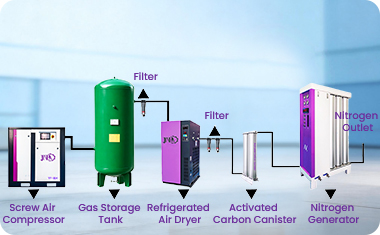
three-stage deep water removal filtration circuit tailored for low temperatures:
a primary cyclone water remover eliminates large condensed water droplets, a
medium refrigerated dryer stabilizes the dew point of compressed air at -40℃,
and a terminal precision activated carbon filter removes oil and gas impurities.
Self-developed heat tracing and thermal insulation pipelines are matched to
avoid pipeline ice blockage under low temperatures, ensuring clean and dry
compressed air entering adsorption towers and extending the service life of CMS
molecular sieves to over 8 years.
The intelligent PSA control module is equipped with an industrial-grade
low-temperature PLC mainboard coated with anti-condensation circuit paint to
adapt to drastic temperature differences in cold storage, supporting stable
power-on operation at -10℃. An exclusive PID concentration closed-loop algorithm
is independently developed, which collects real-time feedback data from oxygen
concentration sensors installed in cold warehouses, and automatically adjusts
adsorption pressure, cycle switching time and nitrogen output flow. When oxygen
concentration inside warehouses exceeds preset thresholds, the unit
automatically increases nitrogen supply; once concentration reaches standards,
unit load is reduced for energy-saving operation. A 4G remote monitoring port is
integrated with self-developed cloud management software to remotely check unit
operating parameters, fault early warnings and maintenance reminders, realizing
24-hour unattended operation.
The overall frame structure adopts integrated compact design developed to
replace bulky split frames. Optimized pipeline layout cuts the floor area of the
whole machine by 35%. The outer shell is coated with low-temperature resistant
anti-corrosion polyurethane paint, and an internal circulating
constant-temperature fan is installed to isolate cold storage moisture from
eroding internal electrical components and avoid dew condensation faults.
3. R&D Performance Testing & Working Condition Verification
After prototype assembly, a simulated constant-temperature and
constant-humidity test cabin for cold storage was built in the R&D
laboratory to conduct 720-hour non-stop aging tests under three typical cold
storage working conditions of 0℃, 5℃ and 10℃, with data of universal CMS
nitrogen generators as control groups. Test results prove that the
self-developed cold-storage-specific unit maintains nitrogen purity fluctuation
within ±0.1% under all working conditions, and the attenuation rate of molecular
sieves is far lower than general industrial equipment. With equal nitrogen
output, overall energy consumption is reduced by 16%, and the recovery speed of
nitrogen concentration after temporary warehouse door opening rises by 40%.
Field pilot tests were carried out targeting three mainstream storage
scenarios: meat products, Chinese medicinal herbs and fruits & vegetables.
The low-oxygen airtight storage environment with high-purity nitrogen restrains
ethylene generation, extending the fresh-keeping cycle of fruits and vegetables
by 2 to 3 times. Oxygen isolation blocks grease oxidation to eliminate rancid
odors of frozen meat, and low-oxygen bacteriostatic conditions greatly reduce
mold growth and loss of active ingredients of medicinal materials, cutting
storage loss by over 60%. The pilot results fully verify that this R&D
scheme perfectly matches the actual application demands of cold chain
warehousing.
4. Innovative R&D Value & Commercial Application Advantages
From the perspective of technical research and development, this CMS
nitrogen generator for cold storage realizes three core innovations: customized
low-temperature adaptive carbon molecular sieve formula, three-stage deep
low-temperature water removal pretreatment system, and cold-chain-exclusive
intelligent control algorithm linked with warehouse oxygen concentration. It
solves long-standing industrial pain points of traditional nitrogen generators
including poor adaptability to low-temperature high-humidity cold storage
environments, insufficient nitrogen purity and excessive energy consumption. In
terms of commercial implementation, the integrated unit eliminates frequent
nitrogen cylinder replacement and slashes long-term operating costs by 50%.
Fully automatic intelligent regulation reduces manual on-site management, and
the compact frame fits multiple scenarios including small and medium cold
warehouses, fresh food distribution warehouses and pharmaceutical cool storage
rooms, delivering outstanding market adaptability.
Future R&D iteration directions will focus on modular capacity
expansion, energy-saving transformation matched with photovoltaic power supply,
and independent nitrogen concentration control for multi-zone warehouses. The
product line of special nitrogen generation equipment for cold chain storage
will be continuously upgraded to provide high-performance domestic nitrogen
production solutions for low-temperature modified atmosphere fresh-keeping
industries of fresh agricultural products.