A desktop commercial nitrogen generator is mainly applied in laboratories,
testing institutions, small processing workshops and other scenarios, providing
nitrogen on site for processes such as chromatographic analysis, laser cutting,
pneumatic driving and food preservation. The process requirements of such
equipment usually center on the point of gas use, emphasizing small footprint,
flexible start-stop and on-demand gas supply, while also meeting specific purity
and flow requirements of particular processes.
Analytical testing is one of the common applications of desktop nitrogen
generators. Instruments such as gas chromatography and mass spectrometry often
use nitrogen as carrier gas or auxiliary gas, requiring relatively high gas
purity while consuming small quantities. When supplying gas for such processes,
the purity indicator must match instrument requirements, and the outlet pressure
must be stable to avoid pressure fluctuation affecting analysis results. Since
laboratory space is limited, equipment size, noise level and maintenance
convenience are also soft requirements to consider in process selection.
Laser and welding processes value consistency and cleanliness of the gas
source. In some laser cutting and precision welding applications, nitrogen acts
as auxiliary gas to blow away slag and isolate oxidation, so airflow stability
affects processing quality. Such processes usually have moderate gas consumption
and certain purity requirements. If a desktop model can deliver stable output,
it reduces the frequency of cylinder replacement and supports continuous
operation. Meanwhile, oil and moisture in the gas source can contaminate optical
parts or affect weld quality, so pre-filtration and purification configurations
need to match process cleanliness requirements.
Pneumatic driving and purging processes pay more attention to whether flow
and pressure meet end-use needs. Cylinders and pneumatic fixtures require stable
and continuous pressure supply. Insufficient nitrogen flow causes slow action,
and unstable pressure affects execution accuracy. These processes have
relatively loose purity requirements but are sensitive to supply continuity and
pressure stability. When selecting a desktop nitrogen generator, the maximum
instantaneous flow of end-use equipment must be calculated to avoid insufficient
supply during peak gas consumption.
Food preservation and packaging processes value the cost and cleanliness of
gas production. Small bakeries, fresh-keeping packaging and canned nitrogen
filling need continuous nitrogen supply to displace oxygen and extend shelf
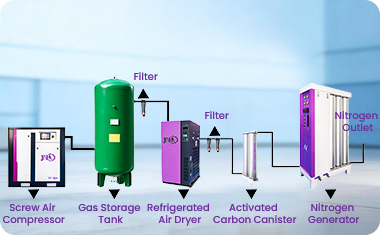
life. Desktop models use air compressors as the gas source, and on-site
generation eliminates cylinder transportation and storage, keeping running costs
controllable. Meanwhile, food-grade applications impose requirements on nitrogen
cleanliness, so gas purification, pipeline materials and outlet cleanliness
indicators should be configured according to relevant hygienic requirements.
In process connection, confirming gas parameters is the premise of
selection. The demand side needs to specify purity, flow, pressure and
start-stop frequency of gas use, and the supplier matches the separation method,
gas storage configuration and control system accordingly. For intermittent gas
use, equipping storage tanks and automatic start-stop control can avoid frequent
starting and reduce energy consumption. For continuous gas use, the equipment
needs to operate stably for long periods.
Operation and maintenance also form part of process requirements. Desktop
models are placed directly in laboratories or workshops, so maintenance
intervals, consumable replacement convenience and clear alarm prompts all affect
daily experience. Filters and dryers need periodic replacement. Models with
simple maintenance procedures and easily available accessories reduce downtime.
Meanwhile, noise level and heat dissipation should coordinate with the
installation environment to avoid interfering with precision experiments or
personnel work.
In summary, the process requirements of a desktop commercial nitrogen
generator include basic performance indicators such as purity, flow and
pressure, as well as scenario-based requirements such as cleanliness, stability,
footprint, quietness and maintenance convenience. Different processes assign
different weights to each requirement. Only by matching specific gas-use
processes and site conditions can truly applicable equipment be selected. The
value of desktop models lies in satisfying diverse process nitrogen demands in a
flexible, on-site and controllable manner.