In clean production workshops for precision manufacturing, electronic
packaging, pharmaceutical processing and high-end laser cutting, the vertical
type nitrogen generation system has become the mainstream equipment for
standardized workshop gas supply due to its advantages of vertical integrated
structure, small floor area, regular layout and strong airtightness. Compared
with traditional horizontal nitrogen production equipment, the vertical model
features a compact structure, centralized pipeline layout and better overall
airtightness, making it more suitable for clean workshops and intensive
production scenarios. However, the long-term stable gas supply, service life
extension and failure downtime reduction of the equipment fully depend on a
scientific and standardized operation and maintenance management system.
Conducting daily maintenance, regular inspection, fault troubleshooting and
working condition adaptation from the perspective of operation and maintenance
can maximize the performance of the vertical type nitrogen generation system,
help enterprises reduce operation and maintenance costs, avoid production
shutdown losses, and ensure the stable operation of the production line
throughout the year.
Daily basic operation and maintenance is the core foundation for the stable
operation of vertical nitrogen generation systems and the most easily overlooked
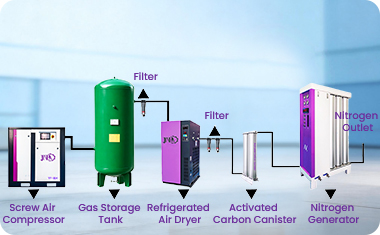
link in most workshops. The vertical type nitrogen generation system adopts a
vertical stacked integrated design, with air compressors, dryers, filter
components and gas storage tanks arranged neatly from top to bottom. Despite its
high integration, the heat dissipation, air intake and filtration structures of
each component are relatively concentrated, and dust accumulation will easily
affect operational efficiency. Workshop operation and maintenance personnel
shall establish a regular cleaning mechanism, clean the air inlet filter screen,
heat dissipation holes and external pipeline dust of the equipment every day to
prevent poor air intake and heat dissipation caused by dust accumulation, which
may lead to equipment high-temperature load reduction and insufficient gas
production. Meanwhile, it is necessary to inspect the equipment air pressure,
nitrogen purity, operating noise and instrument parameters daily to ensure
stable pressure values and compliant purity parameters, record operating data in
a timely manner, and predict equipment aging and abnormal working conditions in
advance.
Periodic in-depth operation and maintenance is the key to extending the
service life of the vertical type nitrogen generation system and eliminating
hidden faults. The core consumables and precision components of vertical
nitrogen generation systems are concentrated, so graded maintenance plans shall
be formulated according to operating hours. After about 300 hours of equipment
operation, it is necessary to inspect the filter elements of all levels of
precision filters and replace blocked and damp filter consumables to prevent
impurities and moisture from entering the molecular sieve tank and causing
attenuation of adsorption performance. After 1000 hours of operation,
comprehensively detect the working state of carbon molecular sieves, check the
air tightness of the tank body and internal pipelines, and investigate pipeline
loosening and gasket aging problems that may occur during long-term operation of
the vertical structure. Compared with horizontal equipment, vertical equipment
has more uniform tank pressure bearing but higher requirements for the accuracy
of sealing accessories. Regular replacement of sealing parts and pressure
regulating valve accessories can effectively avoid air leakage and pressure
relief and ensure stable gas production. In addition, it is necessary to
regularly clean the condensed water of the refrigerated dryer and check the
working condition of the automatic drain valve to prevent backflow of
accumulated water from affecting the cleanliness of the gas source.
Working condition adaptive operation and maintenance can effectively reduce
the failure rate of the vertical type nitrogen generation system and adapt to
the long-term production needs of workshops. Most equipment failures in
enterprises are not caused by equipment quality problems, but by improper
operation and maintenance adaptation. Vertical nitrogen generation systems are
suitable for clean, dry and stable workshop conditions. Humid, dusty and
temperature-fluctuating workshop environments will greatly accelerate component
loss. In the operation and maintenance process, the equipment operation mode
shall be adjusted according to the workshop production rhythm, and the
energy-saving standby mode shall be enabled during non-continuous production to
avoid long-term no-load high-load operation of the equipment. During
high-capacity continuous production, monitor the equipment load state in real
time to prevent overpressure and over-temperature operation. At the same time,
the vertical equipment is placed upright, so it is necessary to regularly check
the horizontal fixing state of the equipment to prevent equipment offset and
internal component dislocation caused by long-term vibration, and reduce
equipment loss from the perspective of working condition adaptation.
Fault prediction and emergency operation and maintenance are important
guarantees to keep the production line running without shutdown. The vertical
type nitrogen generation system has a high degree of intelligence, with built-in
functions such as fault alarm, overload protection and abnormal pressure early
warning. Operation and maintenance personnel shall be familiar with various
fault codes and abnormal manifestations, and establish a rapid troubleshooting
mechanism for common problems such as decreased gas production purity, unstable
pressure, abnormal equipment noise and abnormal drainage. Substandard purity is
mostly caused by failed filter elements or aging molecular sieves, and pressure
fluctuation is mostly caused by pipeline air leakage and pressure regulating
valve failure. Timely troubleshooting and repair can quickly restore equipment
working conditions. Meanwhile, establish equipment operation and maintenance
accounts, record maintenance time, consumable replacement and fault maintenance
records, form a standardized operation and maintenance system, and reduce the
recurrence of similar faults.
Standardized operation and maintenance management enables the vertical type
nitrogen generation system to maintain long-term efficient, low-consumption and
stable operation, greatly reducing the probability of major equipment overhaul
and consumable replacement costs. For industrial precision production workshops,
high-quality equipment matched with a professional operation and maintenance
system can not only stabilize the quality of nitrogen gas supply and ensure the
yield of processed products, but also effectively extend the service life of
equipment, reduce long-term operating costs, and build a solid equipment
foundation for sustainable and stable production of enterprises.