With stable inert properties, nitrogen serves as a protective medium in
many manufacturing processes to reduce risks including oxidation, combustion and
deterioration. As industrial production sets higher requirements for continuous
gas supply and gas quality, many factories gradually move away from bottled
nitrogen and liquid nitrogen supplied by external vendors, and build on-site gas
production solutions instead. A properly configured industrial nitrogen
generation system acts as the core carrier for stable nitrogen supply.
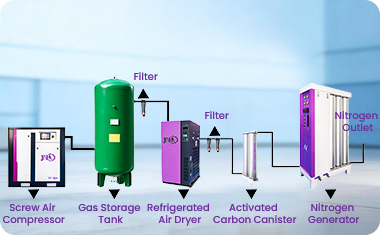
A complete gas supply chain is more than a single main unit. It consists of
air pretreatment units, separation hosts, buffer storage modules, monitoring and
control assemblies, and delivery pipelines. Ambient air is first compressed,
dried and filtered in multiple stages to remove moisture, oil mist and solid
particles. This prevents contaminants from entering the separation unit and
damaging the separation medium, which would shorten service life and compromise
gas quality. Treated clean compressed air flows into the separation device.
Through selected technical processes, nitrogen is separated from oxygen and
other impurity gases. Nitrogen meeting process specifications is then stabilized
in buffer tanks and delivered to different consumption points.
Three mainstream technical routes are pressure swing adsorption, membrane
separation and cryogenic air separation, suitable for different output capacity
and purity requirements. Membrane separation units feature simple structure,
convenient start-stop operation and low maintenance workload, suitable for
scenarios with moderate purity requirements and stable gas consumption. Pressure
swing adsorption solutions are widely adopted and capable of delivering
high-purity nitrogen, commonly used in sheet metal processing, electronic
packaging and lithium battery production. Cryogenic air separation equipment is
designed for large-flow and ultra-high-purity continuous production, with higher
overall investment. When selecting an industrial nitrogen generation system,
enterprises shall first sort out peak gas consumption, daily operation hours,
nitrogen purity and pressure requirements before confirming the technical
route.
Process differences across industries bring different configuration
requirements for gas production solutions. Food manufacturers use nitrogen for
modified atmosphere packaging to restrain microbial growth and extend shelf
life. Chemical plants apply nitrogen for tank blanketing and pipeline purging to
lower safety risks caused by contact between flammable materials and oxygen.
Laser processing and heat treatment rely on nitrogen to block oxygen and avoid
oxidation defects on workpieces. Electronic and photovoltaic industries demand
nitrogen with superior cleanliness to prevent defects of components under
high-temperature processing. Selection of an industrial nitrogen generation
system should not copy standard configurations. Additional components such as
fine filters, monitors and explosion-proof structures shall be arranged
according to industry standards.
Stable operation relies on regular maintenance. Operators need to inspect
inlet pressure, outlet purity, temperature and valve status during routine
checks. Purity analyzers should be calibrated periodically to ensure valid
readings. Filter elements, seals and adsorption media are consumables and need
inspection and replacement on schedule. Failure of upstream filters allows oil
and water to damage core separation materials and cause unstable gas supply.
Pipeline leakage inspection helps cut pressure loss and maintains steady
pressure when multiple stations consume gas at the same time. A proper
maintenance schedule extends the service life of an industrial nitrogen
generation system and reduces unplanned shutdowns.
Compared with purchased gas supply, on-site nitrogen production offers
better supply autonomy. Production will not be limited by delivery schedules and
transportation conditions, which suits factories with stable gas demand. During
evaluation, apart from initial investment, it is necessary to calculate
long-term power consumption, consumable and maintenance costs. Some solutions
carry low upfront cost yet consume more power, leading to higher cumulative
expenditure over years. When enquiring about an industrial nitrogen generation
system, buyers should assess total cost of ownership rather than only comparing
main unit prices.
Site conditions also need to be taken into account. Installation areas
require enough ventilation space and compliant power and drainage supplies.
Explosion-proof environments must meet relevant safety standards. Skid-mounted
integrated units are easy to install and commission, ideal for sites with
limited space and tight commissioning schedules. Split-type layout supports
later capacity expansion and fits factories with growing output.
Expandability of the gas system deserves attention as well. Many
enterprises adjust production capacity continuously. When planning an industrial
nitrogen generation system in the early stage, expansion interfaces can be
reserved. If gas demand rises later, output can be lifted by adding modules
instead of replacing the whole system. Proper gas system planning and consistent
maintenance keep nitrogen parameters matching production requirements steadily.
In this way, the advantages of on-site gas production can be fully utilized to
support smooth operation of all working procedures.