A large capacity PSA nitrogen generator is a large-scale on-site air
separation device based on pressure swing adsorption technology. Designed for
continuous high-volume industrial gas demand, a single unit can produce hundreds
to thousands of cubic meters of nitrogen per hour, replacing liquid nitrogen
storage tanks and bulk high-pressure cylinder central gas supply schemes.
Equipment selection for such large systems differs from small nitrogen
generators. It requires comprehensive evaluation of gas consumption load, air
source conditions, site layout, energy consumption and maintenance capacity. The
selection plan directly determines long-term operational stability and total
cost of ownership.
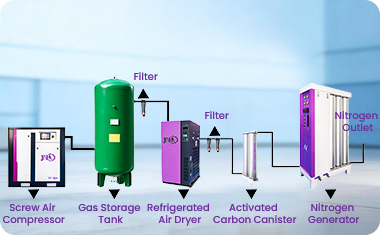
The large capacity PSA nitrogen generator achieves nitrogen-oxygen
separation via selective adsorption of carbon molecular sieves. Ambient air is
compressed by a large air compressor and sent to a pretreatment unit.
Multi-stage filters and refrigerated dryers remove dust, oil mist and moisture
from compressed air. Purified dry compressed air flows into two large adsorption
towers. Under pressurization, carbon molecular sieves capture oxygen from air
while nitrogen is enriched and delivered. After adsorption saturation, the
system automatically switches towers. Pressure reduction desorbs and releases
oxygen to regenerate molecular sieves. The two towers cycle alternately to
deliver non-stop gas production around the clock. Nitrogen purity can be
steadily maintained from 95% to 99.999% and fine-tuned online according to
process requirements. Large-capacity models feature bigger adsorption vessels
and sufficient molecular sieve loading, offering stronger tolerance to pressure
fluctuations and suitable for 24-hour continuous factory production.
The primary selection parameter is rated gas production capacity. Selection
should not depend merely on average gas flow. Peak gas consumption must also be
calculated. Instantaneous flow surges during production cause pressure drop in
gas pipelines. If equipment capacity only matches average flow, nitrogen purity
and outlet pressure will decline during peak demand. The general selection
principle is to reserve 10%~20% extra margin based on maximum peak consumption,
together with a large nitrogen buffer tank. The buffer tank smooths flow
fluctuations and reduces repeated pressure impact on adsorption towers,
protecting carbon molecular sieves. Factories with multiple production lines may
choose one large central unit or parallel redundant multi-unit configuration.
The advantage of parallel units is that remaining generators can keep supplying
gas during maintenance of one unit and avoid total plant shutdown.
Next, confirm nitrogen purity, outlet pressure and dew point. Higher purity
reduces the maximum achievable gas flow under the same equipment size. For the
same generator, lowering purity increases output capacity, while raising purity
requires reduced throughput. Therefore selection must balance purity and flow.
Avoid over-specifying ultra-high purity unnecessarily, which raises energy
consumption and equipment cost. Outlet pressure must account for pressure loss
across plant pipe networks and end-use equipment. Long-distance gas delivery
pipelines need extra margin for pressure drop. The dew point determines gas
dryness. Industries such as oil & gas, heat treatment and powder metallurgy
enforce strict dew point requirements and need deep drying components in the
pretreatment system.
The compressed air source and upstream compressor system are often
overlooked during selection. Large PSA nitrogen generators are highly sensitive
to compressed air quality. Excess oil, water and dust quickly poison carbon
molecular sieves. Before selection, evaluate the air compressor type; oil-free
or low-oil screw compressors are preferred. Also calculate required compressor
flow, which is normally 2 to 3 times the nitrogen output. If the existing
compressor system lacks capacity or sufficient purification, the pretreatment,
filtration and drying packages must be upgraded at the same time as nitrogen
generator selection. Otherwise molecular sieve service life will shorten sharply
and raise consumable replacement cost.
Site layout and supporting utilities are also included in evaluation. Large
capacity PSA nitrogen generators are heavy and bulky. A solid load-bearing
foundation is required, plus reserved maintenance access for later replacement
of molecular sieves, valves and filter cartridges. Outdoor installations need
extra protection from rain, frost, sunlight and heat dissipation. Indoor
installation must assess workshop ventilation and noise. Large compressors and
adsorption towers generate operational noise; acoustic enclosures may be
required. For electrical supply, high-power units require confirmation of plant
power capacity and voltage stability to support stable operation of PLC control
and pneumatic valve groups.
Energy consumption, maintenance and redundancy are long-term considerations
in selection. Large systems consume substantial energy, so specific energy
consumption per unit nitrogen should be checked. High-quality models optimize
adsorption timing and valve switching logic to cut air consumption. For
maintenance, evaluate spare part availability and prefer standardized models
with readily available valves, filters and molecular sieves. For
continuous-process industries such as chemical and new material production where
shutdown cannot be tolerated, redundant parallel configuration is recommended to
enable maintenance without stopping gas supply.
In industrial application selection, large capacity PSA nitrogen generators
are widely adopted in semiconductor, powder metallurgy, heat treatment, chemical
tank blanketing and lithium battery material production lines. Heat treatment
furnace protection and tank inert blanketing usually require moderate purity and
prioritize stable large-flow supply. Lithium and electronic material processes
demand strict controls over nitrogen purity, cleanliness and dew point,
requiring enhanced upstream purification systems.
Selecting a large capacity PSA nitrogen generator is a systematic project
rather than simple flow matching. Reasonable assessment of gas load, air source
quality and site conditions, together with consideration of peak margin, energy
consumption and maintenance scheme, helps select properly matched equipment.
Scientific selection ensures stable and continuous large-scale nitrogen supply,
reduces long-term operating costs and delivers reliable on-site gas solutions
for industrial production.