The assessment of investment for nitrogen generation equipment supporting
petrochemical facilities is an important task in pre-project planning, budget
estimation and long-term operation scheme formulation. Many projects, during the
evaluation stage, tend to focus only on the one-time expenditure at the
procurement stage while ignoring associated costs of supporting facilities,
operation and maintenance, energy consumption and other items throughout the
full lifecycle. This may lead to budget deviations in the early stage or
operating expenses exceeding expectations later on. To form an objective and
reasonable investment evaluation framework, it is necessary to move beyond
simply comparing quotations. A complete calculation logic can be established by
comprehensively sorting out various factors affecting overall expenditure from
multiple dimensions, including equipment configuration, working condition
adaptation, on-site supporting works, consumable consumption and lifecycle
performance.
First of all, the selection of process route fundamentally determines the
investment range. At present, mainstream industrial nitrogen generation
technologies include pressure swing adsorption, membrane separation and
cryogenic air separation. These three routes differ greatly in technical
principles, hardware composition, energy consumption, applicable production
capacity ranges and suitable petrochemical working conditions. Pressure swing
adsorption systems feature relatively compact structures, low infrastructure
requirements and flexible start-stop performance, suitable for
small-to-medium-scale and intermittent gas supply scenarios. Membrane separation
units occupy a small footprint, require fewer maintenance items and adapt well
to on-site installation conditions, fitting stable gas supply with medium purity
requirements. Cryogenic air separation applies to large-capacity, high-purity
continuous gas supply for major petrochemical installations. It delivers high
single-unit output yet demands higher upfront investment for hardware, civil
works and automatic control supporting systems, while additional refrigeration
systems raise complexity. Petrochemical sites feature complex media environments
with mandatory requirements for explosion protection, corrosion resistance and
stable continuous gas supply. Route selection should not be judged merely by
initial outlay priority. Matching gas consumption load, purity indicators and
continuous operation duration ensures that mismatched selection does not trigger
extra supplementary investment.
Secondly, customised configuration for working conditions acts as a key
variable affecting expenditure levels. There are obvious differences in hardware
standards between general standard models and customised versions for
petrochemical hazardous areas. Most petrochemical plant areas are classified as
hazardous zones. Equipment bodies, control cabinets, sensors, valves, motors and
other components must comply with corresponding explosion-proof specifications
and adopt explosion-certified parts, which changes procurement costs compared
with ordinary industrial models. Besides, the raw gas pretreatment unit cannot
be overlooked. Feed compressed air contains oil, moisture and dust. Humidity and
dust concentration in petrochemical zones are often relatively high. Simplified
pretreatment allows impurities to continuously invade core separation
assemblies, accelerating ageing and failure of adsorbents and hollow fibre
membranes, shortening replacement cycles of core components and pushing up
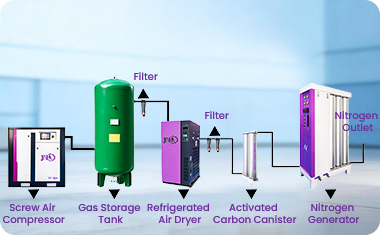
consumable expenses in later stages. Adding filters, refrigerated dryers and
adsorption drying devices according to raw air quality raises upfront investment
yet stabilises gas supply quality, extends the service life of core assemblies
and balances long-term expenditure. Gas pressure regulation, buffer tanks,
online monitoring instruments and remote signal docking modules also fall under
custom configuration. Selection depends on downstream process requirements for
pressure fluctuation control, purity stability and data uploading.
On-site supporting conditions also generate indirect expenses that are
frequently omitted during evaluation. After delivery, the equipment cannot be
put into operation simply by connecting the power supply. It also requires
supporting compressed air pipe networks, power supply circuits, earthing
systems, drainage pipelines and ventilation facilities. Wiring, cable trays and
earthing construction in explosion-proof zones follow special codes with
stricter standards than ordinary workshops. In terms of site layout, equipment
areas need reserved maintenance passages and ventilation space. Some large units
also require shock absorption foundations. If the existing compressed air system
in the plant lacks sufficient margin, capacity expansion of air compressors and
gas storage systems must be assessed accordingly. Such supporting works are not
covered in the equipment quotation but are indispensable for project delivery.
Failure to incorporate them into early calculations easily results in budget
gaps and delays commissioning.
Energy and consumable consumption constitute recurring operating costs and
account for a large share in long-cycle petrochemical projects. The main power
consumption of nitrogen generation equipment comes from upstream air
compressors, followed by automatic control systems and auxiliary power for
drying units. For the same rated nitrogen output, units adopting different
processes and supplied by different manufacturers show gaps in specific energy
consumption. Cumulative electricity charges become substantial after years of
continuous operation. In terms of consumables, pressure swing adsorption units
require regular replacement of adsorbents and filter cartridges. Membrane
separation systems need periodic filter component replacement and full membrane
module replacement at end-of-life. Cryogenic units involve regular replacement
of molecular sieves, seals and lubricants. Replacement cycles and unit prices
are directly linked to pretreatment configuration and raw air cleanliness. Some
projects cut costs by choosing simplified pretreatment at first, only to face
sharply rising consumable replacement frequency afterwards, leading to higher
overall long-term expenditure.
Operation and maintenance services, warranty packages and spare part
reserves should also be included in investment evaluation. Suppliers offer
different warranty durations and coverage scopes. Some packages only cover the
main host unit, while wearing parts such as filters, valves and sensors are
excluded. After expiry of basic warranty, annual maintenance can adopt on-site
inspection, remote monitoring or on-demand emergency service modes with
corresponding service charges. Most petrochemical installations run
continuously. Nitrogen supply interruption disturbs downstream reactions,
purging and shielding procedures and may even create process safety risks. Many
projects therefore maintain stocks of critical spare parts, which represent
another planned expenditure. Sound maintenance mechanisms reduce unplanned
shutdown probability and indirect losses caused by production stoppage. This
implicit value also deserves consideration in cost estimation.
Finally, residual value and upgrade potential over the equipment lifecycle
serve as auxiliary references. A properly matched nitrogen generation unit can
operate for many years under stable process conditions. Some models support
capacity expansion modification when plant output is adjusted, raising nitrogen
output by adding assemblies instead of full machine replacement and avoiding
large re-purchasing costs. By contrast, over-sized equipment selected with
excessive margin runs under low load for a long time, lifting specific energy
consumption and creating persistent energy waste.
In summary, investment assessment of nitrogen generation equipment for
petrochemical use is a comprehensive calculation covering upfront procurement,
supporting construction, energy consumption, consumables, maintenance and spare
parts. Scheme quality cannot be judged solely by initial quotation. Combining
explosion-proof codes for petrochemical zones, gas supply continuity, purity and
pressure requirements as well as project service life, short-term outlay and
recurring long-term consumption should be compared within one framework. This
helps select a scheme matching local working conditions with controllable
overall expenditure, ensures stable and reliable nitrogen supply and meets the
safe operation requirements of petrochemical installations.