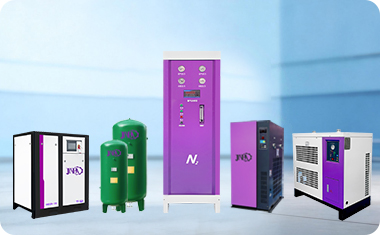
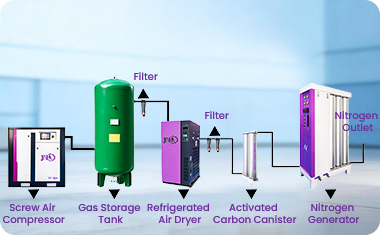
A split type nitrogen generation system adopts a modular separated layout,
distributing raw air pretreatment units, separation mainframes, buffer gas
storage units and automatic control assemblies across different zones within the
plant. It suits sites with limited space and scattered gas-consuming
workstations. In long-term operation, the whole system is exposed to compressed
air, moisture, oil mist, dust and corrosive substances in the ambient
environment. Material selection for each functional unit directly governs
equipment stability, service life, gas quality and long-term operation
expenditure. Material grade is not an isolated selection criterion. It must be
planned holistically according to medium characteristics, working pressure,
ambient temperature and humidity, explosion-proof and anti-corrosion
requirements. Differentiated material specification for individual sections
balances reliability, adaptability and overall investment.
Air pipelines form the fundamental carrier for medium transport, where rust
resistance, air tightness and cleanliness are primary considerations. Common
options include carbon steel, galvanized steel and stainless steel pipes. In
dry, clean indoor environments with fully deoiled and dried feed air, galvanized
tubing offers convenient fabrication and relatively low upfront cost.
Nevertheless, in high-humidity zones or locations with trace corrosive agents,
or processes requiring strict gas cleanliness, peeling galvanized layers
introduce particulate contaminants that damage downstream separation assemblies,
making stainless steel the preferred alternative. There are distinctions among
stainless steel grades. Grade 304 is widely used for general air transfer to
withstand routine moisture erosion; grade 316L is specified for coastal
salt-spray or petrochemical trace-corrosion environments, delivering superior
resistance to intergranular corrosion and preventing pitting leakage. Flanges,
fittings and gaskets must match the pipe material. Direct coupling of dissimilar
metals triggers galvanic corrosion and leakage risks.
Filter units serve as the first purification barrier. The material
combination of filter supports, housings and seals defines filtration
performance. Filter support frames are available in plastic, coated carbon steel
and stainless steel. Plastic frames are lightweight and economical for
low-pressure, ambient-temperature non-corrosive conditions yet prone to
deformation and ageing under heat. Coated carbon steel frames provide higher
rigidity and pressure tolerance, though rusting occurs once the coating is
scratched. Stainless steel supports maintain stable performance and are widely
used for precision pre-filters. Filter media are selected by intercepted
contaminants: glass fibre composite media for oil removal and polyester for dust
capture. Nitrile rubber is the standard seal material for compressed-air
applications with stable oil resistance. Fluororubber seals replace nitrile
rubber when acidic or alkaline vapours exist to prevent swelling and seal
failure. Filter housings also match working conditions: aluminium housings are
lightweight and dissipate heat well for small and medium filters, while large
high-pressure filter vessels adopt pressure-vessel-grade carbon steel with
internal anti-corrosion coatings.
The adsorption separation section is the core of the split system.
Materials for pressure vessel shells, tower linings, flow guides and adsorbent
support screens are critical. Adsorption towers for pressure swing adsorption
split nitrogen systems are manufactured from special pressure-vessel carbon
steel, subject to non-destructive testing, blast cleaning and specialised
internal anti-corrosion coatings to isolate moisture from steel substrates.
Stainless steel tower shells are specified for ultra-clean gas supply or
corrosive environments. Internal support screens and flow distribution plates
endure continuous airflow friction and granular adsorbent abrasion. Stainless
steel woven mesh or perforated plates are deployed for adequate wear resistance,
preventing screen rupture and adsorbent carry-over into downstream piping. Flow
guiding components avoid easily peeling coatings that shed debris into nitrogen
streams. Although adsorbents are functional media rather than structural
materials, stable internal construction prevents persistent impurity release and
preserves adsorbent performance.
Buffer storage tanks stabilise pressure and reserve gas, built to pressure
vessel standards. Carbon steel tanks are the most prevalent choice with internal
and external anti-corrosion treatment for conventional dry air and nitrogen
storage. Stainless steel tanks reduce recurring coating maintenance for outdoor,
humid or corrosive installations. Safety valves, pressure gauge ports and drain
connections must match the tank material. Internal coating quality demands close
attention; poor coating peels under airflow scouring and cyclic pressure
fluctuation, carrying particulates to downstream stations and disrupting
sensitive processes such as laser machining and inert shielding.
Valves and actuators regulate gas circuits remotely and switch flow paths.
Valve body materials include brass, aluminium alloy, carbon steel and stainless
steel. Brass bodies offer cost advantages for low-pressure branches, while
stainless steel is preferred for high-pressure or corrosive service. Internal
valve seals follow the same material logic as filter assemblies: nitrile rubber
for general service and fluororubber for elevated temperatures, trace oil or
corrosive vapours. Diaphragms and springs inside solenoid and pneumatic valves
are selected for medium compatibility, with stainless steel springs preventing
jamming from rust. Split layouts spread pipework and valve points widely.
Material incompatibility causes internal or external leakage, destabilising gas
pressure and wasting feed gas.
Enclosures for control systems, sensor housings and wiring components are
specified to match site protection classes. Standard indoor cabinets are
fabricated from powder-coated cold-rolled steel plate. Stainless steel control
cabinets are adopted for humid, dusty or explosion-proof zones for better dust
and corrosion resistance. Sensor probes for pressure and purity measurement
contact gas directly: grade 304 stainless steel for clean nitrogen and grade
316L for corrosive atmospheres. PVC cable conduits degrade rapidly outdoors or
in corrosive settings, replaced by stainless steel corrugated tubing. Many
breakdowns of split nitrogen systems originate not from the main separation unit
but from insufficient weathering resistance of electrical and sensing
accessories, causing signal drift and short circuits after prolonged
environmental exposure.
Beyond individual material grades, material compatibility deserves
attention. Direct contact between dissimilar metals induces galvanic corrosion
in moist media. Rubber seals incompatible with pipe or valve materials swell,
harden or crack. Split nitrogen systems cover dispersed locations with varied
micro-environments. A single poorly specified component can gradually compromise
the whole gas network. Higher-grade materials increase capital outlay and are
not universally necessary; selection should be guided by downstream process
requirements and site conditions.
In summary, material selection for a split type nitrogen generation system
is a coordinated engineering task covering pipelines, filter housings,
adsorption towers, storage vessels, valves and control accessories. Every
medium-contacting component, from raw air intake to nitrogen delivery at
dispersed consumption points, collectively determines corrosion resistance, gas
tightness, gas cleanliness and equipment lifespan. Rational material
specification based on operating conditions mitigates corrosion, rusting and
particulate contamination. This unlocks the core strengths of split layouts:
flexible piping and distributed gas supply, delivering consistent qualified
nitrogen to downstream processes and cutting cumulative costs from unplanned
maintenance and spare part replacement.