In precision manufacturing and analytical testing industries, trace
impurities may interfere with process results and affect product quality.
Therefore, stable and clean supply of inert gas serves as the foundation for
process execution. The traditional gas supply mode relying on purchased
cylinders has drawbacks such as complicated transportation and scheduling,
unstable supply continuity, and the risk of gas interruption during cylinder
replacement. Many enterprises have gradually adopted on-site gas generation
solutions, using integrated equipment to produce nitrogen that meets specified
indicators on location, catering to scenarios with strict control over oxygen,
moisture and hydrocarbon impurities.
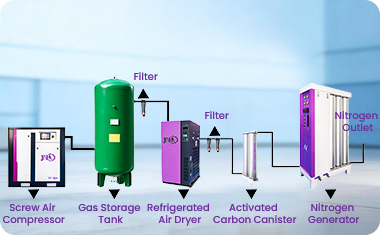
Such gas generation equipment operates through the coordination of air
pretreatment, separation and purification, and deep purification units. Based on
separation principles, it can be divided into pressure swing adsorption,
membrane separation, post-catalytic purification and other routes. Routes differ
greatly in achievable impurity control levels and stable flow ranges. Membrane
separation units feature simple structures and convenient maintenance, suitable
for working conditions with moderate purity requirements. Pressure swing
adsorption combined with multi-stage purification components can reduce trace
impurities such as oxygen and moisture to extremely low levels, fitting
semiconductor, precision instrument analysis, biomedicine and other scenarios
with strict gas index requirements. The whole system is usually equipped with
pre-filtration, drying and dewatering, and precision monitoring modules to
continuously track gas parameters and ensure stable output quality.
Different application scenarios prioritize different gas indicators. In
semiconductor and microelectronic processes, gas is used for wafer protection,
chamber purging and component packaging. Impurities including oxygen and
moisture may trigger oxidation and surface defects, directly lowering finished
product yield. In laboratory analysis, precision instruments such as gas
chromatographs and mass spectrometers are highly sensitive to carrier gas
cleanliness. Impurities cause baseline drift and extra interference peaks,
weakening the reliability of test data. In biomedicine, a clean inert atmosphere
is required for freeze-drying, raw material protection and sample transfer to
reduce material deterioration. For special materials and laser precision
machining, stable low-impurity gas helps reduce machining defects and ensures
consistent processing results.
During selection, purity alone cannot be the reference. Comprehensive
evaluation based on the whole gas supply system is required. First, sort out
continuous gas consumption flow, peak gas demand and allowable pressure
fluctuation range. Insufficient flow configuration leads to gas shortage, while
excessive redundancy increases energy consumption. Next, define impurity control
limits for oxygen content, dew point and total hydrocarbons, and select matching
purification processes. It is also necessary to assess the quality of front-end
compressed air supply. Excessive oil and moisture in the incoming air will
burden downstream purification units and shorten the service life of filter
elements and adsorption consumables. Site conditions including installation
space, ambient temperature and humidity, power supply and noise control
requirements should also be considered. Corresponding protective structures are
required for some explosion-prone areas. In addition, full-lifecycle cost should
be evaluated. Apart from equipment investment, consumable replacement, energy
consumption, regular calibration and maintenance affect long-term operating
expenditure.
After commissioning, standardized maintenance is critical to stable gas
quality. Daily inspections focus on monitored data including pressure, dew point
and oxygen content. Filter elements at all levels shall be replaced on schedule,
adsorption materials regenerated or renewed, and gas detectors calibrated
regularly to guarantee valid readings. Startup and shutdown must follow
operating procedures to avoid gas impact and overload operation. Operation logs
shall be kept to record parameter changes. When indicators deviate, check the
front-end gas source and purification components promptly to resolve risks in
advance and reduce disruptions to production and testing.
With continuous upgrades of precision machining and analytical testing
technologies, industrial standards for gas cleanliness keep rising. Featuring
flexible control and uninterrupted gas supply, on-site gas generation systems
have become a preferred gas source option for many high-precision processes.
Proper process matching and standardized maintenance enable steady output of
qualified gas, reduce reliance on externally supplied gas, and deliver reliable
gas support for diverse precision production and testing activities.