Cost evaluation of nitrogen generators for laser cutting is always deeply
tied to the requirements of cutting processes. Many processing enterprises tend
to look at equipment quotations in isolation during the planning stage, ignoring
the constraints imposed by process parameters on gas supply schemes. This leads
to mismatched configurations that fail to fit actual production conditions, or
unstable gas quality later on, undermining cutting results. To form a sound cost
judgment, it is necessary to start from the logic of laser cutting, sort out the
connections between gas supply indicators, gas consumption rhythm, supporting
pipelines and long-term operation and maintenance, and take process requirements
as the core benchmark for selection and cost estimation, instead of making
decisions based merely on price.
In laser cutting, nitrogen works as an auxiliary gas. Its process function
is to blow away molten slag and isolate ambient air, preventing oxidation and
dark discoloration on cut edges, delivering smooth kerf surfaces and reducing
secondary work such as grinding. Different material types and plate thicknesses
call for different nitrogen purity, pressure and flow rates. These process
indicators directly define the configuration of the nitrogen generator. Fine
cutting of thin stainless steel and aluminium alloy usually demands high
nitrogen purity and low tolerance to pressure fluctuation. Cutting thick plates
requires larger instantaneous gas flow and faster response together with stable
pressure buffering. If the output parameters of nitrogen supply fall below
process thresholds, even lower procurement cost will result in slag adhesion,
oxidised edges and forced reduction of cutting speed. Productivity drops and
rework losses accumulate, raising overall lifecycle expenditure.
Pressure swing adsorption and membrane separation are the two dominant
nitrogen generation processes for laser cutting. Their technical characteristics
suit different production patterns. Pressure swing adsorption separates oxygen
from nitrogen through alternating pressure cycles on molecular sieves. It
supports a wide adjustable purity range and stable high-purity output, fitting
workshops mainly processing stainless steel and high-alloy sheets with strict
edge-quality requirements. The system starts and stops flexibly and can adjust
load following intermittent gas demand of cutters, offering greater
energy-saving potential when multiple machines consume gas at staggered times.
Membrane separation relies on the permeability selectivity of hollow fibre
membranes. It has a compact layout with few moving parts and less maintenance,
suitable for stable continuous gas supply and routine thin-plate processing
requiring moderate purity. Neither process is universally superior; suitability
depends on workshop cutting layout, product mix and gas consumption habits.
Process matching is the foundation of cost performance.
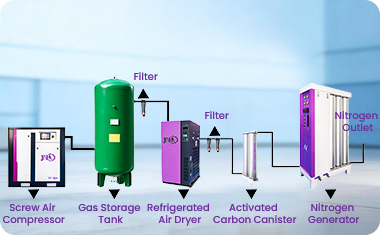
Raw air pretreatment is an easily overlooked link that directly determines
service life and gas supply stability. Nitrogen generators use compressed air as
feedstock, while air from compressors carries oil, moisture and solid dust.
Laser cutting workshops often contain cooling mist and cutting dust, creating
higher contamination risk than ordinary factories. Pretreatment generally
includes multi-stage filtration, refrigerated drying and adsorption drying,
removing impurities step by step. Simplified pretreatment allows oil and water
to invade molecular sieves or hollow fibre membranes, causing irreversible
contamination and premature degradation of core separation components. Although
simplified pretreatment reduces upfront spending, it shortens replacement cycles
for key consumables and triggers unplanned shutdowns that interrupt cutting
sequences. A well-designed pretreatment process uses modest early investment to
protect core assemblies, stabilise gas quality and maintain consistent cutting
performance.
Pressure stabilisation and buffering design are tailored to the consumption
rhythm of laser cutting. Nitrogen demand is not steady during cutting;
pulse-like flow surges occur during piercing, high-speed cutting and corner
transitions. Without properly sized buffer tanks, pressure regulating manifolds
and feedback control, pipeline pressure fluctuates sharply. Unstable blowing
force creates uneven kerf lines and fluctuating yield rates. This buffering
system covers tank sizing, pipe routing, online pressure monitoring and
variable-frequency linkage, sometimes with bypass reflux regulation to maintain
steady pressure at cutting heads. Buffering hardware adds cost, yet unlocks the
full capacity of the nitrogen unit and prevents mutual interference when
multiple laser cutters share one gas source, which is ideal for sheet-metal
workshops with clustered equipment.
Automatic control and monitoring systems integrated with production
processes also affect total expenditure. Modern gas supply systems track
nitrogen purity, pressure, flow and filter status. Some versions support linkage
with laser cutting machines, adjusting gas parameters automatically according to
cutting programs. Such process integration helps operators switch settings
quickly for different plate specifications, cutting trial-cut waste and the risk
of scrapping from incorrect parameters. Basic units only provide simple gauges
with lower upfront cost, but manual adjustment is required for every change in
material or thickness, relying heavily on operator experience. Cumulative
trial-cut losses can be substantial over time. Enterprises can select suitable
monitoring solutions based on product update frequency and workforce
capability.
Energy management defines recurring operating costs. Power consumption
mainly comes from upstream air compressors, followed by drying units and control
systems. For the same rated nitrogen output, energy consumption varies between
processes and control strategies. In pressure swing adsorption systems, energy
use rises sharply with higher purity requirements. Membrane separation maintains
relatively stable power draw and performs better at moderate purity levels. Many
workshops apply a single high-purity setting across all jobs, even for ordinary
carbon steel cutting that does not require such specifications, leading to
continuous energy waste. Process designs with separate pressure regulation and
grading purification deliver nitrogen at matching quality to different
workstations, supplying only what each process needs and cutting long-term
energy expenses.
Maintenance plans should also be arranged around production continuity.
Sheet-metal orders often have tight lead times, and gas supply outages halt
entire cutting lines. Maintenance covers periodic filter replacement, gas
quality testing, host servicing and predictive exchange of core components.
Service windows can be scheduled around shift patterns and order timetables to
avoid peak production hours. Some workshops keep backup gas sources or spare
modules as process safeguards. This reserve adds cost but avoids order delays
and losses caused by unexpected breakdowns.
In conclusion, the cost of nitrogen generators for laser cutting cannot be
calculated in isolation from cutting processes. Required purity, pressure, flow,
fluctuation characteristics, product mix and workshop layout together shape the
choice of process route, pretreatment scheme and stabilisation control
configuration. Only after clarifying internal processing requirements can
enterprises select matching gas supply solutions, balancing initial outlay,
energy consumption, consumables and shutdown risks. This approach delivers
controllable overall cost, reliable gas supply and sustained cutting quality and
productivity.