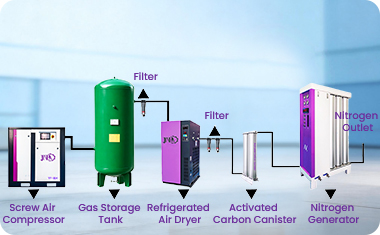
Carbon Molecular Sieve (CMS) is the core adsorption material of Pressure Swing Adsorption (PSA) nitrogen generators, which determines the nitrogen purity, production efficiency, and operational stability of the entire equipment. The CMS relies on the principle of differential adsorption rate to separate oxygen and nitrogen in compressed air, and long-term high-pressure alternating adsorption and desorption will lead to gradual performance attenuation. Regular replacement of carbon molecular sieves is the key maintenance measure to ensure the long-term stable operation of PSA nitrogen generators, and its replacement cycle is affected by equipment operating environment, air source quality, operating load, and daily maintenance level.
Under standard industrial operating conditions, the conventional replacement cycle of CMS for commercial PSA nitrogen generators is 3 to 5 years. For equipment operating 8 hours a day with stable and purified air sources, low humidity, and no oil pollution, the carbon molecular sieve can maintain stable adsorption performance for up to 5 years. The uniform particle size and complete pore structure of new CMS ensure efficient oxygen-nitrogen separation, maintaining nitrogen purity above 99.9%. With the extension of service time, the pore structure of CMS will be gradually blocked by oil stains, dust, and condensed water in the air source, and the adsorption capacity will decline, resulting in decreased nitrogen purity and reduced gas production, which cannot meet production requirements after long-term use.
Harsh operating environments and irregular maintenance will significantly shorten the CMS replacement cycle. If the equipment is operated in high-humidity, high-dust, or oil-polluted workshops for a long time, unpurified compressed air will directly erode the CMS. Oil pollution will cause irreversible pore blockage of the molecular sieve, and excessive moisture will reduce the adsorption selectivity, making the replacement cycle shortened to 2 to 3 years. In addition, long-term full-load operation, frequent start-stop of equipment, and failure to replace precision filters and cold dry machines on schedule will accelerate CMS aging and failure. For food-grade and high-purity nitrogen production equipment, the CMS attenuation standard is stricter, and early replacement is required once slight purity fluctuation occurs.
Judgment criteria for CMS failure and standardized replacement procedures are crucial for equipment operation. When the nitrogen generator shows problems such as unable to reach the set purity, obvious reduction in gas production, increased system pressure difference, and frequent equipment alarm, it indicates that the CMS has failed and needs to be replaced immediately. During replacement, it is necessary to completely clean the adsorption tower, remove residual invalid molecular sieves and impurities, and fill new CMS uniformly to avoid gaps and channeling. After replacement, pressure maintaining test and purity calibration must be carried out to ensure that the equipment returns to standard operating conditions. Scientific maintenance such as regular air source purification and filter replacement can effectively delay CMS aging and extend its service life.