A compact commercial nitrogen generator separates feed air to produce
nitrogen within limited footprint. However, sustained stable operation depends
on a set of baseline site conditions. In many applications, the separation
modules and control electronics remain intact, yet operators encounter purity
drift, flow reduction and erratic start-stop behaviour. Such issues most often
stem from site conditions falling outside design specifications. These
prerequisites cover feed air supply, ambient environment, power supply,
drainage, installation clearance and maintenance access. They should be verified
during project evaluation to avoid recurring performance troubles after
commissioning.
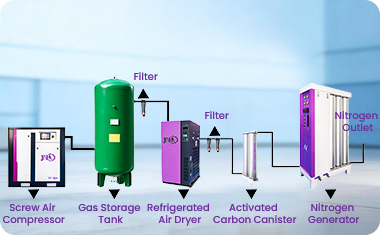
Feed compressed air stands as the primary prerequisite. The system relies
on clean compressed air as raw material. Inlet pressure must stay within the
rated operating window. Insufficient pressure reduces separation driving force
and cuts nitrogen output. Frequent large pressure swings subject adsorption or
membrane assemblies to unstable working states and cause repeated purity
deviations. Besides pressure, inlet cleanliness and dryness are critical. Oil
mist, dust and water vapour in compressed air gradually damage core separation
media. Without upstream filtration and drying pretreatment, contaminants build
up on carbon molecular sieves or hollow fibre membranes and trigger irreversible
efficiency loss. Inlet temperature must also stay within limits. Hot feed air
alters adsorption and permeation characteristics and disrupts separation
equilibrium.
Ambient conditions determine heat dissipation and component service life.
The unit contains valve manifolds, sensors, piping and heat dissipation
structures that release heat continuously during operation. The installation
zone requires adequate ventilation and should not be confined inside airtight
small enclosures. Excessively high ambient temperature and poor cooling raise
failure rates of valves and control components. Very low temperature may
condensate and freeze residual water in pipelines and block drainage routes.
Exposure to corrosive vapours, heavy dust and persistent condensation should be
avoided, as these accelerate corrosion of metal fittings and electrical contacts
and skew sensor readings. The floor should be flat and stable to minimise
vibration, which loosens connections and disturbs adsorbent packing inside
adsorption vessels.
Power supply reliability supports control and actuator functions. Control
boards, pressure transducers, solenoid valves and instruments require stable
voltage. Chronic undervoltage or wide fluctuations lead to inaccurate readings,
delayed valve response and unintended control triggers. Voltage stabilisation
and proper earthing are recommended to mitigate electrostatic and lightning
hazards. Dedicated wiring is preferred; sharing circuits with high-impulse loads
introduces voltage spikes that interfere with control logic. Emergency shutdown
sequencing must allow controlled depressurisation to prevent abnormal stress on
pressure-containing parts after power loss.
Drainage and piping arrangements are frequently overlooked. Condensate from
pretreatment must discharge freely. Blocked or elevated drain lines allow
backflow into downstream separation assemblies. Pipe sizes for feed air,
nitrogen outlet and vent lines should match design flow rates. Undersized piping
creates throttling pressure drop. Excessively long runs and numerous bends also
increase losses. Piping assemblies require leak testing after connection. Minor
steady leakage reduces effective output. If downstream consumers generate
backpressure, check-valve protection is needed to prevent reverse flow of
process gas into the generator.
Installation clearance and maintenance access facilitate future servicing.
Despite its compact layout, clearance must be reserved around the unit for
filter and desiccant replacement, sensor exchange and valve inspection. No stock
should block cooling air channels. Sampling ports are recommended for periodic
nitrogen purity testing to detect gradual performance degradation.
Supporting maintenance practices underpin long-term reliability. Operators
monitor and log pressure, dew point and purity trends. Consumable replacement
cycles adapt to feed-air quality; filters and drying media deplete faster where
air contamination is high.
In summary, the equipment itself is merely the gas-producing assembly.
Suitable supporting site conditions form the foundation for consistent qualified
nitrogen supply. Matching feed air, environment, power, drainage, piping and
maintenance arrangements to design limits reduces non-equipment faults and
sustains steady nitrogen output.