An affordable nitrogen generation system delivers on-site nitrogen supply
for small and medium gas consumption applications. Compared with purchased
bottled or liquid nitrogen, its core merit lies in cutting recurring gas supply
expenses. Most systems adopt membrane separation or simplified pressure swing
adsorption layouts, with streamlined automatic control, buffering and monitoring
assemblies to reduce upfront capital outlay. They fit processes such as food
packaging, light welding and basic purging where gas specifications are
moderately relaxed. Still, affordability comes with trade-offs. Operators must
balance capital cost, energy consumption, stability and maintenance workload
rationally instead of judging only by purchase price while ignoring
full-lifecycle expenditure.
Its most obvious advantage is lower entry barriers. Traditional cryogenic
air separation units demand heavy investment and large footprints for
high-volume continuous production. By contrast, affordable units are compact,
often integrated with air compressors and pre-filtration packages. Installation
and commissioning cycles are short without complicated civil works. For small
enterprises with volatile or non-round-the-clock nitrogen demand, the system
removes reliance on cylinder delivery scheduling, liquid nitrogen refilling and
empty cylinder exchange. Gas is generated on demand, and costs amortize over
stable operation periods. Membrane-based affordable designs have few moving
parts and simple routine maintenance limited to periodic filter replacement.
Simplified PSA variants use standardized adsorption tower modules and perform
adequately within moderate purity ranges.
The first major trade-off exists between purity and energy consumption. For
any given separation technology, higher nitrogen purity sharply raises
compressed air demand and power consumption per unit output. To keep prices low,
many affordable systems omit precise online oxygen monitoring and adaptive
pressure regulation, running at fixed conservative setpoints. Specifying purity
far above process requirements inflates ongoing electricity bills. Insufficient
purity margin, on the other hand, risks drifting out of specification under
fluctuating inlet humidity or pressure and hurting yield. Most blanketing and
protection applications work reliably at 99.5% to 99.9%, and ultra-high purity
needs are generally unsuitable for budget systems.
The second trade-off concerns reliability limits from simplified
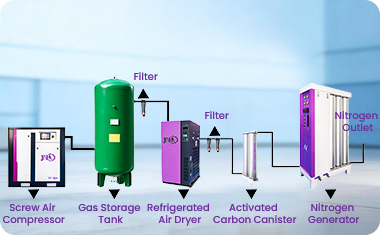
pre-treatment. Some low-cost packages cut back on dryers, oil removal and
multi-stage filtration to reduce selling price. Water vapor, oil aerosols and
dust in compressed air gradually degrade membrane elements or carbon molecular
sieve beds. Oil contamination permanently impairs membrane permeability.
Sustained moisture exposure causes sieve caking and falling output. Such
degradation progresses silently. By the time flow or purity degrades visibly,
core separation media often require replacement, and these consumable charges
erase the initial equipment savings. Affordable systems are not
maintenance-free. Consistent drain management and filter replacement are
mandatory to protect feed gas quality.
The third trade-off covers supply stability and redundancy. Budget units
commonly feature single towers or minimal modules, seldom with standby trains or
large buffer vessels. Peak draw, compressor cycling or sticking aged valves
trigger larger pressure and purity swings than premium equipment. They are not
ideal for processes requiring uninterrupted gas. If downtime cannot be
tolerated, extra buffer tanks or backup bottled nitrogen become necessary hidden
expenses that must be included in budgeting.
Suitability assessment goes beyond quotation comparison and calculates
total ownership cost covering power, filters, media replacement, spare parts and
outage losses. Affordable nitrogen generation works best for steady,
intermittent loads with moderate purity tolerance and basic maintenance
capacity. For high-purity, nonstop operation or poor incoming air quality,
forcing a low-cost solution leads to higher overall expense.
An affordable nitrogen generation system is an application-specific supply
option rather than a universal substitute. Prioritizing feed pre-treatment and
properly sized purity matching, instead of chasing the lowest equipment price,
keeps long-term gas expenditure predictable and strikes a practical balance
between economy and supply reliability.