PSA (Pressure Swing Adsorption) nitrogen generators are widely adopted in
industrial fields including electronic packaging, laser cutting, food
preservation and metal heat treatment as well as lithium battery production.
With continuous intelligent upgrading of factories, PSA nitrogen generators
equipped with remote control functions rely on PLC control systems and IoT
communication modules to realize remote status viewing, parameter adjustment,
fault alarm and start-stop operations. They help enterprises achieve unattended
gas supply management and reduce on-site manual inspection workload, making them
a preferred supporting gas supply solution for modern production lines.
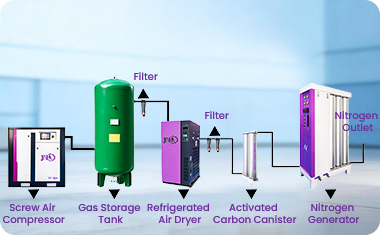
The basic nitrogen generation principle of remote control PSA nitrogen
generators remains the same as traditional PSA models. After being processed by
pre-filters and dryers, compressed air is delivered into adsorption towers
filled with carbon molecular sieves. Under pressurized conditions, oxygen in the
air is preferentially adsorbed while nitrogen is enriched for output. Two towers
alternate between adsorption and desorption regeneration to achieve continuous
gas production. Remote functions do not change the nitrogen generation process
itself. Instead, communication units are added to the original electric control
system to upload operating data to local host computers, cloud platforms, or
factory MES and DCS control systems. Operators can obtain full equipment
operating conditions remotely through computers, tablets or mobile
terminals.
The remote control system consists of hardware and software components. On
the hardware side, a PLC acts as the core controller, paired with various
sensors to collect key data in real time, including nitrogen purity, outlet
pressure, gas flow, adsorption tower pressure, inlet air temperature and valve
operating status. Communication modules support multiple industrial protocols
such as Modbus and TCP/IP, transmitting data via wired Ethernet or wireless
4G/WiFi. The software side includes local touchscreens, host monitoring software
and cloud management platforms. Basic versions only support remote data viewing
and fault alerts; advanced versions support remote start-stop, modification of
purity thresholds and pressure parameter setting. Some models even support
remote program upgrades. When detecting abnormal purity, pressure, excessive
filter pressure difference or valve failure, the system automatically pushes
alarm notifications and executes preset protection logic, such as automatic
venting of unqualified nitrogen and switching to a backup gas supply circuit,
preventing unqualified gas from entering production processes and causing
product rejection.
Remote control delivers multiple practical benefits. For large factories
with multiple workshops and several nitrogen generator units, operation and
maintenance staff can manage all equipment uniformly through a centralized
monitoring platform without traveling between workshops, greatly cutting
inspection workload. Some nitrogen generators are installed in harsh
environments where long-term human presence is inconvenient; remote monitoring
reduces personnel access to high-risk zones and improves operational safety.
When equipment malfunctions, maintenance personnel can read historical operating
curves before arriving on site to diagnose faults in advance and prepare
corresponding spare parts, shortening downtime for troubleshooting. The system
can also store long-term historical operating data for energy consumption
statistics, consumable life prediction and production traceability, facilitating
enterprise energy management and predictive maintenance. Maintenance can be
scheduled before failures such as molecular sieve deactivation or filter
blockage occur to prevent unexpected shutdowns.
During the selection phase, buyers need to comprehensively evaluate
communication stability, data security and function matching of the remote
control system. If only data collection and alarm notifications are required, a
basic remote monitoring version will suffice. If remote start-stop and parameter
modification are needed, priority should be given to verifying authority grading
functions to prevent unauthorized personnel from arbitrarily modifying process
parameters and affecting gas supply quality. The network scheme should also be
assessed according to factory conditions: wired industrial Ethernet offers
higher stability for permanent workshop deployment, while wireless modules are
suitable for scattered equipment with difficult wiring. Meanwhile, the
equipment’s security isolation design should be verified to ensure the
industrial intranet will not face cybersecurity risks caused by internet access.
Apart from the control system, core components of the equipment itself cannot be
overlooked. The quality of carbon molecular sieves, pneumatic valves and
pipeline filters directly determines gas production stability and service life.
The remote system serves only as an auxiliary management tool and cannot
compensate for defects in hardware.
Industries have different priorities for remote control PSA nitrogen
generators. High-precision manufacturing sectors such as semiconductors and
lithium batteries demand stable high-purity nitrogen and usually select models
capable of connecting to factory DCS or MES systems for full-plant automatic
linkage. Laser cutting and heat treatment factories pay more attention to
pressure fluctuation warnings and energy consumption statistics, while food
packaging focuses on gas supply continuity and abnormal alarms. Equipment
specifications range from small integrated units to large skid-mounted sets,
customizable according to on-site gas consumption, nitrogen purity and pressure
requirements. Upon equipment delivery, suppliers need to complete communication
commissioning and platform access, and train operation and maintenance personnel
on platform operation, alarm identification, authority management and network
fault diagnosis.
After commissioning, daily operation and maintenance cover two aspects:
maintenance of the nitrogen generator main unit and upkeep of the remote
communication system. For the main unit, air filter elements and activated
carbon filters are replaced regularly according to specifications, oxygen
content meters are calibrated, valve status is inspected, and carbon molecular
sieve performance is tested periodically. For the communication section, network
links should be checked regularly to ensure stable data upload, and account
authority management should be maintained. In case of offline disconnection,
lines, gateways or IoT modules must be inspected quickly to avoid loss of
equipment monitoring. It must be clarified that remote operation is an auxiliary
management method. Major overhauls and component replacement still require
on-site work and cannot be fully completed remotely.
Remote control PSA nitrogen generators represent an important direction for
intelligent upgrading of on-site industrial nitrogen generation systems. They
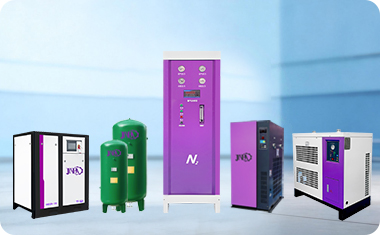
are not standalone devices and require supporting air compressors, refrigerated
dryers, precision filters and gas storage tanks to form a complete gas supply
system. Linkage logic of the whole system needs unified planning to realize
coordinated operation of air compressors, drying equipment and nitrogen
generator hosts. When selecting products, enterprises should not only focus on
remote functions, but comprehensively evaluate gas production performance,
energy consumption, hardware service life, communication reliability, data
security and after-sales maintenance capabilities. Properly configured remote
monitoring systems, paired with standardized predictive maintenance strategies,
can continuously deliver qualified nitrogen, reduce on-site staffing, lower
risks of unexpected shutdowns, stabilize factory production schedules and
optimize long-term gas costs.