The CMS Nitrogen Generator for Factory Use adopts Carbon Molecular Sieve
(CMS) together with PSA pressure swing adsorption technology. It directly
produces nitrogen from compressed air on factory sites. During procurement, many
factory managers tend to only compare quotations, ignoring the complete
manufacturing value behind the equipment. The value of an industrial-grade CMS
nitrogen generator lies in the full manufacturing chain: material selection,
core component processing, system integration, factory verification and
full-lifecycle after-sales service, rather than simple assembly of spare parts.
With refined manufacturing technology, premium CMS nitrogen generators deliver
four core values for factories: optimized production cost, upgraded
manufacturing quality, improved operational safety and reduced long-term
operational loss. It has become a preferred on-site gas supply solution for
sheet metal processing, heat treatment, food packaging, chemical industry,
lithium battery, electronics and other manufacturing sectors.
The primary manufacturing value of CMS nitrogen generators lies in the
selection and filling technology of carbon molecular sieves (CMS), the heart of
the machine, which directly determines gas production efficiency, purity
stability and overall service life. High-quality factory-use CMS nitrogen
generators adopt high-selectivity and high-mechanical-strength carbon molecular
sieve materials. The micropore size of raw materials is precisely controlled to
separate gas by the diffusion rate difference between oxygen and nitrogen
molecules. Under pressurization, oxygen molecules are adsorbed while nitrogen is
enriched. Oxygen is desorbed under pressure relief to regenerate the sieves. Two
adsorption towers work alternately to achieve uninterrupted nitrogen supply. In
manufacturing, molecular sieve filling is far more than simple pouring. It
adopts layered filling and mechanical constant-pressure compaction technology,
eliminating internal voids inside adsorption towers. This prevents mutual
friction and pulverization of molecular sieve particles under repeated pressure
fluctuation cycles, avoiding sieve failure and purity attenuation. Low-cost
simplified equipment uses rough manual filling without compaction and
shock-absorbing structures. After a period of operation, loose molecular sieve
bed generates plenty of dust which blocks pipelines and filters, leading to
rapid performance degradation and frequent shutdown maintenance. With superior
manufacturing craftsmanship, CMS molecular sieves can run stably for 5 to 8
years, greatly reducing the medium replacement cost for factories, forming the
first layer of long-term value brought by equipment manufacturing.
Secondly, the manufacturing process of the pre-treatment air purification
unit determines the protection level of CMS molecular sieves and constitutes a
critical part of manufacturing value. Factory environments are commonly filled
with dust, oil mist and water vapor. Once oil contaminants in compressed air
enter adsorption towers, they will cause permanent poisoning of CMS molecular
sieves, which cannot be regenerated. This is the leading cause of premature
scrapping of factory nitrogen generators. Premium factory CMS nitrogen
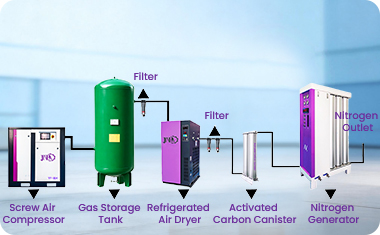
generators integrate a complete multi-stage air pre-treatment module during
manufacturing, including pre-filter, precision oil removal filter, activated
carbon filter and refrigerated dryer. Filter housings are integrally forged with
weld inspection for pressure resistance and corrosion resistance. Filter
elements adopt multi-layer composite filter materials with filtration accuracy
up to 0.01μm to continuously intercept oil mist, moisture and solid particles.
The whole pre-treatment system completes gas circuit matching and commissioning
before delivery to stabilize inlet air dew point and protect core CMS molecular
sieves from the source. Many low-cost assembled models simplify filtration units
and reduce filter stages. Although the initial purchase cost is low, they
quickly damage molecular sieves, forcing factories to bear high filler
replacement cost and production shutdown losses. Low manufacturing value leads
to higher overall lifecycle cost.
Thirdly, precision manufacturing of adsorption towers, program-controlled
valves and gas pipelines guarantees stable gas supply for continuous factory
production, serving as the hardware foundation of manufacturing value. As
pressure vessels, adsorption towers are manufactured in accordance with
industrial pressure vessel standards, going through steel plate rolling,
welding, flaw detection, hydraulic pressure test, internal and external
anti-corrosion spraying. They can withstand alternating pressure impact and
eliminate air leakage risks. Program-controlled solenoid valves are key
executive parts for tower switching. Factory CMS nitrogen generators adopt
dedicated high-cycle program-controlled valves. Valve bodies and seals are
treated with wear-resistant technology to sustain millions of switching cycles
and ensure accurate switching between adsorption and regeneration. For gas
pipelines, seamless stainless steel tubes are used. Pipeline layout is optimized
via fluid simulation to reduce gas flow resistance, improve nitrogen recovery
rate and cut air compressor energy consumption. Ordinary low-cost assembled
equipment uses general valves, thin steel plate tanks and normally welded
pipelines. Under frequent pressure fluctuation, valve leakage and tank corrosion
easily occur, triggering nitrogen purity fluctuation and gas supply
interruption. Once factory production lines stop due to nitrogen shortage, the
shutdown loss far exceeds the price difference of equipment. Sophisticated
hardware manufacturing enables 7×24 continuous operation, matching non-stop
factory production and avoiding production losses caused by shutdown.
Fourth, the R&D and manufacturing of integrated machines and
intelligent control systems bring digital management value for factories. As
modern factories move toward automation and digitalization, the control system
of CMS nitrogen generators is no longer limited to simple start-stop control.
Industrial models are equipped with customized PLC intelligent control systems,
embedded with high-precision sensors for pressure, purity, flow rate and dew
point. Sensors are multi-point calibrated before delivery to collect real-time
operating data and automatically adjust adsorption cycles to adapt to
fluctuating factory gas demand. The system increases gas output during peak
consumption and lowers load in off-peak hours to reduce unnecessary energy
consumption. It integrates fault early warning, filter element loss reminder and
purity interlock protection. It automatically alarms when gas source abnormality
or substandard purity occurs, and triggers interlock shutdown when necessary to
protect downstream production equipment. Some models support IoT remote access,
allowing factories to monitor equipment status on central control platforms and
implement predictive maintenance, transforming breakdown repair into proactive
maintenance. The R&D, calibration and testing of this intelligent control
system represent the software part of equipment manufacturing value. It helps
factories realize refined gas energy management and adapts to smart factory
construction.
Fifth, the full-condition factory inspection system acts as the final
guarantee of manufacturing value. After assembly, factory CMS nitrogen
generators will not be shipped directly. They go through standardized factory
test procedures: full air tightness inspection, 72-hour continuous full-load
operation test, multi-point calibration of nitrogen purity, simulated high and
low pressure test and fault interlock simulation test. Operating parameters of
every unit are recorded and filed to ensure stable production once the equipment
arrives on site. In contrast, simple assembly factories only perform basic
power-on and gas production tests without standardized calibration. After
delivery, equipment easily suffers parameter drift and mismatched working
conditions, resulting in lengthy on-site commissioning and delayed factory
production. Complete factory verification solves potential problems at the
manufacturing stage, reduces on-site debugging risks and guarantees scheduled
production startup.
Evaluating CMS factory nitrogen generators from manufacturing value
perspective, procurement cost is only the tip of the iceberg. Equipment
manufacturing technology determines long-term energy consumption, consumable
loss, shutdown frequency and production stability. Purchasing liquid nitrogen or
bottled nitrogen brings continuous high transportation cost, gasification loss
and safety hazards of high-pressure cylinder storage. High-quality CMS nitrogen
generators, built on mature manufacturing systems, produce nitrogen on demand on
factory sites, consuming only compressed air and a small amount of electric
power, greatly cutting long-term gas cost. Meanwhile, nitrogen purity can be
customized from 95% to 99.999%, meeting diversified factory process requirements
such as heat treatment protection, food modified atmosphere packaging, chemical
inerting, laser auxiliary cutting and electronic soldering protection.
Against the backdrop of cost reduction, efficiency improvement and green
production transformation in manufacturing, factories should move beyond simple
price comparison when selecting CMS carbon molecular sieve nitrogen generators.
They need to assess the whole manufacturing value system behind the equipment.
Superior manufacturing technology extends the service life of core CMS molecular
sieves, reduces energy consumption and maintenance loss, ensures stable gas
supply and avoids production interruption risks, bringing multiple long-term
benefits including economy, process optimization and safety. A high-value CMS
nitrogen generator is not merely gas production hardware, but a stable and
reliable on-site gas supply solution integrated into factory production systems,
continuously empowering factories to achieve production quality improvement,
cost reduction and green upgrading.