Widely applied in industrial processing, food packaging, oil and gas
exploitation, laser welding and other fields, mobile nitrogen generators have
gradually replaced traditional bottled nitrogen due to their advantages of
flexible portability, on-demand nitrogen production and no need for cylinder
nitrogen storage, becoming core equipment for small and medium-sized enterprises
and field operation scenarios. Equipment cost is the top concern for most
purchasers. The market price of mobile nitrogen generators varies greatly,
ranging from low-cost entry-level models to high-end industrial units worth
hundreds of thousands of US dollars. The huge price gap stems from
differentiated equipment configurations, performance parameters, technical
processes and supporting services. This article comprehensively analyzes the
cost composition, price range and core influencing factors of mobile nitrogen
generators, providing accurate cost reference for enterprise procurement.
The market price of mobile nitrogen generators is graded clearly to meet
the budget demands of different scenarios. Entry-level lightweight portable
models are designed for laboratories, small-scale laser welding, small-batch
food preservation and other low-demand scenarios, priced at approximately $1,300
to $6,500. Featuring small nitrogen production capacity and a nitrogen purity of
95%-99.5%, these models with complete basic functions deliver high cost
performance, ideal for start-ups and small workstations. Mid-range mainstream
industrial models suit continuous operation of small and medium-sized factories,
field mobile construction, chemical auxiliary nitrogen production and other
scenarios, with prices ranging from $10,000 to $50,000. Adopting mature PSA
pressure swing adsorption technology, they achieve a nitrogen purity of
99.99%-99.999%, equipped with intelligent control systems and stable drying
modules for lower energy consumption and higher stability. High-end large-scale
skid-mounted mobile models are tailored for harsh scenarios such as oil and gas
drilling, large-scale industrial explosion-proof operation and high-precision
electronic manufacturing, costing $50,000 to $200,000. They support high-flow
nitrogen production and are fitted with imported adsorption components,
explosion-proof systems and remote operation and maintenance functions to adapt
to severe field working conditions.
Nitrogen purity and production flow are the primary factors determining the
core cost of mobile nitrogen generators and the main cause of price differences.
Every upgrade in nitrogen purity raises higher requirements for adsorption
molecular sieves, filtration systems and purification devices, greatly
increasing production costs. Ordinary models with 99.5% purity only require
basic adsorption components, while high-purity models with 99.999% purity need
multi-stage purification and precision filtration equipment, doubling the cost
of core accessories. Meanwhile, a higher hourly nitrogen production flow
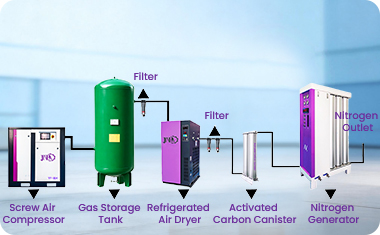
requires larger specifications for air compressors, gas storage tanks and
separation modules, as well as stronger fuselage materials and heat dissipation
systems, directly driving up equipment prices.
In addition, core processes and accessory quality significantly affect
equipment pricing. PSA pressure swing adsorption models dominate the market with
high cost performance and wide applicability. Membrane separation models feature
simpler structures and smaller sizes but limited high-purity nitrogen production
capacity, priced slightly lower than equivalent PSA models. High-end models
equipped with imported molecular sieves, Siemens PLC intelligent control systems
and low-dew-point dryers offer better stability, longer service life and lower
energy consumption than ordinary domestic accessories, with correspondingly
higher procurement costs. Customized models with explosion-proof, mute, remote
monitoring and automatic start-stop functions cost 20%-40% more than standard
models.
Hidden operating costs, easily overlooked by purchasers, are critical for
long-term cost control. The long-term costs of mobile nitrogen generators mainly
include energy consumption, maintenance and accessory replacement. Low-cost
entry-level models have high energy consumption, resulting in high electricity
fees during long-term continuous operation. Their low-quality molecular sieves
and filter elements wear out quickly and require frequent replacement, and the
additional labor and maintenance costs make their overall long-term expense much
higher than energy-saving high-end models. In contrast, although mid-to-high-end
energy-saving models have higher upfront procurement costs, they feature low
energy consumption, durable accessories and low failure rates, greatly reducing
long-term operating costs and delivering better comprehensive cost performance
within 3-5 years of use.
Furthermore, brand after-sales service, certification qualifications and
customized demands also slightly affect equipment prices. First-tier brand
equipment undergoes strict quality inspection and provides comprehensive
after-sales services including on-site installation, commissioning and lifelong
maintenance. Priced slightly higher than unknown generic brands, they
effectively avoid risks of equipment failure shutdown and absent after-sales
support. Models with CE explosion-proof certification and industrial safety
qualifications support wider application scenarios and come with relatively
higher pricing. Customized models for special working conditions such as high
pressure, low temperature and ultra-quiet operation will generate extra costs
based on customization difficulty.
Enterprises should avoid blindly pursuing ultra-low prices or
over-configured equipment and select models according to actual working
conditions. For low-frequency small-scale operation scenarios, entry-level
portable models are preferred to control procurement costs. For continuous
industrial operation and high-purity nitrogen demand scenarios, mid-range
energy-saving and stable models are optimal to balance procurement and operating
costs. For harsh field and high-precision industrial scenarios, high-end
customized models can be adopted as needed. Comprehensive consideration of
procurement price, energy consumption cost, maintenance cost and after-sales
guarantee helps achieve optimal overall costs and avoid resource waste caused by
blind procurement.