As a common inert medium in the industrial sector, nitrogen is widely used
in material heat treatment, chemical tank blanketing, modified atmosphere food
packaging, electronic soldering, laser processing and other scenarios. It
isolates oxygen to reduce risks of oxidation and combustion, and maintains
stable product quality. For a long time, many manufacturers rely on purchased
cylinder nitrogen or liquid nitrogen delivered by tank trucks to meet gas
demands. This supply mode has obvious limitations. Gas delivery is affected by
logistics and inventory scheduling, and the overall cost will gradually rise
under continuous gas consumption. Pressure swing adsorption nitrogen units adopt
air separation technology to produce nitrogen on-site directly from compressed
air, offering a feasible way for factories to build independent inert gas
sources.
Pressure swing adsorption technology separates gas by virtue of the
differentiated adsorption properties of carbon molecular sieves toward oxygen
and nitrogen. Clean compressed air, after pretreatment to remove oil, moisture
and solid impurities, flows into adsorption towers. Under pressurized
conditions, the molecular sieve preferentially adsorbs oxygen in the air, and
concentrated nitrogen is delivered outward. Two sets of adsorption towers
alternate between adsorption, pressure relief and regeneration to realize
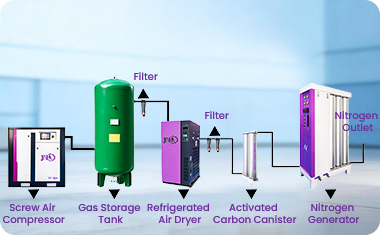
continuous gas production. A complete system generally consists of an air
pretreatment unit, main adsorption separation body, pressure stabilizing buffer
tank, online monitoring components and an automatic control module. It can
steadily output nitrogen with specified purity and pressure according to process
requirements, with purity ranging from 95% to 99.999%, matching process
standards of different industries.
Industries vary in nitrogen parameter requirements. In heat treatment of
metals, nitrogen acts as protective gas to prevent oxidative decarburization on
workpiece surfaces. Tank blanketing for chemical storage tanks and reactors
focuses on controlling oxygen concentration inside vessels to avoid accumulation
of combustible media. In food packaging, nitrogen displaces oxygen inside
packages to slow down lipid oxidation and microbial reproduction. The reflow
soldering and encapsulation of electronic components rely on low-oxygen
environments to protect solder pads and precision devices. For laser cutting,
high-purity nitrogen reduces oxidative slagging on cutting sections and improves
surface finish. During selection, excessively high purity should not be pursued
blindly. Higher purity will raise energy consumption per unit gas output.
Reasonable parameters shall be determined according to process documents to
balance technical needs and long-term energy costs.
Compared with purchased gas sources, on-site nitrogen generation units have
advantages for continuous and stable gas consumption. Once connected to
compressed air and power supply circuits, the equipment generates nitrogen
continuously, lowering reliance on external gas suppliers and avoiding
production shutdown caused by transport restrictions or gas supply interruption.
For production sites with year-round gas demand, extra expenses such as liquid
nitrogen volatilization loss, round-trip cylinder transportation and regular
cylinder inspection can be saved. The modular skid-mounted structure features
flexible layout. The unit can be arranged near gas consumption points to shorten
pipelines and reduce pressure loss during gas transmission. The matched
automatic control system supports unattended operation, monitors key indicators
such as oxygen content and pressure in real time, and sends alerts promptly
under abnormal conditions to ease on-site maintenance workload.
At the preliminary communication stage, both parties need to fully exchange
working condition information. Apart from nitrogen purity, peak flow rate and
continuous supply duration, it is necessary to confirm the quality of on-site
compressed air, ambient temperature, installation space and power supply
specifications. Some scenarios require explosion-proof or anti-corrosion
configurations, which shall be reflected in equipment electrical and structural
design. Before delivery, both sides can confirm testing plans, acceptance
criteria, spare parts lists and maintenance schedules. Filter elements and
carbon molecular sieves are consumables with fixed service life. Standardized
periodic maintenance is the foundation for stable equipment operation. The
pretreatment effect of compressed air directly affects the service life of
molecular sieves, which is often overlooked in daily maintenance.
Safety control is also essential. Nitrogen is an inert gas. Mass release in
enclosed spaces may lead to oxygen deficiency hazards. On-site operations shall
be equipped with oxygen monitoring alarms, ventilation facilities and work
approval procedures. Pipelines and pressure vessels need regular inspection for
leakage risks in accordance with regulations. System interlock thresholds shall
be set properly based on on-site risk levels, and alerts will be triggered once
pressure or oxygen readings exceed limits.
In general, pressure swing adsorption nitrogen units are not suitable for
every gas usage scenario. Purchased cylinder nitrogen remains flexible for
occasional projects with low consumption. For factories with continuous
production and stable gas demand, however, such units can build an independently
controllable inert gas source. It balances process safety, supply stability and
long-term operating economy, making it a technical solution worthy of
comprehensive evaluation during industrial gas supply planning.