For non-stop production scenarios such as metallurgical heat treatment,
laser cutting, electronic packaging and chemical inert protection, stable gas
supply 24/7 is the bottom line of production. Continuous duty nitrogen
generators have become standard equipment for many manufacturers. Most
purchasers tend to simply compare equipment quotations during selection, yet
ignore the comprehensive cost differences under continuous operation conditions.
As a result, they often encounter awkward situations: low-priced equipment
brings high long-term power consumption, frequent maintenance and heavy losses
caused by shutdowns. To rationally evaluate investment value, enterprises must
abandon the mindset of focusing merely on upfront purchase cost and calculate
full lifecycle costs comprehensively.
The overall costs of continuous duty nitrogen generators fall into four
major categories: initial investment cost, energy consumption and operation
cost, daily maintenance cost, and implicit production shutdown risk cost.
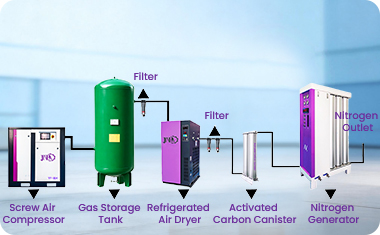
Initial investment covers the main unit, air pretreatment system, pipelines,
control system, installation and commissioning fees. For equipment with the same
nitrogen output, market prices vary widely. The core differentiators include
molecular sieve quality, durability grade of valve sets, overall heat
dissipation structure and intelligent energy-saving control system. Models
designed for continuous operation must adopt a twin-tower alternating adsorption
structure to guarantee uninterrupted nitrogen supply. Although ordinary
intermittent models are cheaper, long-term full-load continuous operation will
accelerate component aging, making them unsuitable for non-stop production
lines.
Energy consumption accounts for the longest-term expenditure of continuous
duty nitrogen generators and serves as the key factor widening gaps in
comprehensive costs. Equipment running continuously usually operates 7,000 to
8,500 hours per year, and power expenses often exceed the equipment purchase
cost. High-quality units optimize airflow circulation and compressed air
consumption to reduce the load of matching air compressors. Outdated or low-spec
equipment features low air utilization rate and keeps increasing power
consumption. Many enterprises purchase low-cost models, and extra electricity
bills within just two to three years offset the price difference. Meanwhile,
nitrogen purity directly affects energy consumption. Matching purity parameters
reasonably to meet process requirements and avoiding excessive ultra-high purity
demand is an effective way to control gas costs.
Maintenance costs cannot be overlooked either. Uninterrupted continuous
operation means valves, filters and adsorption components work under cyclic
conditions all year round. High-grade continuous duty nitrogen generators are
equipped with longer-lasting spare parts, featuring extended replacement cycles
for filter elements and seals, so annual maintenance expenses remain stable and
controllable. Cost-effective entry-level equipment suffers insufficient
durability of components, requiring frequent consumable replacement. Coupled
with labor costs from repeated repairs, operating expenses keep rising.
Authorized manufacturers provide standardized maintenance plans to extend
molecular sieve service life and lower major overhaul risks. In contrast,
equipment without consistent technical support bears unpredictable long-term
repair costs.
The implicit cost triggered by gas supply interruption is most easily
ignored by enterprises. For factories with continuous assembly lines, sudden
nitrogen generator breakdown and gas cut-off may lead to workpiece oxidation,
mass product rejection and production line shutdown. Continuous-duty models are
engineered with enhanced stability redundancy and equipped with real-time
monitoring and fault early warning systems to minimize unexpected shutdown
risks. If equipment incapable of long-term continuous operation is adopted,
economic losses from a single shutdown may far exceed the equipment price gap.
Compared with purchasing bottled nitrogen or liquid nitrogen, on-site continuous
nitrogen production eliminates extra expenses including cylinder transportation,
tank rental, liquid nitrogen boil-off loss and fluctuating delivery prices,
delivering prominent long-term economic advantages.
When planning gas supply solutions, enterprises should build a full
lifecycle cost evaluation model and calculate the payback period based on actual
nitrogen demand, required purity and annual operating hours. Equipment unit
price should never be the sole decision-making factor. Industrial nitrogen
generators optimized for continuous working conditions are preferred.
Professional suppliers can customize solutions according to on-site working
conditions, accurately match nitrogen output and energy consumption, and balance
upfront investment and long-term operating expenses.
In short, continuous duty nitrogen generator cost is essentially a
long-term cost trade-off. Upfront purchase cost is only the starting point.
Sustained energy consumption, maintenance investment and production stability
jointly determine total expenditures over a ten-year cycle. Selecting
high-efficiency, highly stable nitrogen generators adapted to continuous
operating conditions is the optimal solution for manufacturing enterprises to
secure stable gas supply and continuously cut production costs.