Membrane nitrogen generators rely on hollow fibre polymer membranes to
separate oxygen from nitrogen. Dustproof structural design builds graded
protective enclosures within the equipment frame to block solid particulate
contaminants from reaching core membrane modules, while maintaining proper air
distribution, pressure stability and service accessibility. Premature failure of
many membrane separation units is not caused by intrinsic membrane degradation,
but by fine dust carried by airflow depositing on fibre surfaces and blocking
gas permeation channels, which gradually reduces separation efficiency. A
well-designed dustproof structure is more than a simple sealed outer casing. It
forms a continuous graded protection system covering upstream pretreatment,
cabinet chambers, flow passages, membrane supports and outlet sampling
ports.
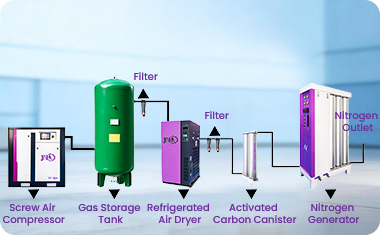
The pretreatment module acts as the first dust defence barrier at the air
inlet, integrating multi-stage filters, buffer chambers and differential
pressure monitoring ports. Primary coarse filtration captures large debris, rust
and chips, while downstream fine filters intercept fine dust particles. Filter
cartridges are enclosed in independent sealed housings with flow-oriented
layouts to prevent localized breakthrough. Access panels allow filter
replacement, and differential pressure taps indicate clogging status. This
module is isolated from the main chamber; cleaned feed air then travels to the
membrane assembly, cutting dust ingress at the source. For heavily dust-laden
feed streams, cyclone pre-separation can be added to remove heavier particles by
centrifugal force and reduce loading on fine filters.
The main cabinet and compartment dividers form the structural backbone of
dust protection. The cabinet is generally a sealed sheet-metal assembly fitted
with gaskets along seams to limit ingress of ambient airborne dust. Instead of
one large open plenum, internal baffles create separate zones for inlet
distribution, membrane mounting, vent discharge and control electronics.
Segmentation prevents venting airflow from stirring settled dust inside the
cabinet and recontaminating fibres. Inspection hatches, instrument penetrations
and cable glands are fitted with sealed covers. Seals must be restored after
servicing to avoid continuous dust accumulation. The cabinet also incorporates
thermal management features, balancing dust tightness with heat dissipation to
prevent trapped heat from accelerating membrane ageing.
Membrane assembly housings and mounting supports are central to dust
protection. Hollow fibre bundles are potted with resin at both ends inside
pressure vessels. The potting medium segregates gas paths: compressed air flows
inside fibres while permeate exits the shell side, and it blocks dust from
entering gaps between fibres. Membrane vessels are suspended on supports, offset
from the cabinet base so settled dust on the floor cannot contact the membrane
shell. Supports leave sedimentation space; a small fraction of residual fine
particles settles in dedicated collection zones rather than on fibre surfaces.
Clean-out ports at sediment zones enable periodic purging to prevent
re-entrainment by fluctuating airflow.
Flow distributors and guide piping prevent concentrated dust impingement on
local fibre sections. Inlet splitters spread compressed air evenly across
membrane modules, avoiding high-speed jets that erode potting layers or filter
surfaces. Piping minimizes dead legs, where dust accumulates and can be swept
back into modules during pressure transients. Vent lines discharge directly
outside the unit without recirculating back into the membrane chamber,
eliminating internal re-circulation of captured particles. Pipe joints are fully
sealed and, where possible, positioned outside process chambers for
inspection.
Control and instrument hardware is housed in a separate dust-tight
compartment. Pressure transducers, solenoid valves, flow transmitters and
control boards are isolated from process air chambers. Dust deposits on
electrical contacts and circuit boards cause signal drift and intermittent
faults. The isolated compartment shields electronics from process-side
contamination, and cable entries are sealed with cable glands. A separate
service hatch permits electrical maintenance without breaking the dust seal
around the membrane zone.
Outlet and sampling hardware are also included in dust protection planning.
A secondary guard screen at the nitrogen outlet stops accidentally resuspended
particles from travelling downstream. Sampling ports are fitted with sealing
caps, normally closed to prevent reverse ingress of environmental dust. Seals
and filter elements are consumables designed for straightforward replacement,
with service routes arranged to avoid breaking the overall dust barrier
unnecessarily.
The core design challenge lies in reconciling competing requirements:
sealing against dust while keeping flow resistance low; enclosing chambers to
block ingress while preserving access for inspection, purging and part
replacement. Excessive sealing causes poor heat dissipation and trapped dust;
minimal enclosure fails to provide sustained particle containment.
In summary, the dustproof nitrogen membrane generator adopts a layered
protective architecture. Upstream filtration, compartmentalized chambers, potted
membrane vessels, guided piping and isolated electrical enclosures all work
together to intercept, separate and settle particulates. This graded containment
reduces dust exposure to hollow fibres, slows performance decay of membrane
modules and extends the reliable operating life of the complete system.