The metal heat treatment industry widely uses nitrogen as protective
atmosphere for processes including annealing, quenching, brazing and powder
metallurgy sintering. It prevents oxidation and decarburization of workpieces
under high temperature and ensures surface quality of metal parts. Nitrogen
generators for heat treatment produce nitrogen on-site inside factories and
replace purchased bottled nitrogen and liquid nitrogen. When evaluating heat
treatment nitrogen generator cost, buyers should not only compare equipment
purchase prices, but calculate comprehensive expenditure across the whole
lifecycle, including initial investment, energy consumption, consumables,
maintenance, spare parts and downtime losses, to judge the economic benefits of
on-site nitrogen generation.
Heat treatment processes impose specific requirements on nitrogen
indicators. The purity and flow demand corresponding to different processes
directly affect system configuration and overall cost. For ordinary annealing,
nitrogen purity of around 99.9% is generally sufficient; precision brazing and
bright quenching often require nitrogen purity of 99.99% or higher. Continuous
heat treatment lines for large workpieces demand stable large-flow gas supply,
while batch furnace production sees pulsating and fluctuating gas consumption.
PSA (Pressure Swing Adsorption) technology is the most commonly adopted option
for heat treatment applications, featuring flexible configuration and convenient
start-stop to fit gas consumption characteristics of most heat treatment
furnaces. Membrane nitrogen generation suits scenarios with moderate purity
requirements and stable gas demand. Cryogenic air separation is intended for
ultra-large factories requiring huge flow and non-stop long-term gas supply with
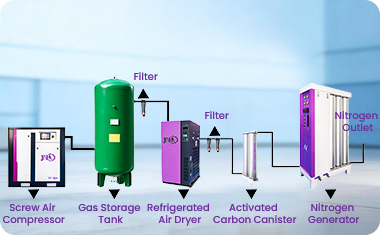
relatively higher upfront investment. Apart from the nitrogen generator main
unit, the complete system includes air pretreatment units, gas storage buffer
tanks, pipelines, valves and monitoring instruments. Some projects also require
supporting nitrogen boosters and post-purification devices; each component
contributes to overall cost.
Heat treatment nitrogen generator cost falls into two major categories:
one-off initial investment and recurring operating expenses. Initial investment
covers nitrogen generation mainframe, air compressor, dryer, filters, gas
storage tanks, pipeline installation, instruments, electric control systems,
on-site commissioning and engineering construction. Integrated skid-mounted
units are pre-assembled at factory, reducing on-site construction and
commissioning costs. Large split-type units require heavy on-site piping and
electrical work, leading to higher civil engineering and installation expenses.
Higher purity requirements demand better-equipped purification modules and
precision instruments such as online oxygen analyzers, raising equipment
procurement prices. Larger gas flow increases the size of adsorption towers,
molecular sieves and valves, pushing up mainframe cost. Meanwhile, automation
configurations, remote monitoring and interlock protection functions add certain
cost increments, suitable for continuous heat treatment production lines aiming
to cut on-site attendance and guarantee stable gas supply.
Recurring operating costs account for the largest long-term expenditure in
heat treatment workshops, mainly consisting of electricity, consumable
replacement, maintenance labor and spare parts procurement. On-site nitrogen
generation relies on air compressors to compress air, and power consumption
forms the core of operating costs. Oversized flow margin selected during
equipment procurement causes compressors to run under low load for extended
periods, wasting power and increasing long-term electricity bills. Carbon
molecular sieves, air filter cartridges, activated carbon filters, seals and
pneumatic valves are consumables requiring periodic replacement. Heat treatment
workshops contain high levels of dust and metal oxide particulates, accelerating
wear of inlet filters compared with ordinary workshops and shortening filter
replacement cycles, thus increasing consumable expenses. Routine maintenance
covers regular inspection, instrument calibration and component overhaul. As
equipment ages, wearing parts such as pneumatic valves and sensors degrade
faster, gradually raising spare parts expenditure. If equipment failure triggers
shutdown of heat treatment furnaces, indirect losses from scrapped workpieces
and halted production often far exceed maintenance fees, such hidden costs must
be considered during solution evaluation.
During selection, buyers should match equipment specifications properly
according to heat treatment process parameters to avoid unnecessary cost
increases caused by over-specification. Many enterprises blindly select
ultra-high purity models even though their processes only require medium-purity
nitrogen, resulting in double waste of procurement budget and energy
consumption. First, calculate peak gas flow, average flow rate, nitrogen purity
and supply pressure for single or multiple heat treatment furnaces, distinguish
continuous and intermittent gas usage to define rated gas production capacity.
Properly configured buffer gas tanks smooth flow fluctuations caused by pulsed
gas consumption of furnaces, allowing smaller mainframe sizing and cutting
initial investment and energy consumption. It is also necessary to assess
workshop environmental conditions. Heat treatment workshops feature high
temperature and heavy dust, so front filtration systems must adapt to harsh
working conditions, reduce impurities entering nitrogen generators, protect
carbon molecular sieves, extend consumable service life and lower long-term
maintenance expenditure.
When comparing proposals from different suppliers, mainframe quotation
alone cannot serve as evaluation benchmark. It is essential to verify
configuration of core components, including carbon molecular sieve grade,
quality of pneumatic valves, filter rating and precision of online monitoring
instruments. Low-price solutions sometimes adopt low-performance molecular
sieves and generic valves. While upfront purchase cost is low, molecular sieves
degrade rapidly and valve failure rates rise, leading to fast growth of
consumable and spare parts costs and higher overall lifecycle cost. Suppliers
may be requested to provide energy consumption calculation reports and estimated
consumable replacement cycles. Meanwhile, evaluate local after-sales response
capability and spare parts delivery lead time. Heat treatment production lines
usually run continuously; gas supply interruption will scrap the whole batch of
workpieces. Suppliers’ emergency maintenance capacity directly determines losses
caused by breakdowns.
After commissioning, standardized maintenance is critical to control
long-term operating costs. Replace pre-filters according to maintenance
schedules to prevent dust and oil from entering adsorption towers and protect
carbon molecular sieves against contamination and failure. Calibrate oxygen
analyzers regularly to ensure accurate purity monitoring and avoid workpiece
oxidation caused by unqualified nitrogen due to instrument drift. Inspect valve
operation and pipeline leakage during routine checks, and resolve minor faults
promptly to prevent small defects escalating into major shutdown incidents. For
intermittently operated heat treatment workshops, equipment start-stop logic can
be optimized to reduce unit load during furnace downtime and save electricity.
Some systems support remote monitoring to track purity, pressure and energy
consumption in real time and enable predictive maintenance, arranging servicing
before complete component failure and lowering risks of sudden breakdowns.
Cost control for heat treatment nitrogen generators is essentially
balancing process requirements, upfront investment, long-term energy consumption
and maintenance. On-site nitrogen generation is usually cost-effective for heat
treatment factories with stable continuous gas demand compared with purchased
liquid nitrogen. For factories with highly intermittent gas usage and short
annual operating hours, careful calculation is required to verify whether
on-site nitrogen generation is economical. The full nitrogen supply system is
not standalone equipment; matching performance of air compressors, dryers,
filters, storage tanks and boosting devices has significant influence on energy
consumption and equipment service life. Proper system design, accurately sized
gas production capacity and implemented predictive maintenance can deliver
stable protective nitrogen supply, reduce scrap from workpiece oxidation,
control full-lifecycle gas supply costs for heat treatment workshops and ensure
stable operation of heat treatment processes.