Carbon molecular sieve nitrogen generators separate nitrogen and oxygen
through cyclic pressure variation. Long-term stable performance relies on
coordinated and reliable operation of every functional component. Many purity
fluctuations, gas output decay and unexpected shutdowns stem not from separation
principles themselves, but from degraded individual parts, mismatched
specifications or structural weaknesses. From air pretreatment assemblies,
adsorption vessels, sieve compression assemblies, programmed valve banks, buffer
tanks, sensing and control modules to silencers and pressure relief accessories,
each component fulfils distinct functions while interacting with others, forming
the hardware foundation for steady gas supply. Understanding their roles,
failure modes and stability design considerations helps identify risks during
selection, acceptance and maintenance and maintains consistent output
quality.
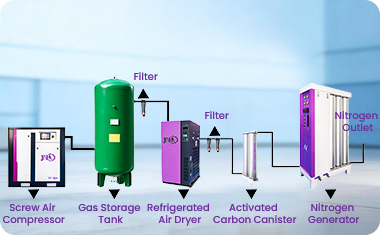
Pretreatment assemblies form the first protective barrier of the system,
mainly consisting of multi-stage filters, refrigerated dryers, activated carbon
units and automatic drain assemblies. Oil mist, liquid water and solid dust in
compressed air are primary contaminants for carbon molecular sieve. Once
impurities enter adsorption towers, they adhere to micropores and cause
irreversible decay of adsorption capacity, damage that cannot be restored
through regeneration. Filters are arranged by precision grades: primary stages
remove coarse particles and bulk liquid water, coalescing cartridges capture oil
mist, and downstream activated carbon traps trace hydrocarbon vapour. Dirt
holding capacity, temperature and pressure resistance of filter media define
service cycles, and rising differential pressure is a typical warning sign of
approaching saturation. Dryers reduce dew point and limit water vapour
concentration; drain assemblies discharge accumulated condensate periodically to
prevent liquid carry-over. Stability challenges for pretreatment components
arise from variable operating conditions. Frequent compressor cycling and
ambient temperature and humidity swings change de-oiling and de-watering load,
and delayed response propagates disturbances to the separation core and
destabilizes nitrogen quality.
Adsorption vessels are pressure-bearing bodies hosting separation cycles,
usually arranged in pairs to alternate between adsorption and regeneration. As
pressure vessels, they comply with specifications on material, welding,
non-destructive testing and overpressure relief. Beyond vessel shells, internal
gas distribution structures are critical for stability. Distribution plates and
mesh baffles disperse incoming airflow to avoid direct jet impact on the sieve
bed. Poor distribution creates channeling, where gas passes rapidly through
limited pathways. Most adsorbent remains underutilized, output declines and
particle friction and powdering intensify. Bed compression assemblies, commonly
spring-loaded or air-bag structures, maintain bed compactness. Molecular sieve
expands and contracts repeatedly under pressure cycling. Loose packing causes
particle collision, abrasion and dust generation together with gas shortcut
channels. Compression mechanisms deliver consistent preload. Insufficient
preload leads to loosening, while excessive force crushes particles, both
undermining long-term stability.
Carbon molecular sieve is the core functional medium filled inside towers.
With precisely sized micropores, it selectively adsorbs oxygen under elevated
pressure while nitrogen passes through and accumulates as product gas. Oxygen
desorbs and releases during depressurization for regeneration. Particle crush
strength, adsorption capacity and water shock resistance set the baseline
performance limit. Powdering under cyclic pressure and airflow erosion is the
most common failure mode. Fine powder migrates into valves and piping, abrading
sealing surfaces and causing valve sticking. This medium is extremely vulnerable
to contamination; oil permanently blocks adsorption micropores, and purity falls
continuously even if other components remain intact. Packing density and uniform
filling are also vital; uneven void distribution creates uneven flow
distribution across the bed.
Programmed valve banks execute process switching and represent the most
frequently actuated components in the system. Sequences including adsorption,
pressure equalization, co-current depressurization, counter-current
depressurization and purging rely on timed valve switching to alternate tower
status. Seal integrity, synchronous actuation and response speed directly
determine the accuracy of pressure cycling timing. Worn sealing faces, debris
trapped on seats and unstable pilot supply cause internal leakage or delayed
movement. Timing imbalance breaks adsorption‑regeneration equilibrium and
triggers sharp purity swings. These valves differ from general industrial
isolation valves, engineered for high-cycle duty with seals resistant to
temperature and trace dust. Pilot air supply for actuators includes dedicated
filters and regulators to stabilize driving pressure and avoid incomplete
stroke. Synchronization across multiple valves is central to stability; failure
of a single valve disturbs the whole pressure cycle.
Buffer storage assemblies include inlet air receivers and product nitrogen
tanks. Air receivers after pretreatment smooth pressure pulsation from
compressors and protect adsorption beds from sharp inlet pressure shocks.
Nitrogen tanks at the outlet stabilize delivery pressure and buffer variable
downstream demand, preventing sudden load changes from disturbing adsorption
equilibrium. Tanks are fitted with pressure gauges, safety relief valves and
drain ports. Relief valves provide passive protection by venting at overpressure
to safeguard pressure vessels. Although buffers do not participate in gas
separation, they decouple load disturbances. Without adequate buffer volume,
fluctuations from upstream air supply or downstream consumption transmit
directly to sieve beds and cause erratic purity and poor disturbance
resistance.
Sensing and control units integrate online purity analysers, pressure
transmitters, differential pressure sensors and PLC modules. Sensors
continuously monitor pressure, differential pressure and nitrogen concentration,
and the controller triggers valve actions according to predefined sequences and
feedback signals. Online analysers serve as the monitoring window for quality;
differential pressure transmitters detect early signs of sieve powdering or
filter blockage. Sensor drift, signal lag and poor electrical contact produce
misreading and incorrect timing adjustments. Robust control logic incorporates
fault tolerance, activating alarms or protective shutdown when pressure or
purity exceeds thresholds to prevent component damage under abnormal conditions.
Advanced controllers support mild adaptive timing adjustment against inlet
variation to improve site adaptability.
Silencers, check valves and gasket seals are auxiliary components often
overlooked. Silencers are fitted at regeneration exhaust outlets to reduce noise
and contain sieve fines; check valves prevent reverse flow and avoid
cross-contamination from waste regeneration gas; gaskets and O-rings isolate
internal and external leakage. Subjected to cyclic pressure and temperature,
seals age through swelling, hardening and cracking. Leakage changes pressure
retention inside towers and impairs separation performance. Though low in
individual cost, these accessories are frequent sources of instability and
should be scheduled for inspection and replacement in maintenance plans.
Stability of all components is linked in a chain. Failed pretreatment
damages molecular sieve; inadequate compression accelerates powdering; sieve
dust abrades valve seals; internal valve leakage disrupts pressure cycles;
sensor drift deprives the controller of valid feedback. Stability assessment
cannot focus only on the adsorbent core. It requires reviewing component
matching, material grade, protective design and redundancy along the gas flow
path. Maintenance plans adopt tiered inspection schedules, periodic replacement
for high-wear parts and regular calibration for pressure vessels and sensors.
Only when the whole component chain remains in sound condition can carbon
molecular sieve nitrogen generators sustain consistent gas quality over extended
continuous operation and reduce unplanned downtime.