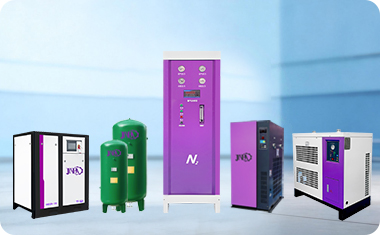
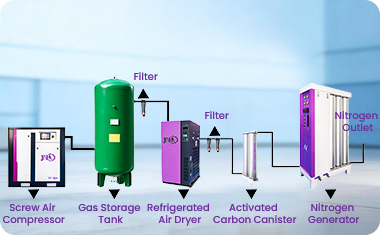
Modular commercial nitrogen generators separate nitrogen and oxygen in
compressed air using the pressure swing adsorption principle with carbon
molecular sieve (CMS) as the core adsorbent medium. Featuring abundant
micropores, granular CMS preferentially adsorbs oxygen to enrich nitrogen. Under
prolonged continuous operation, fluctuating working conditions, incoming gas
contaminants and improper maintenance, the sieve bed gradually develops caking.
Caking is not an instantaneous breakdown; it describes the slow deterioration of
the originally loose packing structure, where adjacent particles adhere and
consolidate into dense solid masses. Once caking occurs, internal airflow
distribution inside the adsorption tower is disrupted, lowering adsorption
efficiency, reducing product nitrogen purity and raising energy consumption. In
severe cases, channeling, localized heat buildup and abnormal tower pressure
emerge, triggering cascading operational risks across the modular nitrogen
generation unit.
To understand caking mechanisms, the structural traits of modular
commercial nitrogen generators must first be clarified. Modular designs
integrate adsorption towers, piping, control valves and filter assemblies into
standardized blocks that can be paralleled for capacity expansion. Inside each
tower, CMS granules are restrained by support screens and hold-down plates. In
normal condition, uniform voids exist between particles. When compressed air
flows through the bed, gas diffuses evenly and every granule participates in
adsorption and desorption cycles. Modularity enables flexible assembly and
online switching of standby modules, yet the compact packing space inside each
tower leaves limited buffer capacity. Once local agglomeration forms,
self-recovery through airflow disturbance is unlikely. This explains why CMS
caking tends to spread faster on modular units than on large fixed nitrogen
plants.
Moisture ingress is the most common trigger for CMS caking. Although
pre-treatment trains including refrigerated dryers and precision filters remove
bulk liquid water and most water vapor, these components have operational
limits. Delayed maintenance, expired filter elements, faulty dryer refrigerant
supply or condensate backflow from compressed air pipelines introduce excessive
moisture into adsorption towers. The porous CMS matrix readily adsorbs water
molecules. Water films on granule surfaces combine with residual minor binders
and fine dust debris to form cement-like layers that bind neighboring particles.
At first only small clusters form. With continuous wet feed, clusters merge into
widespread caking. Moisture-driven caking usually originates near the gas inlet,
where the moisture load peaks and consolidation propagates inward along the
bed.
Feed contaminants and dust constitute another major contributing factor.
Pipe rust oxides, compressor oil mist, fragments from sealing materials and
ambient dust travel with inlet air. Thin oil coatings block CMS micropores
permanently while acting as binding agents to stick particles together. Solid
dust fills intergranular voids, reduces porosity and increases inter-particle
friction. Under cyclic pressure loading, loosely packed sieve material is
compacted and gradually solidified. Many modular nitrogen generators pair with
general-purpose air compressors and carry simplified pre-treatment chains. Poor
pre-treatment accelerates caking when oil, dust and moisture act in synergy.
Unlike water-only caking, oil-contaminated caking forms rigid agglomerates that
resist disaggregation via simple purging and often cause irreversible
degradation.
Pressure surges and cyclic compaction accelerate caking progression.
Pressure swing adsorption relies on cyclic pressurization for adsorption and
depressurization for desorption. Tower pressure swings between near-atmospheric
level and working pressure. Solenoid and pneumatic valves in modular units
switch frequently. Without damping buffers, rapid valve action creates transient
pressure shocks that pound the sieve bed. Granules rub and collide repeatedly
under shock, generating fine CMS fines that settle into voids. Sustained
compression consolidates the bed into dense compacted zones, defined as
compaction-type caking. This form can emerge even with dry, clean feed gas.
Improper preload on hold-down plates worsens the issue: excessive preload
squeezes packing continuously from startup, while insufficient preload allows
violent granule bouncing during pressure switching, producing extra fines that
promote consolidation.
Caking triggers successive adverse consequences. First, gas channeling
develops. Dense caked zones show very low permeability, so compressed air
bypasses solidified regions and rushes through adjacent loose gaps. Most sieve
material stops participating in adsorption cycles, cutting effective capacity
and dragging down nitrogen purity. Operators often compensate by raising set
pressure or extending adsorption duration, which amplifies pressure shocks and
compaction in a destructive feedback loop. Second, bed differential pressure
rises steadily, increasing compressor duty and specific power consumption.
Third, uneven heat accumulation arises. Adsorption releases heat; poor flow
distribution prevents heat removal from caked zones, elevating local temperature
and speeding CMS aging. In extreme cases, large consolidated blocks shift or
collapse during pressure transitions, striking internal components, rupturing
support screens and deforming hold-down plates. Broken CMS particles migrate
downstream, clogging flow meters, regulators and valves.
Detecting caking on modular parallel systems carries unique challenges.
When multiple modules run side by side, early degradation in a single unit is
masked by healthy blocks. Total nitrogen purity and flow readings stay nearly
unchanged in incipient stages. Routine inspections rely on single-tower
differential pressure, exhaust noise and valve actuation sound as auxiliary
indicators. Typical warning signs include steadily rising differential pressure
on one tower, growing pressure deviation between identical modules, unstable
desorption exhaust with intermittent particle rattling, persistently lower
nitrogen output purity from the affected module and short-lived purity
improvements after parameter tuning. By the time purity collapses sharply,
caking has already spread extensively. Narrow packing access ports on modular
blocks make inspection, screening and replacement more labor-intensive than
servicing large standalone towers, with greater disruption to continuous
production.
Caking control relies on three layers: feed pre-treatment stabilization,
process parameter management and scheduled maintenance. Feed conditioning forms
the primary defense. Dryers and filters shall be specified to match the
generator requirements. Precision and activated carbon oil removal filters are
replaced on schedule, while dryers and automatic drain traps are inspected
regularly to stop condensate from entering towers. On the process side, valve
switching speed is moderated with pressure buffers to suppress surge loading.
Hold-down plate preload follows manufacturer calibrated ranges to avoid
over-compression or particle bouncing. Operating inlet temperature is controlled
within rated limits; high inlet temperature boosts vapor adsorption and
cementation risk. Periodic low-speed purging with clean dry air removes free
fines.
For beds already caked, remediation is tailored to the root cause. Mild
water-induced caking may be partially reversed by isolated high-temperature dry
purging to strip trapped moisture, provided oil contamination is excluded.
Severe oil-associated caking is mostly irreversible because oil films
permanently block micropores and stabilize consolidated bonds. Packing must be
unloaded, hardened lumps screened out and fresh CMS installed. During refilling,
support meshes, screens and seals are inspected to eliminate residual fines that
could recontaminate new media. Uniform layer distribution during loading
prevents uneven packing density that invites repeat caking.
Caking of carbon molecular sieve in modular commercial nitrogen generators
is a progressive defect driven jointly by feed contaminants, cyclic pressure
shocks and inherent granular packing characteristics. It is highly concealed
with faint early symptoms, and parallel modular architecture tends to hide
incipient failure signals. Prevention prioritizes stable inlet gas quality,
smooth pressure cycling and routine performance monitoring rather than reactive
repairs. Controlling moisture, oil and dust ingress slows particle cementation.
Regular tracking of per-module differential pressure and product quality
preserves uniform loose packing and supports long-term, energy-efficient
operation of modular nitrogen generation systems.