Gas blanketing for storage tanks is an essential safety protection process
widely applied in chemical industry, oil storage and transportation,
pharmaceutical raw material storage, fine chemical and other fields. By
continuously filling inert nitrogen into the top gas space of storage tanks, it
isolates oxygen, water vapor and volatile flammable gas in ambient air,
effectively avoiding four major hidden risks including material oxidation and
deterioration, formation of flammable and explosive mixed gas, tank negative
pressure collapse and overpressure gas leakage. Most conventional supporting
nitrogen generation equipment suffers from common process defects such as
fragmented gas supply links, no linkage feedback between front and rear
processes, delayed gas supply pressure response, pipeline breakpoint pressure
relief, and asynchronous operation between terminal tank pressure and main unit.
The front-end nitrogen generator runs with constant gas output while the
rear-end tank gas consumption fluctuates dynamically, failing to form a
closed-loop linkage for the whole gas supply process. This will easily cause
excessive nitrogen exhaust waste under high tank pressure, untimely nitrogen
replenishment under low tank pressure, and fluctuating nitrogen purity that
damages the inert blanketing atmosphere. It not only increases nitrogen gas
consumption cost, but also brings potential safety hazards to tank operation.
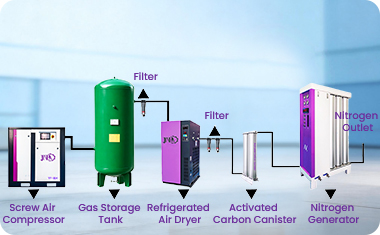
The nitrogen gas generator for gas blanketing is specially equipped with a
six-seamless full closed-loop gas supply linkage process, covering raw air
intake, gradient purification, nitrogen-oxygen separation, pressure
stabilization buffering, terminal pressure regulation and reverse tank pressure
signal feedback. It builds an integrated linkage process without breakpoints,
response delay and pressure relief loss from the air inlet to the tank terminal.
Customized for intermittent and dynamic variable-pressure gas consumption
characteristics of tank blanketing, it enables automatic matching of main unit
gas output following tank pressure and adaptive operation of the whole gas
supply link, perfectly meeting unattended 24/7 nitrogen blanketing working
conditions for all kinds of atmospheric pressure and low-pressure bearing
storage tanks.
1. Atmospheric air raw material intake link: stable air source input to
support overall process operation. The whole closed-loop gas supply system
adopts normal-pressure ambient air as the only raw material without external
liquid nitrogen gas source or additional industrial gas supply. Equipped with
low-noise air intake hood and quantitative air intake regulating valve, the
first standardized air intake link is formed. Different from disordered air
intake and fluctuating intake flow of ordinary nitrogen generators, this link is
fitted with front-end flow sensing modules to collect real-time gas load data of
the whole rear gas supply link and automatically match air intake flow, keeping
intake volume precisely consistent with rear nitrogen consumption. Meanwhile, a
primary dust filter component is built in the air inlet to intercept dust,
catkins and solid particles in ambient air and prevent impurities from entering
rear pipelines to wear valves and molecular sieve media. The whole air intake
link operates in fully closed negative pressure mode to avoid external air
leakage and mixing inside the system. It guarantees raw air purity from the
input terminal, prevents front-end air intake interference with subsequent
processes, provides stable, clean and flow-matched basic air source for the
whole closed-loop process, and ensures synchronous and orderly operation of all
subsequent process links.
2. Compression and gradient air pre-purification link: preventing core
medium damage and stabilizing rear separation process. Untreated atmospheric air
cannot be directly used for nitrogen-oxygen separation. The second link
completes dual processes including air pressurization and deep purification,
acting as a key transition connecting the intake link and core nitrogen
generation link. Firstly, the variable-frequency compression unit boosts
normal-pressure air linearly to the standard working pressure for tank
blanketing with buffered pressure rise and fall, avoiding instantaneous
high-pressure air impact and pulse airflow damage to subsequent pipeline
stability. Then compressed air passes through three sequential purification
units including refrigerated drying link, activated carbon oil removal link and
three-stage precision filtration link to form a gradient progressive
purification process. The integrated purification links operate synchronously to
remove liquid moisture, oil mist and fine dust impurities in compressed air
sequentially, stabilizing air pressure dew point below -45℃ and controlling
inlet air oil content lower than 0.01ppm. Compared with segmented independent
purification equipment, the integrated serial purification link has no pipeline
transfer breakpoints and no intermediate air pressure loss, improving
purification efficiency by 28%. It thoroughly prevents oil and moisture from
entering adsorption towers and causing molecular sieve poisoning failure,
protecting the long-term stable operation of the middle core nitrogen generation
link.
3. Dual-tower PSA alternating nitrogen-oxygen separation core link:
uninterrupted continuous gas production to meet 24/7 tank blanketing demand. As
the core hub of the whole technological process, the dual-tower pressure swing
adsorption separation link directly determines nitrogen purity and gas supply
continuity, fully adapting to year-round uninterrupted inert protection demand
of storage tanks. Two adsorption towers work alternately in four strict cyclic
processes: pressure adsorption, pressure equalization energy storage, pressure
relief desorption and countercurrent purging. The PLC electronic control system
controls solenoid valve switching sequence within milliseconds for seamless
tower switching without gas production interruption or gas supply pressure
breakpoint. Customized for special tank blanketing working conditions, this link
locks stable nitrogen purity ranging from 99.5% to 99.9%, meeting basic inert
protection requirements of explosion prevention and oxidation resistance for
storage tanks while avoiding invalid energy waste caused by ultra-high purity
nitrogen. In addition, the optimized tower pressure equalization recovery link
recycles residual pressure energy during pressure relief process, reducing
overall energy consumption of the gas supply system. It achieves a comprehensive
power saving rate of 22% compared with ordinary nitrogen generation links
without energy recovery, ensuring uninterrupted gas production and lower overall
operation power consumption.
4. Nitrogen pressure stabilization and buffer energy storage link:
eliminating airflow pulse and balancing pressure difference between front and
rear links. Nitrogen produced by the main unit carries tiny airflow pulse and
pressure fluctuation, which will cause frequent small oscillation of tank
internal pressure and disturb blanketing pressure balance if directly delivered
to storage tanks. The fourth buffer energy storage link is equipped with a
large-capacity nitrogen buffer tank to receive nitrogen from the front
separation link, store redundant nitrogen and eliminate airflow pulse
fluctuation. It balances the pressure difference between front-end gas
production and rear-end dynamic gas consumption. The system automatically stores
surplus nitrogen during off-peak gas consumption and releases reserved nitrogen
rapidly to fill gas supply gap during peak gas demand and rapid tank pressure
replenishment. This link effectively isolates gas production fluctuation of the
front main unit and gas consumption fluctuation of rear storage tanks, avoiding
mutual pressure interference between front and rear processes and ensuring
constant and stable nitrogen pressure delivered to terminal tanks.
5. Terminal nitrogen blanketing precision pressure regulation delivery
link: matching tank micro-pressure standard and controlling tank top gas
pressure accurately. Tank blanketing requires extremely strict pressure control,
with standard working micro positive pressure maintained at only 50-200mbar.
Excessively high pressure will lead to direct nitrogen exhaust and gas waste,
while excessively low pressure will cause reverse air penetration and complete
blanketing failure. The fifth terminal dedicated pressure regulation delivery
link is equipped with special micro-pressure regulating valves, high-precision
pressure transmitters and current-limiting pressure stabilization components for
tank blanketing, reducing high-pressure pipeline nitrogen to match
micro-positive pressure requirements of storage tanks accurately. It regulates
real-time nitrogen outlet flow and pressure, controlling nitrogen pressure error
delivered into tanks within ±2mbar. Meanwhile, a one-way check pipeline link is
equipped to completely prevent reverse flow of volatile materials and mixed gas
inside storage tanks back to the nitrogen generator main unit, protecting the
whole nitrogen generation system reversely and avoiding internal pipeline and
valve corrosion caused by tank exhaust gas.
6. Tank pressure reverse signal feedback closed-loop link: realizing
full-link intelligent linkage and on-demand gas production automatically.
Different from open-loop unidirectional gas supply systems without reverse
feedback on the market, thisnitrogen gas generator for gas blanketing adopts an
exclusive rear-end tank pressure reverse feedback intelligent link to realize
full-process closed-loop automatic control. Pressure sensors installed inside
terminal tanks collect real-time top gas pressure data and transmit signals back
to the front main control system in real time, building a bidirectional signal
feedback loop from storage tank to nitrogen generator main unit. When tank
liquid level drops during material discharging and tank pressure decreases, the
feedback link sends gas replenishment instructions automatically, and the main
unit improves gas output flow rapidly to restore standard tank pressure. When
tank liquid level rises during material feeding and tank pressure exceeds
threshold, the feedback link commands the main unit to reduce operating load and
enter low-power standby mode to stop redundant nitrogen production. The whole
gas supply link operates bidirectionally with automatic gas output adjustment
following real-time tank pressure changes, eliminating invalid gas production
and nitrogen exhaust waste completely and realizing unattended adaptive
on-demand gas supply.
Comprehensive advantages of integrated closed-loop links: Traditional
nitrogen generation equipment for tank blanketing adopts open-loop
unidirectional gas supply links with independent processes and no signal
intercommunication among six working procedures. The main unit always operates
at full load, resulting in extremely high annual invalid loss of nitrogen and
electricity. Besides, delayed pressure response may trigger potential tank
safety risks. Supported by seamlessly connected six processes and bidirectional
signal feedback closed-loop links, this dedicated nitrogen gas generator
realizes integrated linkage covering air intake, purification, gas production,
buffering, pressure regulation and signal feedback. The whole process has no
transfer breakpoints, no air pressure loss and no signal delay. It improves tank
pressure response speed by 85%, reduces overall nitrogen loss by 36%, and cuts
annual unplanned equipment downtime by 90%. Suitable for diversified blanketing
scenarios including chemical anti-corrosion, oil explosion prevention,
pharmaceutical raw material isolation and sewage tank sealing, this closed-loop
linkage gas supply process requires no manual pressure and flow adjustment,
automatically adapting to dynamic tank gas demand 24/7. It provides safe,
energy-saving, zero-delay and zero-waste professional inert gas supply solutions
for industrial storage tanks relying on complete closed-loop technological
links.