Stable on-site nitrogen generation relies heavily on pretreatment of
compressed feed air. As a core upstream treatment unit, the air dryer shapes the
working condition of separation media and the quality of output gas. After
compression by air compressors, compressed air carries abundant water vapor.
Fluctuations in ambient temperature, humidity and compression heat alter
moisture holding capacity. If vapor is not removed effectively before entering
separation modules, it gradually contaminates adsorbent media or hollow fiber
membranes and becomes a leading cause of performance degradation. The
pretreatment workflow stabilizes pressure dew point within a suitable range and
mitigates hidden failures caused by condensate and moisture.
Moisture impacts separation media in different ways. Pressure swing
adsorption systems use carbon molecular sieves to selectively adsorb oxygen.
Water molecules with stronger polarity occupy micropores preferentially and take
up adsorption sites. Mild moisture ingress gradually reduces nitrogen purity and
destabilizes flow rate. Long-term exposure leads to sieve powdering and caking
with irreversible loss of adsorption capacity; media replacement becomes
necessary to restore function. Membrane separation modules are also
moisture-sensitive. Continuous humid inlet air forms water films over polymer
membranes, changing gas permeation rates, lowering separation efficiency and
accelerating fiber ageing. Drying is therefore not an optional accessory, but an
essential protective barrier for core separation components.
Refrigerated and desiccant dryers are the two mainstream categories, each
suited to different dew point ranges and application scenarios. Refrigerated
dryers condense liquid water through cooling, featuring simple maintenance and
moderate energy consumption for general purity requirements. Desiccant dryers
capture vapor through adsorption and achieve far lower pressure dew points,
fitting electronics, lithium battery and fine chemical processes requiring
extremely dry gas. Selection cannot rely solely on nominal flow capacity. Inlet
temperature, pressure and ambient humidity must be calculated simultaneously.
Deviations from rated parameters reduce drying capacity, leaving insufficient
dehumidification even when flow rates appear matched.
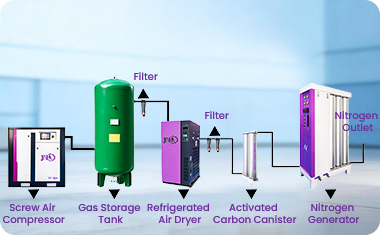
Piping layout and inline filtration are frequently overlooked. The dryer is
normally installed downstream of an air receiver and upstream of the nitrogen
generation unit. The receiver precipitates part of the condensate first and
eases dryer loading. Multi-stage filters are arranged before and after the dryer
to capture particulates, oil mist and residual hydrocarbon vapor. Combined oil
and moisture contamination brings amplified risks: oil residue coats desiccant
or membrane surfaces and blocks vapor transfer pathways. Filter elements are
consumables monitored by pressure differential. Excessive differential pressure
signals clogging and requires timely replacement instead of reactive correction
after downstream quality shifts.
Operational management focuses on drainage, dew point monitoring and steady
working conditions. Condensed liquid water is discharged via automatic drain
traps, among the most common failure points on site. Blocked traps allow
accumulated water to re-enter downstream piping. Routine inspection covers
drainage status and continuous dew point logging at dryer outlets. Rising dew
point indicates declining drying performance, which may stem from refrigeration
faults, exhausted desiccant or overloaded inlet flow. Sharp swings in inlet
pressure and temperature upset drying balance and propagate disturbances to
nitrogen separation, causing unstable purity. Stabilization and temperature
control of upstream compressors must coordinate with dryer operation.
Maintenance schedules adapt to site conditions. In persistently humid
environments, desiccant saturates faster and regeneration cycles need
adjustment. Refrigerated units require regular condenser cleaning; poor heat
dissipation directly weakens condensation efficiency. Root-cause analysis of
many system breakdowns shows core component damage rarely originates from
manufacturing defects. It develops from neglected upstream drying control and
cumulative moisture intrusion. Such failures progress slowly. Early symptoms
include minor purity drift that escapes notice until severe deterioration brings
high replacement costs.
The purpose of air pretreatment is to deliver steady, low-humidity and
clean feed gas to separation assemblies. The dryer and nitrogen generation unit
operate as an interconnected system with mutually constrained parameters.
Upsizing the generator alone while relaxing drying control seldom achieves
target gas quality. A well-designed setup adopts a system-level matching
strategy, defines dew point targets, selects suitable drying technology,
integrates complete filtration and monitoring, and implements regular
inspection. These practices reduce losses from moisture and contaminants and
extend the reliable service life of the nitrogen generation system.