The cost of an industrial nitrogen generation system is a core
consideration for enterprises building on-site gas supply systems. Most
enterprises only focus on the unit procurement price of equipment during
selection, ignoring full-cycle hidden costs such as configuration adaptability,
operating energy consumption, maintenance loss and shutdown loss, which leads to
persistently high gas consumption costs in the later stage. A standard
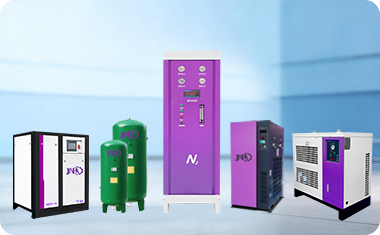
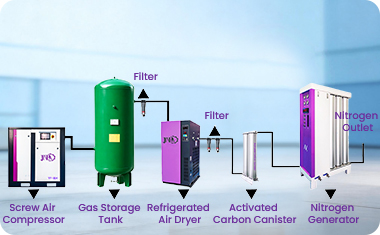
industrial nitrogen generation system consists of five core configurations: air
compression unit, air purification pretreatment unit, carbon molecular sieve PSA
nitrogen generation host, gas storage pressure stabilization unit and
intelligent control unit. Different configuration specifications, brand
materials and process schemes directly determine the initial equipment
investment, daily energy consumption, service life and operation and maintenance
costs. Scientific system configuration matching working conditions can realize
cost optimization from four dimensions: procurement, operation, maintenance and
loss, serving as the key for enterprises to replace bottled nitrogen, liquid
nitrogen procurement and outsourced gas supply to achieve long-term cost
reduction and efficiency improvement. This article comprehensively analyzes the
configuration and full-cycle cost composition of nitrogen generation systems
combined with actual industrial working conditions, providing professional
references for enterprises’ cost-effective selection and precise cost
control.
The initial procurement cost of a nitrogen generation system mainly depends
on the equipment configuration level and working condition adaptation
specifications, which is also the most intuitive cost expenditure for users. The
basic configuration includes screw air compressor, refrigerated dryer,
three-stage precision filter, conventional PSA nitrogen generator, ordinary gas
storage tank and basic electric control system, suitable for small and medium
flow, low purity and conventional working conditions with low procurement
threshold, ideal for micro and small enterprises and temporary gas supply
scenarios. The medium and high-end configuration is equipped with variable
frequency air compressor, adsorption dryer, high-precision multi-stage filter
module, high-adsorption imported carbon molecular sieve, large-capacity
pressure-stabilizing gas storage system and PLC intelligent touch control
module. For special scenarios such as explosion-proof, outdoor and
high-cleanliness environments, special configurations including explosion-proof
electric control, dust-proof and moisture-proof frame, remote monitoring and
standby units are optional. Although high-end configurations require higher
initial investment, they greatly improve equipment adaptability, stability and
gas production accuracy, avoiding problems such as substandard gas production,
frequent equipment failures and rapid molecular sieve failure caused by
insufficient configuration, and eliminating additional costs of reformation and
secondary procurement from the source.
In the overall cost structure, operating energy consumption cost accounts
for the largest expenditure in the full cycle of nitrogen generation systems,
far exceeding equipment procurement cost. The nitrogen generation system relies
on compressed air to complete oxygen-nitrogen separation, and the power
consumption of the air compressor accounts for more than 70% of the total system
energy consumption. Unreasonable configurations such as low-end, non-standard
and under-sized equipment will lead to unbalanced air-nitrogen ratio, low
compressed air utilization rate and frequent full-load start-stop of equipment,
causing huge power waste. The optimized energy-saving variable-frequency
nitrogen generation system can automatically adjust the speed and gas production
flow according to real-time gas load to accurately match production demands and
avoid no-load energy consumption. Equipped with an efficient pretreatment
system, it reduces pipeline resistance and gas loss to further improve air
source utilization. Reasonable system configuration can reduce comprehensive
energy consumption by 20%–40%, and the electricity cost saved by long-term
operation far exceeds the equipment price difference, which is the core key
point of industrial nitrogen production cost control.
Operation and maintenance consumable costs are long-term continuous
expenditures, also determined by the quality of system configuration. Low-end
and low-configured equipment adopts ordinary molecular sieves, low-end filter
elements and simple control valves, featuring fast filter blockage, easy
molecular sieve pulverization and aging, and vulnerable valve seal damage.
Frequent replacement of consumables and maintenance lead to high annual
maintenance costs. In addition, frequent disassembly and maintenance may damage
the equipment structure and accelerate overall aging. The high-quality
standard-configured nitrogen generation system is equipped with high-purity
wear-resistant carbon molecular sieves, thickened precision filter elements,
industrial-grade special pneumatic valves and sealing components, greatly
extending the service life of core consumables. The filter replacement cycle is
increased by 2–3 times, and the molecular sieve can work stably for 8–10 years.
Only routine maintenance is required throughout the year with almost no large
maintenance expenditure. Meanwhile, the modular integrated structure features
neat layout and convenient maintenance without frequent professional on-site
duty, further saving labor operation and maintenance costs.
Hidden production cost is the most easily ignored loss, mainly caused by
production losses due to mismatched equipment configuration. Insufficiently
configured nitrogen generation systems will cause unstable nitrogen purity,
insufficient flow and fluctuating pressure, directly resulting in product
oxidation, process scrapping and production shutdown. Poor equipment stability
and frequent failures will interrupt the continuity of production lines, causing
capacity loss and project delay. In high-demand industries such as electronics,
new energy, chemical industry, laser processing and food medicine, product
scrapping losses caused by substandard gas quality are far higher than the cost
of nitrogen generation equipment itself. The standardized high-adaptability
configuration system supports 24-hour uninterrupted stable gas production with
purity deviation controlled within ±0.1% and constant pressure and flow,
completely avoiding production failures and product losses caused by abnormal
gas sources, ensuring continuous and stable mass production of production lines
and indirectly reducing enterprises’ hidden production costs.
Nitrogen generation system configuration schemes for different working
conditions correspond to completely different cost models. Scenarios with
low-purity gas demand such as ordinary food packaging and hardware processing
can adopt basic standard configurations to meet demands with low investment and
high practicality. High-purity and high-cleanliness gas scenarios including
laser cutting, precision electronics and pharmaceutical production must be
equipped with high-end purification, intelligent pressure stabilization and
continuous gas production configurations to avoid quality risks. Large chemical
industry, new energy parks and large-scale production lines require integrated
high-flow nitrogen generation systems with standby unit configurations to ensure
gas supply redundancy and stability for all-weather full-load working
conditions. Enterprises should not blindly pursue low-price low-end
configuration or excessive high-end configuration. It is necessary to customize
the optimal configuration scheme according to actual gas purity, flow rate,
working environment and operating hours to realize a balance between investment
and long-term operating energy consumption.
In summary, nitrogen generation system cost control is not simply lowering
the procurement price, but optimizing the full-life-cycle cost through
scientific configuration. Low-price low-end equipment seems cost-saving in the
early stage, but has long-term drawbacks including high energy consumption,
expensive consumables, frequent failures and large production losses. Reasonably
high-end and precisely adapted nitrogen generation systems require slightly
higher initial investment, but can recover the equipment price difference within
1–2 years relying on the advantages of low energy consumption, low maintenance,
zero loss and high stability, creating high cost-saving benefits in the long
run. Professional nitrogen generation system configuration design can accurately
match industrial working conditions, balance initial investment and long-term
operating costs, help enterprises completely get rid of the high-cost
traditional gas supply mode of bottled and liquid nitrogen, realize automatic,
energy-saving and low-cost on-site nitrogen supply, and comprehensively improve
production economic benefits.