Large industrial sites usually host multiple independent production lines
with different nitrogen requirements. Some stations demand steady high-flow gas
supply, while others consume nitrogen intermittently. Certain special processes
set strict limits on nitrogen purity, dew point and delivery pressure. Gas
consumption fluctuation from simultaneous operation of multiple stations,
pressure loss caused by long-distance pipeline transmission, and requirements
for year-round non-stop operation create complex on-site working conditions. In
such scenarios, a large plant nitrogen generator system is more than a simple
assembly of gas-producing units. It acts as a centralized gas supply solution
tailored to gas distribution, load variation and safety standards across the
whole site, and is adopted by many large manufacturing facilities to replace
delivered liquid nitrogen and gas cylinders.
Uneven gas load is the most notable feature for nitrogen supply in large
plants. Gas demand rises to peak values when multiple production lines run
during day shifts and drops when some lines reduce output or shut down at night.
If the system is sized only by average flow, pressure and purity will drift
during peak consumption. If units are fully configured according to peak flow,
excessive energy waste occurs under low-load conditions. A well-designed large
plant nitrogen generator system generally adopts a parallel multi-unit layout
paired with large buffer storage tanks. The control system starts, stops or
adjusts operating units dynamically according to real-time gas demand to match
nitrogen output with consumption. Buffer tanks absorb instantaneous flow surges,
reduce wear from frequent unit cycling and stabilize pipeline pressure.
Pretreatment conditions form the foundation for stable long-term operation.
Air compressors in large plants are often arranged centrally with lengthy and
branched compressed air pipelines. Air temperature, oil content and moisture
level tend to shift with seasons and ambient conditions. Liquid water may
separate from compressed air in humid summer weather. Improperly maintained
compressors can carry oil mist downstream. Moisture and oil contaminate carbon
molecular sieves or membrane modules and degrade gas output capacity. Therefore,
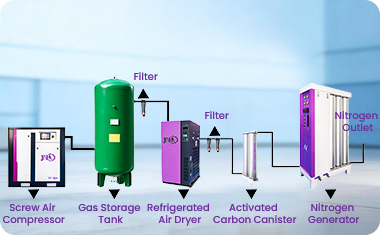
the upstream chain of a large plant nitrogen generator system is normally
equipped with multi-stage dryers and filters, as well as online dew point and
oil content monitors, to keep inlet air parameters within acceptable ranges. For
plants sharing one air source among multiple compressors, air distribution
should be properly managed to prevent pressure fluctuation from other branches
from interfering with nitrogen generation.
Different process zones bring varied requirements for gas distribution and
pipeline design. In chemical, energy storage and heat treatment areas, nitrogen
is used for tank blanketing, purging and hazard mitigation, where supply
continuity and safety standards are prioritized. Laser processing, precision
welding and electronic packaging require nitrogen with high purity and
cleanliness. Food production has extra requirements on pipeline material and gas
hygiene. It is difficult for a single nitrogen specification to satisfy all
processes in one large plant. A large plant nitrogen generator system often uses
graded gas supply strategies. Base nitrogen from the main units can go directly
to stations with moderate requirements, while part of the gas stream passes
through secondary purification and boosting for precision processes. Pipelines
are equipped with zone pressure regulators, shut-off valves and monitoring
instruments to facilitate independent maintenance and parameter adjustment, so
faults in one zone will not interrupt gas supply for the whole plant.
Maintenance protocols for continuous service differ from those for small
nitrogen units. A large plant nitrogen generator system is designed for 24-hour
continuous operation. When one unit fails, remaining parallel units shall
maintain basic gas supply to avoid widespread shutdown. Routine work includes
filter and seal replacement, zoned inspection, monitoring of pressure,
temperature, oxygen content and valve status, and regular calibration of online
analyzers. The control platform can connect to the plant central control system
for data collection and alarm notification. Planned staggered maintenance
schedules allow single units to be serviced during off-peak periods and minimize
disruption to production. Spare part management is also necessary to shorten
troubleshooting time.
Site layout and safety rules must not be overlooked. Nitrogen stations for
large plants need sufficient space for ventilation, fire protection, explosion
protection and noise control, with access room reserved for maintenance.
Integrated skid-mounted packages suit sites with regular layout and tight
construction schedules. Split modular configurations fit plants under phased
construction and gradual capacity expansion. Many factories adjust production
capacity over time. When planning a large plant nitrogen generator system in
early stages, expansion interfaces can be reserved. Additional modules can be
added later for new production lines and gas stations without replacing the
entire system.
Evaluation should not focus merely on upfront investment. Total cost of
ownership shall be calculated based on annual running hours, load curves and
process parameters. Some solutions carry low initial cost yet have limited load
adaptability and unstable purity under high load, leading to high energy and
maintenance expenses over time. Selecting a large plant nitrogen generator
system is essentially matching the system to actual site conditions and
balancing supply reliability, energy consumption, safety management and
expandability. Stable centralized nitrogen supply reduces uncertainties brought
by external gas delivery, supports synchronous operation of multiple production
lines and provides reliable inert gas for continuous manufacturing in large
industrial facilities.