In chemical, oil and gas, pharmaceutical, new material and other
industries, purging serves as a fundamental process to guarantee stable
operations and site safety during equipment startup and shutdown, pipeline
maintenance and material changeover. Traditional methods mostly rely on liquid
nitrogen or cylinder nitrogen purchased from suppliers. Restricted by
transportation scheduling, tank refilling and inventory management, the
continuity of gas supply may be disrupted, and long-term operating costs tend to
fluctuate. Built on air separation technologies, the on-site nitrogen generation
purging system produces inert nitrogen directly from compressed air, and matches
purging requirements under diverse working conditions. It has become an
alternative gas supply option for many production sites.
The core objective of purging is to displace air, combustible vapour,
moisture and trace impurities inside vessels, pipelines and reaction chambers
with inert gas. It keeps oxygen concentration within a safe range, lowers risks
of oxidative corrosion and accumulation of flammable mixtures, and protects raw
materials and semi-finished products sensitive to oxygen and humidity. Two
common purging methods are displacement purging and dilution purging.
Displacement purging applies to long pipelines and large storage tanks, pushing
out original media by gas flow. Dilution purging suits closed chambers, where
continuous nitrogen feed gradually reduces internal oxygen level. Both methods
require stable nitrogen supply with adjustable flow.
Two mainstream technologies are adopted in such systems: pressure swing
adsorption and membrane separation. Pressure swing adsorption utilises the
difference in adsorption speed between oxygen and nitrogen on carbon molecular
sieve. Oxygen is captured under pressurised conditions while concentrated
nitrogen is delivered. Adsorption towers alternate between adsorption and
depressurisation regeneration to maintain continuous production, which fits
scenarios demanding high nitrogen purity. Membrane separation relies on hollow
fibre membrane modules. Gas molecules pass through the membrane at different
permeation rates to achieve separation. It features simple structure and fast
start-stop response, and is suitable for purging tasks requiring moderate purity
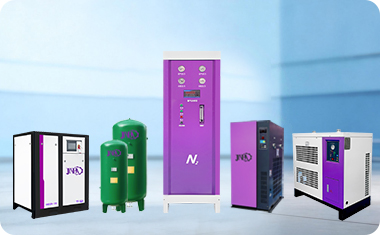
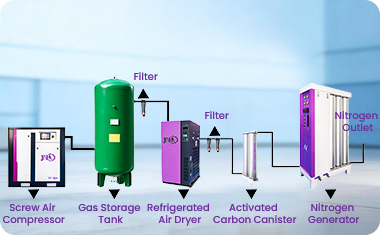
and instant activation. A complete system generally includes air pretreatment
unit, core separation unit, buffer and pressure stabilisation unit, online
monitoring and automatic control modules. Some projects are equipped with flow
regulators and oxygen feedback devices to adjust production parameters
automatically according to purging conditions.
Compared with cylinder and liquid nitrogen tanker supply, the on-site
nitrogen generation purging system has distinctive characteristics. First, it
improves supply independence. The system generates nitrogen continuously once
connected to compressed air and power supply, reduces reliance on external gas
sources and avoids supply interruptions caused by transportation and delivery
cycles. Second, for long-term operation, it eliminates extra expenses such as
liquid nitrogen vaporisation loss, round-trip transportation and cylinder
inspection. It fits plants with frequent purging and stable year-round gas
consumption. Besides, the modular layout is flexible. The skid-mounted package
can be installed near process units to shorten delivery pipelines and reduce gas
transmission loss.
Nevertheless, gas supply mode is not the only factor for selection. Working
parameters should be evaluated comprehensively. Users need to confirm required
nitrogen purity, instantaneous flow, continuous supply duration, ambient
temperature, space constraints and quality of supporting compressed air. Purging
for chemical and oil storage tanks usually has strict oxygen control
requirements, so pressure swing adsorption with reliable purity and high
monitoring precision is preferred. Membrane separation can meet basic demands
for regular pipeline replacement and simple equipment purging. For maintenance,
air filters, molecular sieves and membrane elements are consumables that need
periodic replacement. Oil and water removal of compressed air must be properly
handled to prevent contaminants from damaging core separation components and
sustain stable gas output.
Safety control is also essential for purging work. Even though nitrogen is
inert, massive injection in enclosed spaces may lead to oxygen deficiency.
On-site oxygen alarms, ventilation arrangements and work permit procedures
should be implemented. Automatic control logic of the system shall include
interlock triggers. Alerts will be activated once oxygen or pressure readings go
beyond thresholds, to avoid hazards caused by improper operation.
Overall, the on-site nitrogen generation purging system is not suitable for
every situation. Purchased gas remains flexible for occasional short-term
purging and small consumption. For factories with continuous production and
regular pipeline and vessel purging, however, this system can build a stable
inert gas source, balancing process protection, operational safety and long-term
economic efficiency. It is a technically viable solution worthy of rational
assessment within industrial inert gas supply frameworks.