Energy consumption per unit nitrogen production is a core technical index for evaluating the operating efficiency and energy-saving performance of industrial nitrogen generators, which is of great significance for enterprise energy consumption assessment, production cost accounting, and equipment model selection optimization. The unit nitrogen production energy consumption of industrial nitrogen generators refers to the total electric energy consumed by the equipment to produce per cubic meter of qualified nitrogen under standard operating conditions, including the power consumption of air compressors, drying systems, purification modules, control systems, and auxiliary equipment. Formulating and abiding by unified energy consumption calculation standards can standardize the efficiency evaluation of different types of nitrogen generators, provide accurate data support for industrial energy-saving transformation, and help enterprises reduce production operating costs.
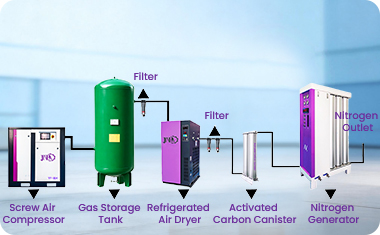
The calculation standard for unit nitrogen production energy consumption of industrial nitrogen generators clarifies unified test conditions and statistical calibers. The standard test environment requires ambient temperature of 20℃±5℃, atmospheric pressure of standard atmospheric pressure, and relative humidity of 40%–60%, eliminating the influence of environmental factors on energy consumption data. The statistical scope of total energy consumption covers all power-consuming components of the nitrogen generation system, including the main air compressor, refrigeration dryer, precision filter fan, electric control cabinet, and pipeline heating and heat preservation equipment. The effective nitrogen production is the net output nitrogen flow after deducting the self-consumption gas of equipment regeneration and purging, avoiding the error of counting invalid gas production into effective output. For different types of equipment such as PSA nitrogen generators and membrane separation nitrogen generators, differentiated calculation coefficients are formulated according to their working principles to ensure the accuracy and comparability of energy consumption data.
In practical industrial application, the unit nitrogen production energy consumption standard is divided into three grade levels: energy-saving grade, standard grade, and backward grade, which is used to guide equipment selection and operation management. High-efficiency PSA industrial nitrogen generators have a unit energy consumption of 0.3–0.5 kWh per cubic meter of nitrogen, membrane separation equipment is 0.25–0.4 kWh per cubic meter, and backward old equipment is generally higher than 0.6 kWh per cubic meter. Enterprises can regularly test the unit energy consumption of equipment according to the standard, judge the operating state of the equipment, and find out energy consumption abnormalities caused by molecular sieve aging, filter blockage, and pressure parameter mismatch. By optimizing operating parameters, replacing aging accessories, and upgrading energy-saving equipment, the unit nitrogen production energy consumption can be effectively reduced, realizing energy saving and emission reduction in industrial production, and improving the economic benefits of enterprise operation.