Semiconductor manufacturing places extremely high demands on the purity and
supply stability of process gases. As a protective gas widely used in wafer
processing, lithography, etching and packaging, nitrogen directly affects the
continuity of production lines and overall expenditures. As production capacity
expands, many manufacturers begin to evaluate on-site nitrogen generation
equipment instead of relying on purchased gas over the long term. Understanding
the cost structure of such equipment is the premise for reasonable gas supply
planning.
The cost of nitrogen generation equipment can be analyzed from several
dimensions. The first is initial investment, covering the equipment itself,
installation and commissioning, pipeline layout and corresponding supporting
facilities. Configurations with different capacity and purity levels differ
greatly in price. The second is operating expenses, mainly reflected in
electricity consumption, matching of air supply equipment, consumable
replacement and maintenance. The third is long-term amortization and potential
risks, including depreciation, impact of downtime on production lines and room
for future upgrading.
In semiconductor scenarios, gas quality is directly related to the
operating cost of the nitrogen generation system. Higher nitrogen purity
requirements usually lead to higher consumption of adsorption media, control
precision and processing units, pushing up initial investment. Therefore,
enterprises should set indicators according to the purity actually required by
their processes and avoid unnecessary expenditure caused by standards beyond
demand. Meanwhile, gas consumption of production lines fluctuates greatly, so
equipment selection should consider load changes. Oversized air configuration
causes idle waste, while undersized configuration may undermine supply
assurance.
Among operating costs, electricity consumption usually accounts for a large
proportion. The energy consumption of nitrogen production is closely related to
gas source pressure, adsorption regeneration cycle and operating efficiency of
the equipment. Reasonable parameter settings, avoiding frequent start-stop and
optimizing the operation of air supply equipment all help control electricity
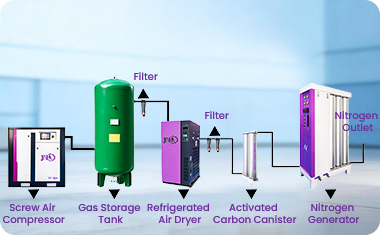
expenses. The matching of supporting air supply equipment cannot be ignored
either. Improper selection of front-end air supply devices may cause unstable
pressure and oil or water carryover in the gas source, which in turn affects the
service life of adsorption media and indirectly raises maintenance costs.
Consumables and maintenance are also key parts of cost planning. Adsorption
media, filters and seals have replacement cycles. Standardized operation and
routine inspection can slow down performance degradation and reduce losses
caused by unplanned shutdowns. Enterprises should include this expenditure in
the overall budget and establish corresponding spare parts management to avoid
extra costs from emergency procurement.
Besides, installation environment and site conditions indirectly affect
cost. Workshops with high cleanliness grades impose stricter requirements on gas
source cleanliness, leading to higher purification configuration investment.
Power supply capacity, cooling conditions and site space influence equipment
layout and supporting engineering investment. Enterprises should fully evaluate
these conditions in early planning to avoid modification expenditure caused by
site limitations later.
In summary, evaluating the overall cost of nitrogen generation equipment
for semiconductor applications requires comprehensive consideration of initial
investment, operating expenses, maintenance consumables and environmental
support, combined with actual requirements for purity, output and supply
stability. Cost control does not simply mean lowering purchase price, but
pursuing long-term economy and reliability while meeting process requirements.
Proper parameter verification and scheme comparison in the early stage, together
with standardized maintenance later, enable the whole gas supply system to run
stably with controllable overall expenditure, supporting continuous production
needs.