In modern industrial production, nitrogen, as an inert protective gas, is
widely used in material processing, food preservation, electronic manufacturing,
chemical reactions, laser cutting and other fields. In the past, many
enterprises chose to purchase bottled liquid nitrogen. Long-term procurement,
transportation and storage tank operation and maintenance brought continuous
cost pressure. Meanwhile, cylinder transfer and low-temperature tank storage
also brought potential safety hazards. With the continuous maturity of gas
generation technology, on-site nitrogen production solutions have gradually
become the first choice for more and more factories. Especially for production
enterprises with limited workshop space, compact nitrogen generating units
effectively solve the pain points of traditional large-scale equipment such as
large space occupation and difficult deployment, and provide economical and
reliable gas source solutions for small and medium-sized factories, laboratories
and modular production lines.
Pressure swing adsorption (PSA) technology is the mainstream technical
route for on-site nitrogen production. It uses special carbon molecular sieve as
the adsorption medium to separate oxygen and nitrogen at room temperature. Its
basic principle relies on the difference in adsorption capacity of molecular
sieves for oxygen and nitrogen under different pressures. Oxygen in the air is
preferentially adsorbed under pressurization, and enriched nitrogen flows out.
In the pressure reduction stage, oxygen adsorbed in the molecular sieve is
desorbed to realize medium regeneration. The whole set of equipment relies on
two groups of adsorption towers working alternately to achieve continuous gas
supply. The whole process does not require low-temperature refrigeration or
complex condensation and liquefaction systems. The equipment has low operation
barriers. Nitrogen can be produced once the machine starts up, with simple
operation procedures and much less maintenance workload than cryogenic air
separation equipment. Traditional large nitrogen generators are bulky and
require independent machine rooms with high civil supporting costs. Many small
and medium-sized workshops do not have enough space to place such equipment.
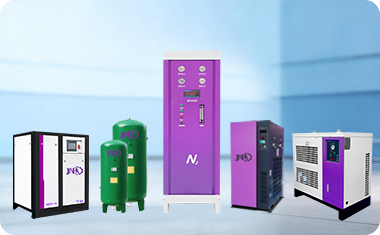
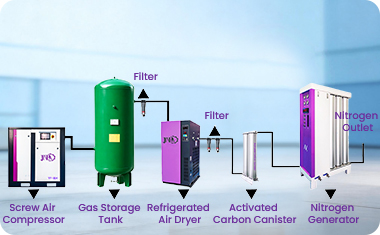
Compact PSA nitrogen generators adopt a large number of integrated
optimizations in structural design. The equipment integrates air pretreatment
units, filter assemblies, adsorption towers, pressure stabilizing gas storage
modules and electric control systems in one frame, abandoning the traditional
split layout and greatly reducing the overall footprint. Compact design does not
mean sacrificing performance. Researchers optimize pipeline layout, select
high-performance carbon molecular sieves and improve the internal flow channel
structure of adsorption towers to reduce gas dead zones and improve adsorption
and separation efficiency. The supporting air treatment system includes
multi-stage filters and a refrigerated dryer, which can remove moisture, dust
and oil stains in compressed air, protect molecular sieves from pollution,
extend the service life of adsorption media and ensure the long-term stability
of output gas purity. The intelligent electric control system monitors key
parameters such as pressure, flow rate and purity in real time, automatically
adjusts the operating state and gives timely alarms in case of abnormalities,
reducing the demand for manual on-duty monitoring.
In terms of performance, such integrated nitrogen generators have many
outstanding advantages. First, flexible deployment and simple installation.
After delivery, the equipment only needs to be connected to the compressed air
pipeline and power supply. It can be put into use after short-time commissioning
without complex civil construction, and it is also easier to relocate, suitable
for production line transformation, temporary projects and modular factories.
Second, controllable operating costs. On-site gas production eliminates
continuous expenses such as liquid nitrogen procurement, transportation and tank
leasing. The equipment has low energy consumption and consumes electric power
only during gas production. In long-term continuous production scenarios, its
economic advantages gradually become prominent. Third, flexible adjustment of
gas purity. Nitrogen purity and output flow can be adjusted within a certain
range according to production requirements to match different process standards.
It can meet the needs from low-purity protective gas for food packaging to
high-purity nitrogen required for electronic soldering and material heat
treatment. Fourth, simple operation and maintenance. The main consumables are
filter elements with long replacement cycles. Operators only need to regularly
check pressure gauges and drainage components in daily work. The maintenance
threshold is low, and ordinary equipment operators can complete basic
inspections after simple training.
This type of equipment is suitable for many application scenarios with
limited site space. In the food and packaging industry, modified atmosphere
packaging for snack foods, nuts and baked goods uses nitrogen to isolate oxygen,
slow down oil oxidation and extend shelf life. Many food processing factories
have compact workshops without spare machine rooms. Integrated nitrogen
generators can be placed directly beside packaging production lines to supply
gas nearby and reduce pressure loss caused by long-distance pipeline
transportation. In the electronic manufacturing field, SMT reflow soldering,
chip packaging and component heat treatment require inert gas protection to
prevent metal oxidation at high temperatures. Many clean rooms have precious
space, and compact nitrogen generating equipment can stably supply gas within
limited clean areas. In the laser cutting industry, nitrogen acts as an
auxiliary cutting gas to improve the cutting section quality of stainless steel
and aluminum alloy sheets. Small processing workshops can place the unit close
to cutting machines and simplify the gas supply pipeline. In addition, such
integrated nitrogen generation equipment is also suitable for scenarios such as
chemical raw material protection, lithium battery production, cable
manufacturing and laboratory gas supply.
In terms of model selection and daily operation and maintenance,
enterprises need to determine equipment specifications combined with their own
gas flow, purity requirements and on-site compressed air quality. The compressed
air source is the foundation for stable operation of the whole system. If the
oil and water content of compressed air exceeds the standard, carbon molecular
sieves will be rapidly contaminated and the adsorption performance will decline.
Therefore, the front-end pretreatment system cannot be omitted. The equipment
placement area needs good ventilation, far away from high-temperature heat
sources, with a small maintenance space reserved. Although the whole machine
occupies a small area, operating space for filter replacement and routine
inspection should still be reserved. Operators need to regularly check various
operating parameters and record gas purity. Once purity drops, troubleshoot
pipeline leakage or aging filter elements in a timely manner. Regular
maintenance in accordance with specifications can effectively extend the service
life of molecular sieves and ensure long-term stable operation of equipment.
As the manufacturing industry transforms towards miniaturization,
modularization and distributed production, the demand for on-site gas production
keeps growing. Against the background of rising land rent and limited workshop
space, integrated nitrogen generation equipment with small footprint has broad
market prospects. In the future, with the continuous iteration of adsorption
materials and intelligent control technology, the gas production efficiency of
equipment will be further improved and energy consumption will keep decreasing.
Meanwhile, intelligent monitoring and remote operation and maintenance functions
will be continuously optimized. Such equipment will continue to help small and
medium-sized manufacturing enterprises reduce gas costs and simplify gas supply
systems, providing stable and convenient on-site nitrogen supply solutions for
many industries including food, electronics, metal processing and new
energy.