When comparing quotations for nitrogen generators with CE conformity
certification, one key factor behind price differences lies in the adopted
technical route. Distinct separation principles, inlet air requirements,
mechanical layouts, maintenance regimes and performance limits create gaps in
material expense, manufacturing complexity, verification investment and
long-term operating cost, which are ultimately reflected in pricing. Comparing
prices in isolation from technical design easily leads to mismatched selection,
insufficient gas output and sustained high maintenance expenditure.
Understanding the working principle, suitable applications, cost structure and
certification focus of mainstream routes helps establish a rational comparison
framework and clarify the value scope of each solution.
Pressure Swing Adsorption is widely adopted across industrial sectors. It
relies on specialized molecular sieve adsorbent for nitrogen‑oxygen separation.
Pre‑treated compressed air flows into adsorption towers. Under pressurization,
molecular sieve preferentially captures oxygen, water vapour and carbon dioxide,
allowing nitrogen to pass through the bed as product gas. Once adsorption
approaches saturation, air supply stops and pressure drops. Trapped impurities
desorb and discharge to regenerate the adsorbent. Two towers alternate
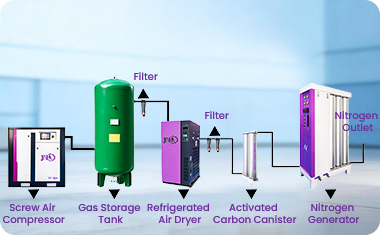
cyclically to deliver continuous nitrogen. The system consists of air
pre-treatment, adsorption vessels, programmed valve banks, buffer storage,
sensing and control modules. This route features moderate initial investment, no
sophisticated cryogenic components and fast start-up, reaching target purity
shortly after activation. It fits most standard industrial nitrogen supply
scenarios.
For certification assessment, attention focuses on adsorbent media,
pneumatic valves, pressure cycling systems and electrical safety. Molecular
sieve crush strength and resistance to oil and water directly determine
long-term stability. Frequently actuated control valves are the main moving
parts, so seal integrity and synchronous operation are closely examined.
Pressure vessel safety, pressure relief and overpressure interlocks under cyclic
loading are mandatory elements in conformity documentation. Within this route,
price variation stems from adsorbent grade, valve selection, filtration stages,
online purity analysers and remote monitoring add-ons. Basic configurations only
meet minimum gas supply requirements, while upgraded filtration, redundant
valves, high-precision monitoring and communication functions raise the offer.
Operating expenditure is dominated by compressed air consumption from feed air
compressors. This route gains economic advantages for low and intermittent gas
demand.
Membrane separation leverages different permeation rates through polymer
hollow-fibre membranes. When mixed air passes the membrane module, small
molecules such as oxygen and water vapour penetrate quickly and exhaust, while
nitrogen migrates more slowly and accumulates on the product side. The assembly
has a simple layout with few moving valves and no adsorption‑regeneration cycle.
It starts rapidly and runs quietly. Core components include membrane elements,
pre-treatment filters, pressure regulators and piping, with compact footprint
and low routine maintenance.
Certification checks centre on membrane elements, pressure housings,
sealing performance and inlet air cleanliness. Membrane material is highly
vulnerable to oil mist and liquid water; contamination causes irreversible
permeability loss, so pre-treatment protection is critical. Membrane cartridges
represent a major share of total cost. At equal purity targets, membrane
separation consumes more feed air than adsorption systems, especially for
high-purity specifications. It suits applications with moderate purity
requirements, steady demand and preference for low upkeep. Choosing this route
blindly for continuous high-purity supply may look attractive at the initial
purchase stage, yet elevated air consumption accumulates high running cost and
weakens overall economy.
Cryogenic air separation is a low-temperature process based on boiling
point differences between nitrogen and oxygen. Purified air is compressed,
cooled and liquefied before entering distillation columns for fractionation to
produce high-purity nitrogen. The workflow is elaborate, including compression,
pre-cooling, purification, expansion refrigeration, distillation towers, heat
exchangers and liquid storage. It requires many refrigeration components,
occupies large space and imposes strict civil and installation requirements.
Its conformity assessment covers pressure vessels, cryogenic piping,
thermal insulation, refrigeration circuits, explosion protection and emergency
relief, involving extensive safety documentation and testing. Capital
expenditure is substantially higher than the other two routes. The main strength
is stable ultra-high-purity output for large-scale, round-the-clock operation.
Once gas volume crosses a certain threshold, specific energy consumption
gradually falls. However, the system has long start-up sequences and complicated
shutdown procedures. It is not suitable for intermittent operation. Fluctuating
load and short daily runtime undermine returns due to heavy upfront investment
and standby power draw.
Besides the three primary routes, hybrid processes are deployed for
specific needs. Membrane separation can perform rough pre-separation followed by
adsorption polishing; cryogenic by-product nitrogen may be upgraded with
adsorption finishing. Combined schemes balance energy use and purity, yet they
extend process chains and control points. Certification validation expands to
integrated logic, interlock protection and fault response, pushing up
engineering and verification cost.
During quotation evaluation, the scope of supply must be clarified. Even
within the same technical route, CE-related cost varies. Basic offers may only
include type testing, while complete packages cover factory quality
surveillance, annual audits, full technical files, hazard analysis and service
manuals. Some quotations include only the main unit, excluding air compressors,
receivers, post-treatment and commissioning; others are turnkey packages. Direct
numerical comparison is invalid without aligned scope.
No single technical route is universally superior; suitability depends on
site conditions. Pressure Swing Adsorption balances capital cost, achievable
purity and maintenance workload. Membrane separation excels at simplicity and
low routine care. Cryogenic separation serves large-volume ultra-high-purity
demand. Buyers should define flow rate, purity, operating hours, inlet air
quality, power supply and space constraints first, then select the matching
technology. Whole-life cost calculation accounts for certification scope,
included accessories, consumable cycles and energy consumption, rather than
relying solely on initial price. Only when pricing is reviewed together with
technical route, application fit, certification coverage and long-term
maintenance can a proper decision be made and operational risks avoided.