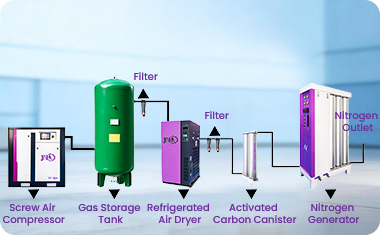
A nitrogen generator fed by compressed air represents a widely adopted
on-site nitrogen production solution. Its reliable operation fully relies on
upstream compressed air infrastructure. Instead of liquid nitrogen or
high-pressure cylinders as feedstock, it draws compressed air from air
compressors and separates nitrogen from oxygen through membrane or pressure
swing adsorption technology for applications such as welding shielding, purging
and packaging blanketing. Many operators focus only on the nitrogen generator
itself, overlooking that it functions as downstream equipment of the compressed
air system. Feed pressure, flow rate and cleanliness directly govern nitrogen
purity, energy consumption and service life of core separation media.
Two dominant technical routes are available. Membrane generators use hollow
fiber membranes. Due to differing permeation rates, oxygen, water vapor and
carbon dioxide pass rapidly through fiber walls and are vented, while nitrogen
is collected as product gas. This design has few cycling valves and delivers
steady continuous flow. PSA generators employ dual towers filled with carbon
molecular sieve. Oxygen is adsorbed under pressurized conditions and released
during depressurized regeneration, with towers alternating cycles to achieve
higher nitrogen purity. Both technologies require well-defined inlet conditions:
stable pressure, sufficient flow, minimal residual oil and low dew point.
Nominal performance cannot be achieved if feed conditions drift outside design
limits.
The compressed air pre-treatment train acts as a critical protective
barrier between the compressor and nitrogen generator. Air leaving compressors
carries condensate, oil mist and pipeline rust particulates, the primary threats
to separation media. Membrane elements are highly susceptible to oil
contamination; thin oil films block permeation pathways irreversibly. Carbon
molecular sieve tends to cake under moisture exposure, while trapped dust raises
bed differential pressure and reduces adsorption capacity. Standard
pre-treatment packages consist of staged precision filters, activated carbon oil
removal filters and dryers to capture contaminants stepwise and maintain inlet
specifications. Cutting pre-treatment hardware to lower upfront cost creates
false savings, as premature replacement of membranes or sieve and production
downtime accumulate rapidly.
Pressure and flow matching is a common pain point in routine maintenance.
Each nitrogen generator has a rated inlet pressure window. Insufficient pressure
weakens separation driving force and reduces purity under fixed settings;
excessive pressure imposes valve shocks and accelerates seal degradation.
Undersized compressors, narrow piping and clogged filters restrict feed flow and
trigger persistent pressure drop. Compressed air is itself a consumable:
producing one unit volume of nitrogen requires multiple volumes of compressed
air. Power consumed by air compressors dominates recurring operating expense.
Total cost evaluation must include compressors, dryers and filters rather than
only the nitrogen generator.
Consequences of feed air fluctuation are often subtle. Compressor loading
cycles, competing air draws and failed drain traps cause periodic deterioration
of feed quality. These disturbances rarely trigger immediate shutdowns but
gradually degrade media and create intermittent purity drift. Operators
frequently adjust valve timing and regeneration duration on the nitrogen
generator with limited improvement, until root causes within the upstream
compressed air network are identified. Inspection workflows should follow an
upstream-to-downstream sequence: verify compressor operation, receiver pressure,
filter differential pressure and dryer dew point before checking internal
generator components.
This compressed-air-fed nitrogen solution carries clear application
boundaries. It suits facilities with existing stable compressed air piping,
allowing shared compressor infrastructure and avoiding separate feed supply
investment. If the original air system is aged, poorly maintained or subject to
violent pressure swings, adding a nitrogen generator will not fix fundamental
weaknesses and may amplify existing problems. Some installations overload
compressors after adding nitrogen demand, leading to poor heat dissipation,
premature separator failure and further feed quality degradation in a
self-reinforcing negative cycle.
Effective system management treats the air compressor network and nitrogen
generator as one integrated system rather than isolated machines. Regular
draining, scheduled filter replacement and continuous dew point and pressure
monitoring preserve pre-treatment integrity. Compressors should carry adequate
capacity margin, and piping layout is optimized to minimize line pressure loss.
Consistent qualified feed air allows the nitrogen generator to deliver rated
performance, slow consumable degradation and sustain economical on-site gas
production.