When selecting industrial gas supply solutions, enterprises should not
merely compare purchase quotations. It is necessary to sort out various
expenditures from a long-term usage perspective. Many manufacturers, during gas
source renovation, tend to consider nitrogen production solutions with better
energy efficiency to balance investment and consumption while ensuring stable
gas supply. Nitrogen shielding is widely used in material heat treatment,
welding, lithium battery production, food packaging, chemical pipeline purging
and other fields. The gas consumption duration and purity standards vary greatly
under different working conditions, leading to different cost structures.
The cost of a complete on-site gas generation system consists of upfront
procurement expenditure, auxiliary equipment, installation and commissioning,
power consumption, consumable replacement, regular maintenance and equipment
depreciation. Among these items, electricity consumption accounts for the
largest share in the long run. Conventional models tend to maintain constant
output under fluctuating load. Even when gas demand drops, air compressors and
separation units keep running under heavy load, causing unnecessary energy
waste. Optimized units adopt intelligent control logic to adjust adsorption
switching rhythm dynamically according to gas load. When flow demand falls,
compressed air supply is reduced to cut no-load power consumption and improve
overall performance.
There are obvious differences in cost logic between on-site generation and
purchased liquid nitrogen or bottled nitrogen. Expenses of outsourced gas
include gas fees, transportation, tank rental, boil-off loss and labor for
on-site handling. The unit price stays relatively fixed, and annual expenditure
rises along with gas consumption. On-site gas production requires higher upfront
investment, while subsequent costs mainly cover electricity and a small amount
of consumables. For factories with continuous gas demand all year round, savings
brought by energy efficiency improvement will gradually accumulate over time.
Under properly configured stable working conditions, the initial investment can
usually be recovered within several years.
Air-to-nitrogen ratio serves as a key indicator to assess equipment energy
efficiency. It refers to the total compressed air consumed to produce a unit
volume of nitrogen. Under the same purity specification, a lower ratio means
lighter load for air compressors and less electricity cost. Many purchasers only
focus on the price of the main unit and overlook the long-term electricity gap
caused by different air-to-nitrogen ratios. Some low-priced models adopt
adsorbents with ordinary performance and have large pipeline pressure drop,
resulting in a high air-to-nitrogen ratio. Although the upfront purchase cost is
low, continuous electricity bills will lift the total cost of ownership over
years of operation. During selection, buyers shall ask suppliers to provide
complete energy consumption calculation based on local electricity price, annual
operating hours and target purity.
Consumable expenses also need to be included in evaluation. Filters,
pneumatic valves and adsorbents all have limited service cycles. Poor
pre-treatment of compressed air allows oil, moisture and dust into adsorption
towers, accelerating aging of adsorbent materials, shortening replacement
intervals and bringing extra costs. High-quality pre-treatment systems and
reliable valve components slightly raise initial investment, yet extend
consumable service life, reduce shutdown maintenance frequency and avoid hidden
losses caused by production suspension.
Nevertheless, energy-saving solutions are not suitable for every scenario.
If gas usage is infrequent, intermittent and the annual total consumption
remains low, on-site equipment will stay idle most of the time and cannot give
full play to energy-saving advantages. In such cases, purchasing gas externally
may be a better choice. Besides, high purity requirements have a notable impact
on energy consumption. Higher purity demands lead to a higher air-to-nitrogen
ratio and more power consumption. Enterprises shall set parameters strictly
according to actual process requirements and avoid unnecessary high purity
settings that waste energy.
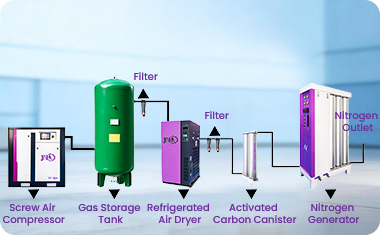
Coordinated design of supporting systems affects final energy consumption
as well. Air compressors, dryers, buffer tanks and nitrogen generator hosts need
matched design. Over-sized auxiliary machines or unreasonable pipeline layout
will create extra pressure loss and offset the energy-saving design of the main
unit. At the early project stage, simulation calculation can be carried out
combined with workshop layout, ambient temperature and humidity, and gas
fluctuation curve to confirm a reasonable system combination.
Against the background of advancing green production, energy efficiency
management of gas supply systems has become one part of factory cost reduction.
By evaluating full-cycle costs comprehensively and balancing initial investment,
energy consumption, maintenance and working condition adaptability, enterprises
can find suitable gas supply solutions for their production lines and realize
efficient resource utilization while keeping stable production.