The Explosion Proof Nitrogen Gas Generator is widely used in oil, chemical,
oil & gas storage tanks, coal chemical industry, hazardous chemical
warehousing and other flammable and explosive hazardous areas. It supplies
nitrogen for tank inerting, pipeline purging, process protection and oxygen
displacement isolation. When selecting explosion-proof nitrogen equipment, many
enterprises tend to prioritize explosion-proof grade, nitrogen purity and safety
certification, while ignoring equipment life-cycle loss. In harsh working
conditions with flammable gas, dust, oil vapor and fluctuating humidity,
abnormal wear and loss of various components will not only raise operation and
maintenance costs, but also cause nitrogen purity attenuation, unstable gas
supply and even potential safety hazards. Understanding the operation logic of
explosion proof nitrogen gas generator from the perspective of loss is critical
to cut comprehensive gas cost and ensure continuous safe production in hazardous
zones.
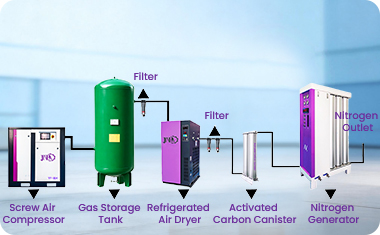
Most explosion proof nitrogen gas generators adopt PSA pressure swing
adsorption technology. The whole set includes air pretreatment unit,
explosion-proof electric control unit, adsorption separation unit and pressure
stabilizing output unit. The losses fall into four categories: loss of core
separation media, loss of pre-treatment consumables, mechanical wear of
explosion-proof electrical and valve components, and system energy & gas
venting loss. Unlike ordinary workshop nitrogen generators, explosion-prone
sites are filled with complex media such as oil, dust and corrosive steam. With
the same running hours, equipment degradation rate is remarkably higher than
units deployed in ordinary environments.
Carbon molecular sieve serves as the core separation medium of PSA
explosion proof nitrogen gas generator and the component with the highest
replacement cost. Under normal operating conditions, the designed service life
of molecular sieve reaches 3 to 5 years. However, on chemical and oilfield
sites, oil mist and water vapor carried by compressed air are the primary
triggers of irreversible molecular sieve degradation. Oil molecules adhere
firmly inside the micropores of molecular sieve and permanently block oxygen
adsorption channels, which is known as molecular sieve poisoning in the
industry. Once poisoned, it cannot be regenerated and repaired, and the packing
inside adsorption towers must be fully replaced. Water vapor also damages the
structure of molecular sieve pellets, causing deliquescence and expansion. Under
cyclic alternating pressure of pressurization and pressure relief in twin
towers, pellets pulverize. The black powder generated by pulverization will
block pipelines, silencers and downstream filters, further increasing system
resistance and pressure fluctuation and forming a vicious cycle. Besides,
explosion-proof units are often operated in remote field sites with frequent
fluctuation of inlet air pressure and dramatic load changes. Alternating
pressure impact inside adsorption towers intensifies friction between molecular
sieve pellets and accelerates pulverization loss. To meet anti-static
requirements in hazardous zones, explosion proof nitrogen generators are
equipped with static bonding and hold-down springs inside adsorption towers.
Once the hold-down structure ages and fails, loose molecular sieve bed will
shake during operation and further accelerate pellet abrasion and shorten
service life.
Consumable loss of pre-treatment purification system is the most frequent
and easily overlooked loss item of explosion proof nitrogen gas generators. The
full pretreatment system includes primary filter, precision oil removal filter,
activated carbon filter and refrigerated dryer, which removes dust, oil mist and
moisture in compressed air to protect molecular sieve. In explosion-prone
environments, the air contains oil vapor and corrosive particles, leading to
much faster filter clogging compared with ordinary working conditions. If filter
elements are not replaced on schedule, differential pressure rises continuously.
It not only causes massive waste of compressed air energy consumption, but also
results in medium penetration, allowing oil contamination to enter adsorption
towers directly. In many projects, premature scrapping of molecular sieve
originates from delayed filter replacement. Enterprises save short-term cost on
low-cost consumables but end up bearing high cost of molecular sieve
replacement. Filters deployed in explosion hazardous areas must meet
anti-explosion and anti-static requirements for filter cartridges and housings;
ordinary industrial filters cannot be used directly, which means higher
procurement cost for consumables than conventional models.
Aging loss of explosion-proof electrical components, solenoid valves,
pressure valves and other mechanical parts is a unique type of loss under
hazardous working conditions. Electric components of ordinary nitrogen
generators do not require explosion-proof enclosures, while all electrical parts
of explosion proof nitrogen gas generators adopt flameproof or intrinsically
safe design, including explosion-proof control cabinets, explosion-proof
solenoid valves, explosion-proof pressure transmitters and explosion-proof
sensors. Although explosion-proof enclosures isolate flammable and explosive
gas, salt spray, dust and corrosive vapor in chemical and field environments
continuously erode enclosure seals, wiring terminals and cable gland joints.
Rubber sealing parts will harden and crack under alternating temperature,
leading to seal failure. Explosion-proof solenoid valves are core components for
tower switching. Frequent opening and closing causes spool abrasion and aging of
sealing components. Once internal valve leakage occurs, pressure imbalance
between adsorption towers will appear, reducing nitrogen recovery rate and
increasing energy consumption loss. Damaged components cannot be replaced with
ordinary spare parts arbitrarily; spare parts with identical explosion-proof
grade are required, which brings longer procurement cycle and higher component
cost.
The fourth category of loss is gas venting loss and electric energy loss.
Deployed in hazardous areas, explosion proof nitrogen gas generators are
equipped with multiple pressure relief and venting protection loops for safety.
Improper system commissioning or drift of pressure sensors will trigger
unnecessary nitrogen venting, directly lowering nitrogen recovery rate and
increasing energy consumption of air compressors. Meanwhile, explosion-proof
units have more pipeline, valve and flange connection points. To meet
anti-static and flameproof requirements, more sealing points are added.
Micro-leakage caused by installation defects or aging will result in accumulated
gas loss over long-term operation. Many enterprises only calculate electricity
and consumable cost while ignoring hidden loss caused by gas leakage and
venting, pushing up long-term gas supply cost.
To reduce full-life-cycle loss of explosion proof nitrogen gas generators,
systematic optimization should cover design, installation and operation &
maintenance. During equipment selection, complete multi-stage air purification
system must be equipped to strictly control oil and moisture content of inlet
air, protect molecular sieve from the source and reduce loss of core media. The
equipment shall be embedded with explosion-proof differential pressure
monitoring and online dew point monitoring to give early warning of filter
clogging and excessive water content of source air, supporting predictive
maintenance and avoiding shutdown maintenance after severe component damage. In
daily operation, avoid long-term overload operation and frequent start-stop,
stabilize inlet pressure, reduce alternating pressure impact and slow down
molecular sieve pulverization. Explosion-proof components shall be inspected
regularly for sealing, grounding and static bonding according to specifications,
and aged sealing parts replaced timely to prevent explosion-proof failure and
medium leakage.
Moreover, intelligent monitoring systems can quantify loss trends, collect
real-time data of purity, pressure, differential pressure and dew point, predict
remaining service life of filter elements, solenoid valves and molecular sieve,
and transform breakdown maintenance into predictive maintenance. It greatly cuts
production losses caused by unplanned shutdown. In chemical and oil-gas
explosion-prone sites, shutdown loss is often far higher than spare parts cost.
Loss control is essentially risk control for safe production.
In summary, loss management for explosion proof nitrogen gas generator is
not merely regular consumable replacement, but a systematic project covering
source air treatment, equipment operation and inspection of explosion-proof
components. In hazardous working conditions, oil vapor, dust and temperature
variation accelerate aging of core components. Neglect of loss management will
not only bring high spare parts replacement cost, but also trigger unstable gas
supply and safety risks for production in explosion-prone areas. A qualified
explosion-proof nitrogen generation system, while meeting explosion-proof safety
compliance, delays attenuation of core components by optimizing
pre-purification, stabilizing working conditions and applying intelligent early
warning. It reduces comprehensive loss of consumables, media, gas and electric
energy, cuts full-life-cycle operating cost and provides stable, safe and
economical on-site nitrogen supply for flammable and explosive areas.