An integrated nitrogen generation system: why more projects no longer buy
the units separately
1. The old problem of piecemeal purchasing
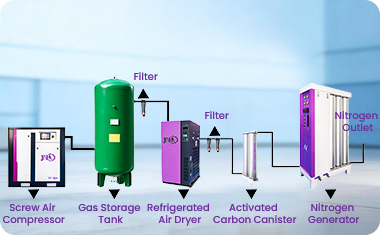
Building a nitrogen station used to mean buying a compressor, a refrigerant
dryer, precision filters, the separation unit, a receiver and a booster
separately, and then having the contractor join the pipework, cabling and
control signals on site. That model is flexible, but it splits system risk
across every interface.
The first problem is where responsibility for pressure drop and dew point
sits. Compressor discharge temperature, dryer dew point, filter accuracy and the
inlet requirement of the separation unit are all linked. If the nitrogen purity
or dew point falls short, each supplier can produce a factory test certificate
saying its own machine was fine, and the problem sits on the interface
parameters while the diagnosis goes back and forth for several rounds.
The second problem is unsynchronised start-up. The separation unit,
compressor and booster each have their own logic, and on site they are run in
sequence by hand or through interlocks added later. Get the order wrong and the
gas is off-spec at best, or the unit starts against pressure and the membrane
takes a liquid slug at worst.
The third problem is footprint and line loss. Units scattered around a room
mean more bends and more fittings, so pressure drop along the run and the number
of leak points both rise; in a tight building the loose arrangement also eats
corridor space.
2. What the integrated package contains
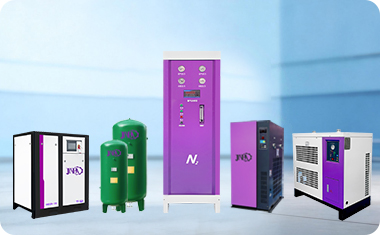
Such a packaged plant normally brings air compression, purification, the
separation unit, buffer storage, boosted output and electrical control onto one
skid, with pipework, wiring and linked commissioning completed before dispatch.
On site the work is mainly setting the skid, connecting services and starting
up.
The content usually covers intake filtration and silencing, the compressor,
aftercooling and refrigeration drying, multi-stage fine filtration, a membrane
or pressure swing adsorption separation unit, a nitrogen receiver, a booster
where needed, online oxygen and dew point measurement, and one control system
with a single operator interface.
The direct consequence is that the system is delivered against whole-system
figures: the inlet condition is fixed, and outlet purity, flow, dew point and
pressure are agreed together. There is one party responsible for the interface,
and acceptance is run on the complete duty point rather than apportioned machine
by machine.
3. What integration actually buys
Pressure drop becomes controllable. The pipework is designed in the
workshop around the total flow, the loss along the run is measured before
dispatch, and nobody has to rework a bend on site.
Start-up becomes interlocked. Control runs along one chain: start the
compressor and confirm pressure and dew point, start the separation unit, then
bring the booster in as demand requires; shutdown runs in reverse and keeps the
purge and depressurisation steps. The sequence lives in the programme, which
lowers dependence on operator experience and makes shift-to-shift variation far
smaller.
Footprint and installation time fall. A skid needs only a level base and
reserved connections, so civil work is small and commissioning is short. For a
rented building or a project that must produce quickly, this often matters more
than the price difference on the equipment. It also makes later relocation
practical: the package can be lifted and reconnected at a new site instead of
being rebuilt from loose components.
Maintenance has one interface. Spares, service intervals and fault
diagnosis all sit in one system, and an abnormal condition does not send the
technician back and forth between several manuals. A single spare-parts list
also shortens the wait when a filter element or a solenoid valve fails at a
remote site.
4. Integration is not the same as assembly
Placing several machines on one base does not by itself produce an
integrated plant. Three tests show whether the integration is real.
First, is control unified? Several independent controllers that only upload
signals represent machines sharing a frame, not a system. Real integration means
one controller performing sequence control, interlocking and alarm handling,
with the interface showing the whole process chain.
Second, do the parameters interact? When air quality changes, can the
system adjust or alarm by itself; when demand falls, does the compressor unload
or slow down instead of running at full load against a closed demand. These
links decide real energy consumption and equipment life.
Third, is the factory test run as a system? A power-on check of each
machine and a run at rated flow for several hours with purity, dew point and
pressure fluctuation logged are two very different levels of verification. Only
the second exposes mismatches at the interfaces.
5. Parameters worth fixing at selection
The first is the inlet condition. Altitude, ambient temperature and dust
and oil loading in the intake directly affect delivered flow and separation
efficiency. A high-altitude project specified on plains figures will produce
less gas than the sheet promises, and the shortfall usually shows up only at the
acceptance test, when the piping has already been sized.
The second is the relation between purity and flow. The same unit delivers
different flow at different purity, and the catalogue rating usually belongs to
one purity level; ask for the flow curve at the purity actually required.
The third is the dew point requirement. The two separation processes
tolerate inlet dew point differently, and the choice between refrigeration and
desiccant drying follows from that; where the dew point is strict, confirm the
drying scheme separately.
The fourth is the load profile. Where demand swings within a day, confirm
the turndown capability at part load and the effect of frequent cycling on
membranes or molecular sieve. A plant sized for the peak and run at a third of
it will consume more air and more power than the flow requires.
The fifth is installation and service space. A skid is compact, but
maintenance still needs side clearance and a lifting route, a point easily
missed during building layout.
6. Where it fits and where it does not
For projects with concentrated points of use, moderate flow, a need to
produce quickly and no dedicated maintenance team, the integrated approach is
clearly advantageous. Where points of use are scattered over long distances with
very small individual flows, central generation is less flexible than small
local units or purchased gas, because the line loss and the cost of running a
large machine for a small demand outweigh any saving on installation. A retrofit
that already has a compressor station and only lacks the separation step does
not need a complete replacement; a separation unit can be added to the existing
supply.
7. Conclusion
The value of such a packaged plant lies in gathering interface
responsibility that would otherwise be split between several suppliers into one
package, and trading unified design, unified control and unified acceptance for
a shorter installation and a more predictable operating state. Look less at
individual machine datasheets and more at how the system behaves as a whole
under the real duty, and that value actually materialises.